
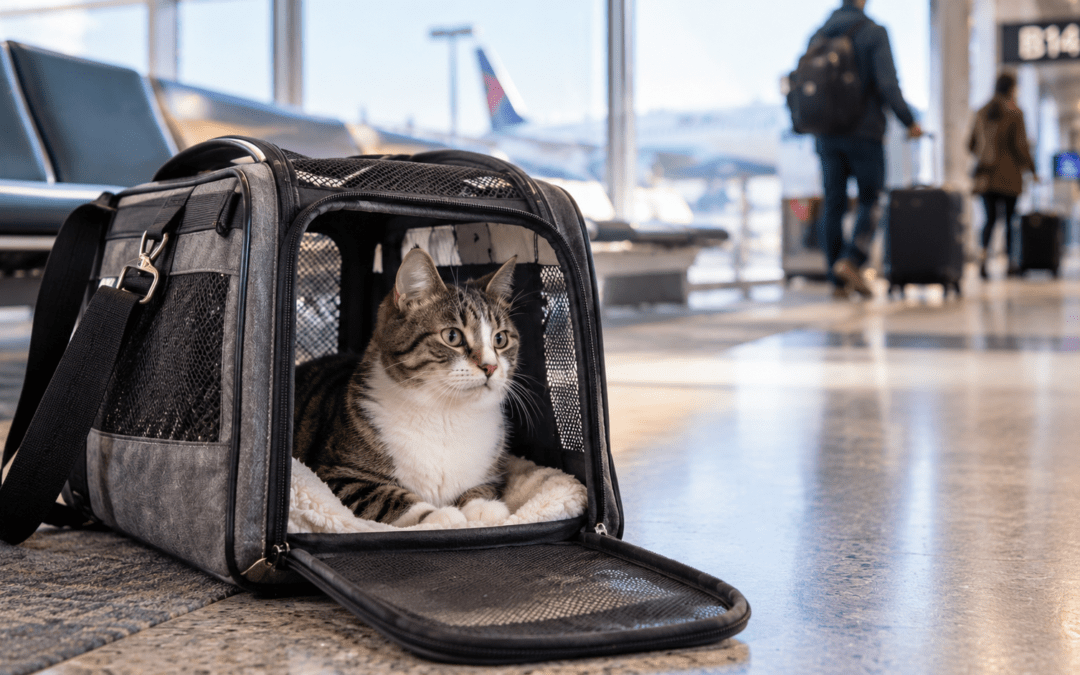
Best Travel Carrier for Cats on Airplanes
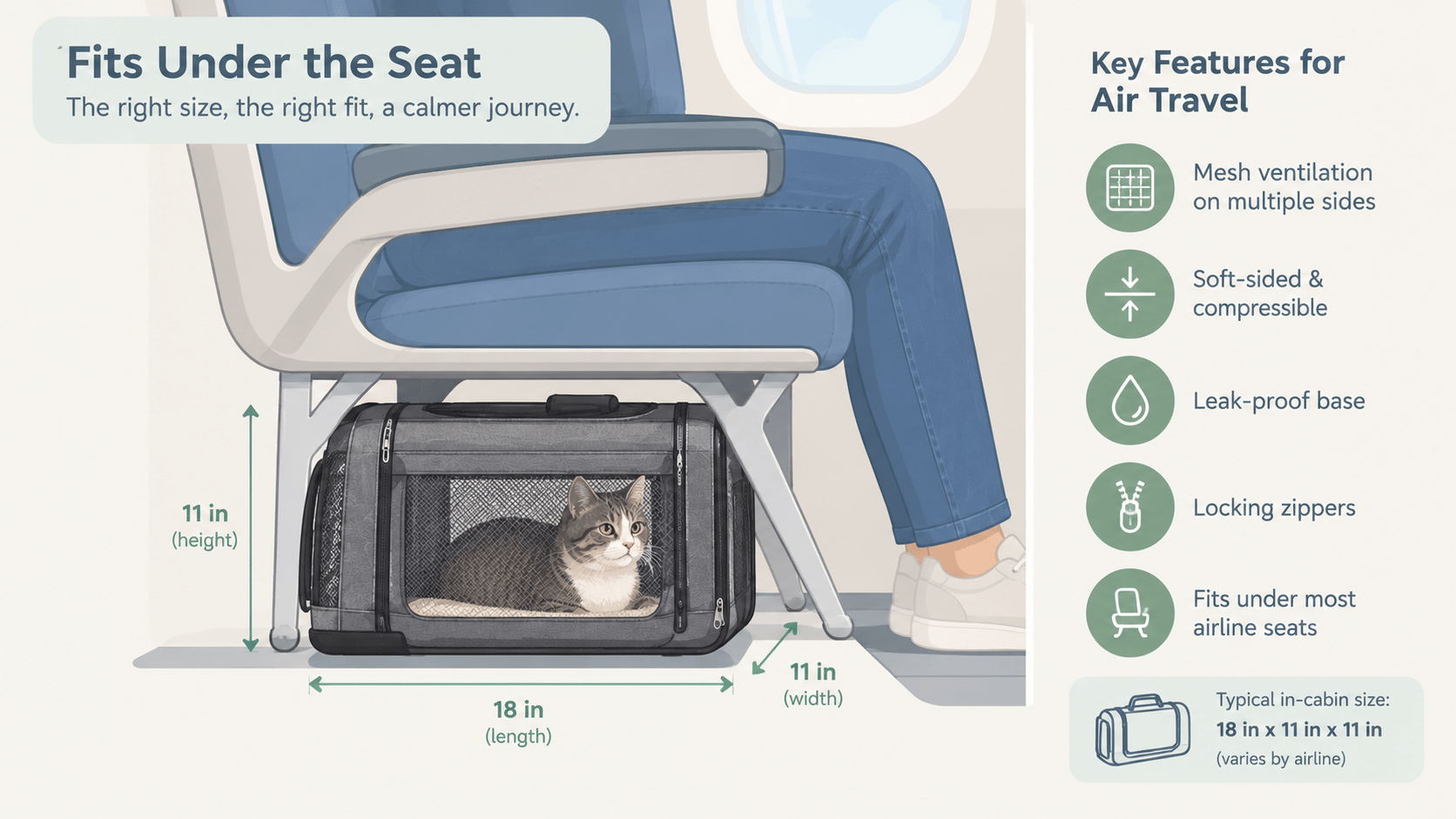
The best cat carrier for flying is soft-sided, compressible, ventilated on multiple sides, has a leak-proof base and locking zippers, and — most importantly — fits under your specific airline’s seat. There’s no such thing as an officially certified “airline-approved” carrier; that phrase is marketing language, not a regulatory standard. IATA (the International Air Transport Association) and individual airlines each set their own container requirements, and the only claim that actually matters is whether your carrier fits your booked flight.
This guide covers the carrier itself, plus the parts most buying guides skip entirely: what documentation you actually need in 2026, why veterinary and aviation authorities advise against sedating a cat for a flight, what happens at the TSA checkpoint, and extra precautions for flat-faced breeds or anxious cats. All of it is sourced directly from AVMA, IATA, TSA, and a major airline’s current policy — not from other pet blogs.
Quick Answer: Choose a soft-sided, compressible carrier with mesh ventilation on multiple sides, a leak-proof base, and locking zippers — around 18″ L x 11″ W x 11″ H fits most major U.S. airlines’ in-cabin limits (confirm with yours), per IATA’s in-cabin guidance, ventilation must cover at least 16% of the container’s vertical sides. Book your cat’s cabin spot early, get a vet health certificate if required, and don’t sedate your cat for the flight — AVMA and IATA both advise against it.
Key Takeaways
- “Airline-approved” is marketing language, not an official certification — always verify dimensions against your specific airline’s current policy before you fly.
- IATA’s in-cabin standard requires ventilation on at least 16% of a container’s four vertical sides, and warns that a compressed soft-sided carrier can block that ventilation.
- AVMA and IATA both advise against sedating a cat for air travel — tranquilizers can affect breathing and blood pressure at altitude and impair the cat’s ability to balance and respond to stress.
- A veterinary health certificate is commonly required, and for cargo travel AVMA specifies it must be dated within 10 days of travel — book your vet visit accordingly.
- Flat-faced (brachycephalic) breeds like Persians face higher risk of overheating and breathing difficulty during travel, and AVMA recommends a carrier one size larger than usual for them.
- TSA requires the carrier to go through the X-ray empty, while you carry or walk your cat through the checkpoint separately.
In this guide: What “airline-approved” really means · Size, weight, and fit · Soft-sided vs. hard-sided · Must-have features · Documentation you need in 2026 · Sedation guidance · Getting through TSA · Flat-faced and anxious cats · Comparison table · Checklists · FAQ
What Does “Airline-Approved” Actually Mean?
There is no government body or industry certification that stamps a carrier “airline-approved” — it’s a phrase manufacturers use because a carrier meets commonly-cited dimensions, not because any airline has tested and certified it. IATA’s own guidance for passengers traveling with a dog or cat in the cabin sets the underlying standard most airlines build their own policies on: the container must let the animal sit erect, stand erect, turn around, and lie down naturally, with ventilation covering at least 16% of the four vertical sides, and it must be both escape-proof and leak-proof.
The only claim that actually matters is your specific airline’s current published dimensions for your specific flight. As an example, Delta’s current in-cabin policy (2026) recommends a soft-sided kennel with maximum dimensions of 18″ x 11″ x 11″ that fits fully underneath the seat in front of you — but this is Delta’s own figure, not a universal standard, and other airlines set their own limits.
Pet Care Tip: Call your airline’s reservations line and confirm your exact carrier’s dimensions against their current policy within a week or two of travel — pet-travel policies and fees change, sometimes more than once a year.
Size, Weight, and Fit: Why One Carrier Doesn’t Fit Every Flight
Most major U.S. airlines’ in-cabin cat carrier limits fall in a similar range to Delta’s 18″ x 11″ x 11″, but airlines generally don’t publish a separate cat weight limit — instead, the standard is functional: your cat needs to move around inside the carrier without touching or sticking out of the sides. Delta, for instance, specifies this functional fit standard rather than a weight cutoff.
Two things that catch owners out:
- Under-seat space varies by aircraft, not just airline. A carrier that fits comfortably on a wide-body jet’s seat may not fit under a smaller regional aircraft’s seat on the very same airline.
- Cabin pet spots are limited per flight and booked on a first-come, first-served basis — Delta explicitly asks customers to call reservations and book a pet spot as early as possible, with your kennel’s exact dimensions ready when you call.
Soft-Sided vs. Hard-Sided Carriers for Flying
Soft-sided carriers are generally preferred for in-cabin travel because they compress slightly to fit variable under-seat spaces and are lighter to carry through the airport. IATA specifically warns, though, that a soft-sided carrier that gets compressed can block its own ventilation and create dangerous heat buildup — so “compressible” should never mean “vents get squashed shut.”
Hard-sided carriers are typically required for cargo-hold travel rather than the cabin, since they hold their shape and offer more impact protection, but they’re rarely flexible enough to fit variable in-cabin seat spaces. If your travel plan involves the cargo hold rather than the cabin, follow AVMA’s crate standard: your cat must be able to stand without touching the top, sit up, turn around, and lie down comfortably, with a secure locking system, solid leak-proof bottom, ventilation on at least three sides (four for international flights), and clear “Live Animals” labeling with directional arrows.
Must-Have Safety and Comfort Features
- Ventilation on multiple sides — IATA’s benchmark is at least 16% of the four vertical sides; check this isn’t compromised when the carrier is compressed to fit under a seat.
- A leak-proof, washable base, with absorbent bedding inside — IATA’s cabin guidance specifically calls for absorbent bedding to manage waste during the flight.
- Locking zippers or an escape-proof closure system.
- A structured but collapsible top, so it holds its shape without caving onto your cat when compressed.
Documentation You Need in 2026
This is the step most “best carrier” articles skip, and it’s a common reason for day-of-travel problems:
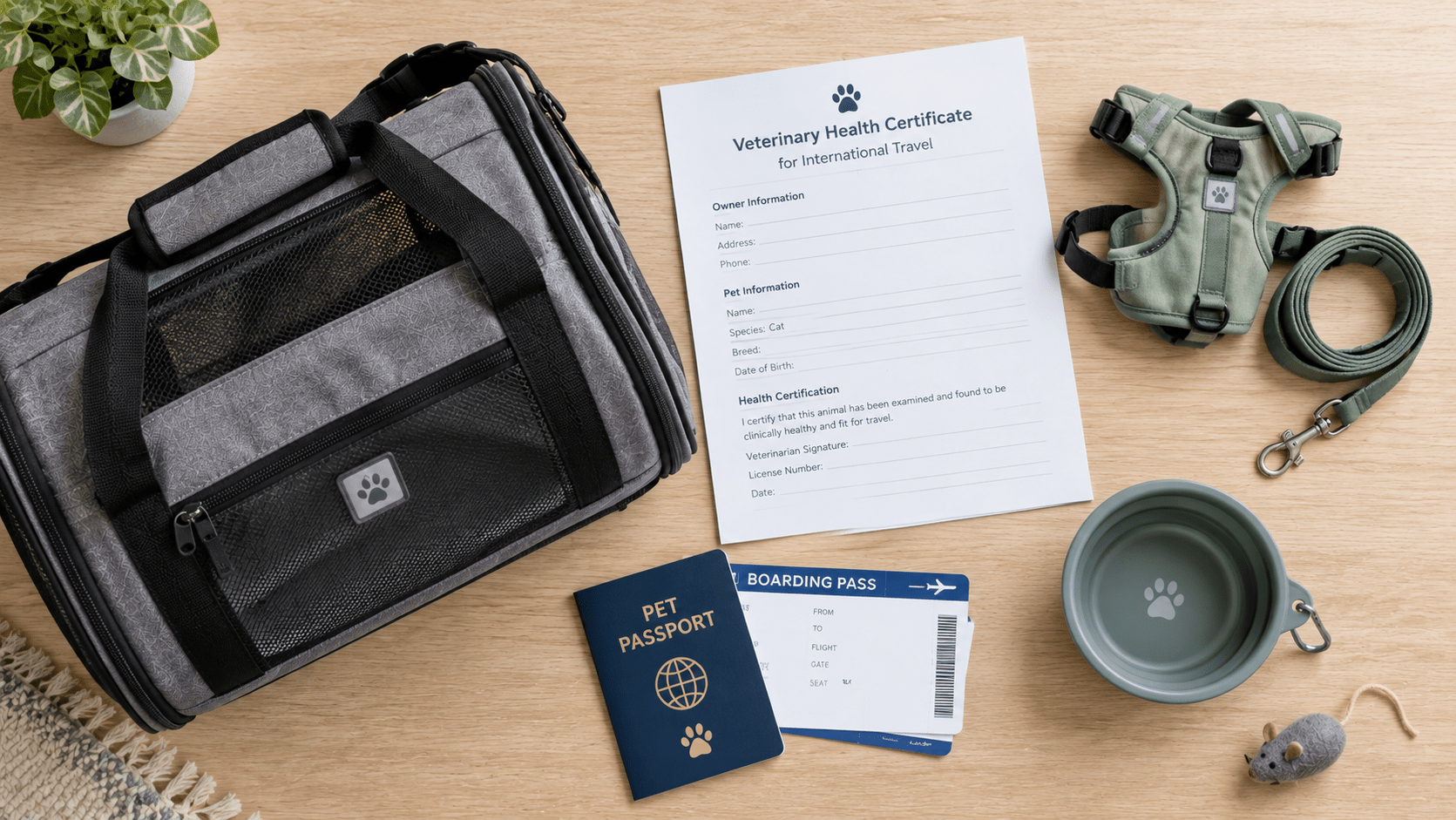
- Health certificate. Many airlines and all international itineraries require a veterinary health certificate. For cargo travel specifically, AVMA specifies the certificate (a Certificate of Veterinary Inspection, plus an acclimation certificate) must be dated within 10 days of travel — book your vet appointment with that window in mind, not the week before.
- Minimum age. IATA sets a general minimum of 8 weeks old and fully weaned for air travel; Delta’s own policy requires cats to be at least 8 weeks old for domestic travel and at least 16 weeks old if traveling to the U.S. from abroad. Always check your specific airline and destination, since requirements can be stricter.
- International documentation. For international travel, IATA notes that health certificates and import documents can take several months to arrange for some destinations — this is not a same-week task, so start early if you’re flying internationally with your cat.
- Booking fees. As a real 2026 example, Delta charges $150 USD/CAD for U.S./Canada/Puerto Rico/U.S. Virgin Islands in-cabin pet travel (up from $95 for tickets booked before April 8, 2025) and $200 for international itineraries — fees like this vary by airline and change over time, so confirm the current fee when you book rather than relying on an older figure.
Should You Sedate Your Cat for Flying?
No — both AVMA and IATA advise against sedating a cat for air travel. AVMA’s guidance states that tranquilizers and sedatives “can increase the risk of heart or respiratory problems and generally are not allowed by airlines,” and recommends consulting your vet before giving your cat anything for travel anxiety. IATA’s own guidance takes the same position, noting that sedation can impair an animal’s ability to balance and respond appropriately to the stress of travel.
If your cat has significant travel anxiety, the better first step is a conversation with your vet — well before travel day — about non-sedative options and, most importantly, acclimating your cat to the carrier in the weeks beforehand. IATA’s guidance explicitly recommends acclimation to the container ahead of travel as part of standard preparation, not sedation as a shortcut.
Pet Care Tip: Start carrier acclimation at least two to three weeks before travel — leave the carrier out at home with the door open, feed your cat near or inside it, and build up short practice sessions with the door closed. This does more for a calm flight than any product feature.
Getting Through TSA Security With a Cat
TSA’s official process is specific, and it’s worth knowing before you’re standing at the checkpoint with a line behind you:
- The carrier goes through the X-ray belt empty — your cat is never sent through the X-ray tunnel.
- Remove your cat from the carrier just before screening begins.
- You may either carry your cat through the walk-through metal detector yourself, or have them walk through on a leash.
- TSA will typically also swab your hands for an explosive trace detection check.
- Once cleared, return your cat to the carrier at the recomposure area just past the checkpoint, away from the main security line.
Pet Care Tip: Bring a harness and leash as backup even if you plan to carry your cat through screening — if your cat startles and needs to be set down, a secure harness is safer than a bare collar.
Special Considerations: Flat-Faced Breeds and Anxious Cats
Brachycephalic (flat-faced) breeds — Persians, Himalayans, and Exotic Shorthairs among them — face a higher risk of overheating and breathing difficulty during travel, according to AVMA, which recommends considering alternatives like a pet sitter or boarding facility when air travel isn’t essential for these cats, and using a carrier one size larger than you would for a typical cat if you do fly. Talk to your vet specifically about your cat’s breed and airway risk before booking, not just about the carrier itself.
Anxious cats benefit most from the acclimation process described above, started well ahead of travel day rather than attempted the night before. A calming pheromone product or other vet-recommended (non-sedative) aid may be worth discussing with your vet, but the carrier-acclimation step is the one most owners skip and most vets emphasize.
Practical Examples
A healthy adult cat on a short domestic flight: a standard soft-sided, compressible carrier meeting your airline’s published dimensions, booked as early as possible for a cabin spot, is generally straightforward — the main task is confirming current fees and dimensions before you fly.
A Persian cat on the same flight: the carrier itself may need to be one size larger per AVMA’s brachycephalic guidance, and a pre-flight vet check specifically addressing breathing risk is worth scheduling well before booking.
An anxious cat with no prior carrier experience: rather than reaching for sedation the week before travel, a two-to-three-week acclimation routine (carrier left out at home, meals near or inside it, short closed-door sessions) is the evidence-aligned approach both AVMA and IATA point toward.
Common Mistakes
- Trusting an “airline-approved” label instead of checking your specific airline’s current published dimensions.
- Booking the flight without booking the pet spot separately — cabin pet capacity is limited per flight and filled first-come, first-served.
- Waiting too long to schedule the vet visit for a health certificate that needs to fall within a specific window before travel.
- Sedating a cat for the flight without veterinary guidance, against AVMA and IATA advice.
- Skipping carrier acclimation and expecting a calm flight from a cat’s first-ever carrier experience.
Editor’s Insights
- Re-confirm your airline’s pet policy and fees close to your travel date — as Delta’s own 2025 fee increase shows, these details change more often than owners expect.
- A carrier that worked for someone else’s flight isn’t a guarantee for yours — aircraft type affects available under-seat space even within the same airline.
- The most overlooked “feature” in this whole topic isn’t a carrier feature at all — it’s acclimation time, which both AVMA and IATA treat as standard preparation.
- For international trips, start the documentation process months in advance, not weeks — IATA notes this can be a lengthy process depending on the destination.
Decision Framework: Which Carrier and Prep Fits Your Trip?
- Is this cabin travel or cargo-hold travel? (Soft-sided compressible vs. hard-sided crash-tested.)
- Is this a short domestic flight or an international/multi-leg itinerary? (Documentation timeline changes significantly.)
- Is your cat a flat-faced breed, or does your cat have an existing anxiety or health concern? (Extra vet consultation before booking.)
- Has your cat ever been in this carrier before today? (If not, acclimation needs to start weeks out, not days.)
Carrier Type Comparison
|
Carrier type |
Best for |
Key features |
|
Soft-sided, compressible |
Domestic in-cabin travel |
Lightweight, flexes to fit variable under-seat space, mesh ventilation |
|
Backpack-style soft carrier |
Hands-free travel, connecting flights |
Structured base, ventilation panel, easier to carry through a busy terminal |
|
Hard-sided, crash-tested |
Cargo-hold travel |
Impact protection, holds shape, generally not accepted in-cabin on major airlines |
Pre-Booking Checklist
- Confirmed your airline’s current in-cabin carrier dimensions and fee
- Booked your cat’s cabin pet spot separately from your own seat
- Scheduled a vet visit timed to your airline’s health-certificate window
- Checked your cat’s age against airline and destination minimums
- Started carrier acclimation at least 2–3 weeks before travel
Travel-Day Checklist
- Carrier ventilation checked to make sure it isn’t blocked when compressed to fit under the seat
- Harness and leash packed as a security-checkpoint backup
- Health certificate and any required documents printed and accessible
- Light meal given roughly two hours before departure, per IATA guidance, with water available up to travel time
- Vet’s contact information saved and accessible during travel
FAQ
Is there an official “airline-approved” certification for cat carriers?
No — there’s no government or industry body that certifies carriers as airline-approved. It’s a marketing term; the only standard that matters is your specific airline’s own published requirements.
What size carrier fits under an airplane seat?
It varies by airline and aircraft, but around 18″ L x 11″ W x 11″ H (Delta’s current published figure) is a common in-cabin benchmark — always confirm with your airline before buying.
Do I need a health certificate to fly with my cat?
Often, yes — especially for international travel or cargo transport, where AVMA requires it dated within 10 days of travel. Domestic in-cabin requirements vary by airline, so confirm directly.
Should I sedate my cat for a flight?
No — AVMA and IATA both advise against it, since sedatives can affect breathing, blood pressure, and a cat’s ability to balance and respond to travel stress. Talk to your vet about non-sedative options instead.
How does airport security screening work with a cat?
The empty carrier goes through the X-ray belt; you remove your cat and carry or walk them through the metal detector separately, then return them to the carrier at the recomposure area past the checkpoint.
Can flat-faced cats safely fly?
It carries more risk — AVMA notes brachycephalic breeds face higher risk of overheating and breathing difficulty during travel and recommends a larger carrier and considering alternatives to air travel when it isn’t essential.
How do I get my cat used to a carrier before flying?
Start 2–3 weeks ahead: leave the carrier out at home with the door open, feed your cat near or inside it, and build up short sessions with the door closed before travel day.
Do international flights have different requirements than domestic ones?
Yes — international travel generally needs a health certificate and import documentation that IATA notes can take several months to arrange, plus airlines often set stricter age minimums (for example, 16 weeks vs. 8 weeks domestically).
Airline fees, dimensions, and booking policies change; the Delta figures cited here are current as of this guide’s last review and should be reconfirmed directly with the airline before booking. Individual airline and destination-country requirements vary — this guide summarizes general standards from AVMA, IATA, and TSA, not a substitute for confirming your specific flight’s rules.
Written and reviewed by the Pets Store Home editorial team. This article is for general information only and is not a substitute for veterinary advice or your airline’s official policy. Consult your vet about your cat’s fitness to fly, especially for brachycephalic breeds or existing health conditions, and confirm current requirements directly with your airline before booking. Last reviewed: September 2026.
Conclusion
There’s no single “best” cat carrier for flying — the right one is whichever soft-sided, well-ventilated, escape-proof carrier fits your specific airline’s current dimensions, and the carrier is only part of what makes a flight go smoothly. Booking your cat’s cabin spot early, timing your vet visit to your airline’s documentation window, skipping sedation in favor of real acclimation time, and knowing the TSA checkpoint process in advance all matter as much as the product itself. Confirm the details directly with your airline and vet close to your travel date, since policies and fees change more often than most owners expect.
[…] Which foreign pets are legal in Washington State? […]