
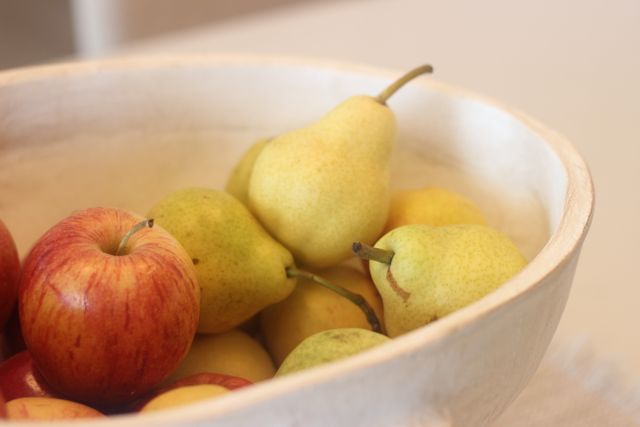
Are pears good for dogs? Yes, in small amounts. Fresh, ripe pear is safe for most healthy dogs as an occasional treat, as long as you remove the stem, core and seeds and cut the fruit into bite-size pieces. Pears offer some fiber and vitamins, but they should never replace a complete dog food.
If your dog sits by your feet every time you slice a Bartlett or Anjou, you are not alone. Owners also ask, “Are pears OK for dogs?” or “Can my dog eat pears?” This guide answers both and covers which parts of the pear are risky, how much to share by dog size, whether Asian and canned pears are safe, and what to do if your dog steals a whole core.
Key takeaways
- Plain, fresh pear flesh is safe for most dogs in moderation.
- Pear seeds contain traces of cyanide, and the core is a choking risk, according to the AKC.
- Treats, including fruit, should stay within 10% of your dog’s daily calories.
- Skip canned pears in syrup and anything with added sugar.
- Asian pears are safe when cut small, but their firmer flesh may raise the choking risk.
In this guide
Are Pears Good for Dogs? The Short Answer
Can dogs eat pears safely? The American Kennel Club says dogs can safely enjoy a little fresh pear, and it names vitamin C, vitamin A and fiber among the fruit’s nutrients. PetMD, in an article reviewed by Sandra C. Mitchell, DVM, DABVP, agrees: pears are fine in moderation once the stem, leaves, core and seeds are removed.
| Part or product | OK for dogs? | Why | Source |
|---|---|---|---|
| Fresh pear flesh | Yes, in small pieces | Safe in moderation | AKC, PetMD |
| Washed skin | Usually yes | Peel for sensitive stomachs | PetMD |
| Core | No | Choking risk | AKC |
| Seeds | No | Traces of cyanide; choking risk | AKC, PetMD |
| Stems and leaves | No | Not safe for dogs | PetMD |
| Canned pears in syrup | No | Added sugar | AKC, PetMD |
Can Dogs Eat Pears With Skin, Core or Seeds?
Are pears good for dogs if you leave the skin on? Usually, yes. Only the flesh and the washed skin are good choices. Here is how each part compares:
- Flesh: the juicy white part is the piece to share.
- Skin: PetMD says washed skin is safe, but peeling may suit dogs with sensitive stomachs. MetLife Pet Insurance notes the skin is thin, so peeling is optional.
- Seeds: the AKC warns that pear seeds hold small amounts of cyanide and are also a choking hazard.
- Core: it is hard and fibrous, so a dog that gulps it could choke.
- Stem and leaves: PetMD lists them as unsafe, so throw them away.
Why seeds matter more for small dogs
MetLife Pet Insurance points out that smaller dogs can be affected by a smaller amount of seeds. A few seeds are less likely to bother a large dog, but there is no reason to take the chance with any dog. Pears belong to the same plant family as apples, and the ASPCA lists apple seeds, stems and leaves as containing cyanide.
How to Prepare Pears for Your Dog
Preparation is what turns a risky snack into a safe one. Following PetMD and AKC guidance:
- Choose ripe, fresh pears. Bartlett, Bosc, Anjou and Comice all work, according to PetMD.
- Wash the fruit under running water.
- Remove the stem, leaves, core and every seed.
- Peel if your dog has a sensitive stomach.
- Cut into bite-size pieces that match your dog’s size.
- Serve plain, with no sugar, syrup, caramel or spices.
Pet Care Tip: Freeze small pear cubes for a cool summer treat. Keep the pieces small so your dog can’t swallow a hard frozen chunk whole.
Is pear good for dogs nutritionally?
Pears for dogs are a nice extra rather than a superfood. The AKC lists vitamin C, vitamin A and fiber among the nutrients in pears, which makes a slice a light, juicy reward.
A dog eating a complete and balanced food already gets the nutrients it needs, though, so the real value of a pear slice is variety, not a health boost. Are pears good for dogs as an occasional swap for store-bought treats? For many dogs, yes, in small amounts.
Can Dogs Have Pears Every Day? Portion Guide
So, are pears good for dogs as a daily snack? Not really. Both the AKC and PetMD apply the 10% rule: treats should make up no more than 10% of your dog’s daily calories. For small dogs, the AKC suggests a single slice from time to time, and warns that a whole pear is likely more than they need.
| Dog size | Example weight | Cautious starting amount | How often |
|---|---|---|---|
| Toy | Under 10 lbs (4.5 kg) | 1–2 small cubes | Once or twice a week |
| Small | 10–25 lbs (4.5–11 kg) | Up to 1 thin slice | Once or twice a week |
| Medium | 25–50 lbs (11–23 kg) | 1–2 slices | A few times a week |
| Large | Over 50 lbs (23 kg) | 2–3 slices | A few times a week |
These are our cautious starting points, not vet-set targets. Your vet may suggest less for your dog.
Can Dogs Eat Asian Pears and Korean Pears?
Can dogs have Asian pears? Yes. PetMD says Asian pears are fine for dogs as long as they are prepped correctly and portions stay small. Korean pears are a type of Asian pear, so if you’re wondering whether dogs can eat Korean pears, the same rules apply.
MetLife Pet Insurance adds one caution: Asian pears have firmer flesh, which could make them a bigger choking risk, so slice them thinner or into smaller cubes than you would a soft Bartlett.
| Pear type | Texture | Prep tip |
|---|---|---|
| Bartlett, Anjou, Comice | Soft and juicy when ripe | Bite-size pieces |
| Bosc | Firmer, denser flesh | Smaller pieces |
| Asian or Korean pear | Crisp and firm | Thin slices or small cubes |
Canned, Dried and Pear Juice: Are Pears Good for Dogs in Every Form?
Not every pear product is a good idea. The AKC advises against canned pears because of their sugar, as it does for most canned fruit, and PetMD advises avoiding pear products with added sugar or syrup.
- Canned pears: skip them, especially in syrup.
- Dried pears: we suggest skipping them; drying concentrates the sugar into a small, chewy piece that is easy to overeat.
- Pear juice: water is the best drink for dogs; juice adds sugar without the fiber.
- Pear desserts: pies, tarts and poached pears often contain sugar, butter, spices or alcohol, so keep them away from your dog.
Are Pears Good for Dogs With Diabetes or Tummy Trouble?
Are pears good for dogs with health problems? For most healthy adults, a little pear is fine. For some dogs, it is better to check with your vet first:
- Diabetic dogs: pears contain natural sugar, so ask your vet before offering any fruit.
- Overweight dogs: every treat counts toward daily calories.
- Sensitive stomachs: PetMD suggests peeling the fruit; stop if you see vomiting, diarrhea or stomach upset.
- Dogs on special diets: prescription diets can be thrown off by extra foods.
When to call the vet: If your dog has repeated vomiting, diarrhea, a swollen belly, or seems in pain after eating pear, call your veterinarian. Mild, one-off tummy upset often settles, but anything that lasts or worsens needs a vet check.
Want other fruit and veggie options? Our guides on apples for dogs and cucumbers for dogs follow the same safety approach.
What to Do If Your Dog Ate a Pear Core
Dogs are fast, and a dropped core can vanish in seconds. Can a dog eat a pear core and be fine? Some dogs do, but the AKC notes that seeds and hard pieces are choking hazards, so watch your dog closely. Stay calm and follow these steps:
- Remove any leftover pear, cores or seeds.
- Note how much your dog ate and when.
- Watch for gagging, coughing, drooling, vomiting, diarrhea or a sore belly.
- Call your vet, the ASPCA Animal Poison Control Center at (888) 426-4435 or the Pet Poison Helpline at (855) 764-7661 if your dog ate several cores or seems unwell. A consultation fee may apply.
- Don’t make your dog vomit unless a veterinarian tells you to.
When to call the vet: Choking, trouble breathing, repeated retching or collapse are emergencies. Go to your veterinarian or a 24/7 emergency animal hospital right away.
Common Mistakes When Sharing Pears
| Mistake | Why it happens | Effect on the dog | How to avoid it |
|---|---|---|---|
| Tossing the core to the dog | Seems like harmless scraps | Choking risk and seeds | Throw cores in a lidded trash can |
| Sharing canned pears | Convenient and soft | Added sugar | Use fresh, plain pear only |
| Large chunks of Asian pear | Firm fruit looks easy to chew | Choking risk | Thin slices or small cubes |
| Daily pear habit | Dog loves it | Extra calories, weight gain | Keep treats within 10% |
Example Scenario (illustrative)
Felix in Portland, Oregon, is packing pears for lunch when his beagle mix, Maple, starts begging. He wonders, “Are pears good for dogs like her?” He cores one pear, cuts three small pieces of flesh and offers them as a training reward. Maple loves them, so Felix keeps pear as a twice-weekly treat and makes sure every core goes straight into the lidded trash can.
Are Pears Good for Dogs? FAQs
Are pears safe for dogs to eat every day?
It is better not to. The AKC and PetMD both say treats, pear included, should stay within 10% of a dog’s daily calories. A few small pieces a couple of times a week is a safer habit than a daily pear.
Can dogs eat pears with skin?
Usually, yes. PetMD says washed pear skin is safe, though peeling is kinder to dogs with sensitive stomachs. Always remove the stem, core and seeds first.
Are pear seeds poisonous to dogs?
The AKC says pear seeds hold small amounts of cyanide and can also cause choking. One or two seeds are less likely to cause problems in a large dog, but remove them every time and call your vet if your dog chewed several cores.
Can dogs eat Asian pears?
Yes, if prepared properly. PetMD calls Asian pears safe in suitable portions, and MetLife Pet Insurance notes their firmer flesh may raise the choking risk, so cut them into small pieces.
Can puppies eat pears?
The sources we checked don’t give puppy-specific advice, so ask your vet before adding new foods. If your vet agrees, start with one tiny piece of plain, seedless pear; a complete puppy food matters far more.
Are pears bad for dogs with diabetes?
Pears contain natural sugar, so a dog with diabetes should not have them unless your veterinarian approves. Your vet can tell you whether any fruit fits your dog’s diet plan.
Final Verdict
Are pears good for dogs? Yes, as a small, occasional treat. Fresh pear flesh, washed or peeled, is safe for most healthy dogs once the stem, core and seeds are gone. Keep portions within the 10% treat rule, skip canned and sugary pear products, and ask your vet first if your dog has diabetes or a sensitive stomach.
Your next steps
- Browse more food safety guides in our pet food center.
- Check which foods are risky, like onions for dogs.
- Find more care tips in our dogs section.
Does your dog love fruit? Share your story on our Facebook page.
About the author
Written and reviewed by the Pets Store Home Editorial Team: pet owners and animal lovers who check every guide against trusted US veterinary and animal-welfare sources. This article is general information, not a substitute for professional veterinary advice. Always talk to your veterinarian about your own pet’s health.
How we checked this guide: we used the American Kennel Club, PetMD (reviewed by Sandra C. Mitchell, DVM, DABVP), MetLife Pet Insurance and the ASPCA Animal Poison Control Center plant list. Portion amounts are our cautious starting points, not vet-set targets. We review this article every 12 months, or sooner if guidance changes.
Last reviewed: November 2026
Sources
- American Kennel Club – Can Dogs Eat Pears? (accessed November 2026)
- PetMD – Can Dogs Eat Pears? (reviewed by Sandra C. Mitchell, DVM, DABVP) (accessed November 2026)
- MetLife Pet Insurance – Can Dogs Eat Pears? (accessed November 2026)
- ASPCA – Toxic and Non-Toxic Plants: Apple (accessed November 2026)
[…] Which foreign pets are legal in Washington State? […]