
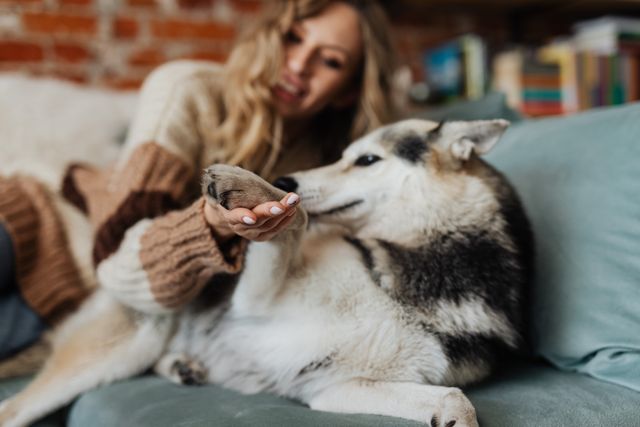
A white husky is a Siberian Husky with an all-white or nearly all-white coat. It is not a separate breed or an albino. White is one of the colors the AKC breed standard allows, and it usually comes from a recessive gene that both parents pass on. Care, size and health needs match any other Siberian Husky.
With their snowy coats and often blue eyes, white huskies get plenty of attention on walks and social media. This guide explains how the color is inherited, what the breed standard says about eyes and nose color, which health tests matter, and what daily life with an energetic white Siberian Husky really involves.
Key takeaways
- A white husky is a Siberian Husky color, not a separate breed.
- UC Davis links the e3 gene variant, found in Siberian and Alaskan Huskies, to pale yellow or white coats.
- Brown, blue, one of each or parti-colored eyes are all allowed by the standard.
- Inherited eye disease and hip problems are key breed health concerns, whatever the coat color.
- PetMD recommends at least 40 minutes of exercise a day and gives a lifespan of about 12 to 14 years.
In this guide
What Is a White Husky? The Short Answer
The Siberian Husky Club of America publishes the AKC breed standard, which lists black, gray, agouti, sable, red and white as allowable colors. So an all white husky is simply a purebred Siberian Husky in one of its accepted shades. The same standard disqualifies merle and brindle, so a “white” puppy with patchy marbling may not be a purebred Siberian.
| Quick fact | White husky | Source |
|---|---|---|
| Breed | Siberian Husky (color, not a separate breed) | SHCA / AKC standard |
| Height | Males 21–23½ in (53–60 cm); females 20–22 in (51–56 cm) | SHCA / AKC standard |
| Weight | Males 45–60 lbs (20–27 kg); females 35–50 lbs (16–23 kg) | SHCA / AKC standard |
| Eye colors | Brown, blue, one of each or parti-colored | SHCA / AKC standard |
| Lifespan | About 12–14 years | PetMD |
| Exercise | At least 40 minutes a day | PetMD |
White Husky Genetics: Why the Coat Is White
Why is a white husky white? The UC Davis Veterinary Genetics Laboratory explains that recessive red variants of the MC1R gene (the E locus) block black pigment and produce shades of cream, yellow or red. The lab says one of these variants, e3, is only expected in Siberian Huskies, Alaskan Huskies and dogs mixed from them. A husky with two copies of e3 has a pale yellow or white coat.
Because the variant is recessive, a puppy needs a copy from each parent. That’s why two gray-and-white huskies can sometimes produce an all-white puppy if both quietly carry the gene. A DNA coat-color test shows exactly what a dog carries.
| Parents | What the puppies can be | Chance of a white puppy |
|---|---|---|
| White × white (both e3/e3) | All white or very pale | Every puppy |
| White × carrier | White or colored carriers | About 1 in 2 |
| Carrier × carrier | White, carrier or non-carrier | About 1 in 4 |
| Carrier × non-carrier | Colored puppies only | None |
Odds follow standard single-gene inheritance and apply to each puppy. Other genes can also affect how much white a husky shows.
Pure white vs cream or “Isabella” white
Some white huskies are bright, snowy white, while others have a faint cream or biscuit tint, especially on the ears and back. Owners and breeders sometimes call the pale, liver-pointed version “Isabella” white. Both are still Siberian Huskies; the label describes shade, not a different dog.
Size, Weight and Lifespan
Coat color doesn’t change a husky’s size. The AKC standard sets male height at 21 to 23½ inches and female height at 20 to 22 inches, and it disqualifies males over 23½ inches and females over 22 inches. PetMD (Tiffany Paul, DVM; reviewed by Jo Cornett, DVM) gives a lifespan of about 12 to 14 years.
| Trait | Male | Female | Source |
|---|---|---|---|
| Height at shoulder | 21–23½ in (53–60 cm) | 20–22 in (51–56 cm) | SHCA / AKC standard |
| Weight | 45–60 lbs (20–27 kg) | 35–50 lbs (16–23 kg) | SHCA / AKC standard |
| Lifespan | About 12–14 years | About 12–14 years | PetMD |
Siberian or Alaskan: which white husky is it?
The UC Davis page mentions both Siberian and Alaskan Huskies. They are not the same.
The Siberian Husky is an AKC-recognized breed with a written standard, while the Alaskan Husky is generally described as a working sled-dog type, bred for performance rather than a set look, so its size and build can vary much more. If a seller calls a puppy a white Alaskan, ask what breeds are in its background and how large the parents are.
Eye Colors and Nose Pigment
A white husky with blue eyes is the image most people picture, but the standard allows much more. The breed standard accepts brown eyes, blue eyes, one of each, or parti-colored eyes (blue and brown in the same eye). For white dogs, the standard allows a nose that is “black, liver or flesh-colored,” and a “snow nose” with lighter, pink-streaked areas is acceptable too.
That pigment is one reason a white Siberian Husky is not an albino. Albinism is a separate condition in which pigment is missing far more widely, while a white husky typically keeps dark or liver coloring around its eyes and nose.
White Husky Health: Eyes, Hips and Tests
Is a white coat linked to poorer health? We found no evidence that it is. The Siberian Husky Club of America names three inherited eye diseases in the breed: juvenile (hereditary) cataracts, corneal dystrophy and progressive retinal atrophy. It stresses that each can occur in any eye color, so blue eyes are not a health problem in themselves.
The club cites a 1999 study of 1,345 huskies examined by veterinary ophthalmologists that found cataracts in about 8%, corneal dystrophy in about 3% and PRA in under 1%. PetMD also lists hypothyroidism and hip dysplasia as breed concerns. The club’s health statement recommends these checks for breeding dogs:
| Health check | What the club recommends | Source |
|---|---|---|
| Eye exam | Yearly exam by a board-certified ACVO ophthalmologist from 12 months of age | SHCA health statement |
| Hips | Evaluation through OFA, OVC, PennHIP or an equivalent registry | SHCA health statement |
| DNA tests | SPS1 and SHPN1 tests for breeding dogs | SHCA health statement |
When to call the vet: Cloudiness, redness, squinting or bumping into things can signal an eye problem. Book a vet visit promptly; sudden pain or vision loss needs same-day care at your vet or a 24/7 emergency animal hospital.
Temperament, Exercise and Escape-Proofing
A white coat doesn’t change personality. PetMD describes huskies as independent thinkers and notes that bored huskies may try to escape the yard. They need at least 40 minutes of exercise every day, and many enjoy far more.
- Secure the yard: check fences for gaps and digging spots.
- Leash walks: a strong husky can pull hard; our guide on how to stop leash pulling helps.
- Training: keep sessions short and rewarding with our puppy training tips.
- Brain work: puzzle feeders, scent games and harness sports such as canicross or bikejoring can suit this working breed.
Grooming, Shedding and Tear Stains
Every husky has a double coat, and PetMD notes that the undercoat sheds about twice a year. A white coat shows dirt and stains more easily, and PetMD mentions that white huskies may develop tear staining.
- Brushing: brush regularly, and more often during the twice-yearly heavy sheds.
- Tear stains: wipe under the eyes gently with a damp cloth; ask your vet if staining is new or heavy.
- Bathing: bathe only when needed, and dry the dense coat fully.
- Hot weather: in Southern summers, walk early or late and give shade and water. Don’t shave the coat without your vet’s advice.
Buying or Adopting: Questions to Ask
PetMD puts Siberian Husky puppies at up to $1,500. A white coat is not a reason to pay more, so be wary of sellers who charge extra for color or call it rare. Husky rescues and shelters also rehome adult dogs of every color.
Questions to ask a breeder
- Can I see current ACVO eye exam results for both parents?
- What are the parents’ hip evaluation results?
- Have the parents had SPS1 and SHPN1 DNA tests?
- Are both parents purebred Siberian Huskies, with no merle in the line?
- Can I meet the mother and see where the puppies are raised?
- Will you take the dog back if I can’t keep it?
Common Mistakes New Owners Make
| Mistake | Why it happens | Effect on the dog | How to avoid it |
|---|---|---|---|
| Paying extra for “rare” white | Color is marketed as special | No benefit to the dog | Choose on health tests |
| Underestimating exercise | Calm puppy at the breeder | Boredom, digging, escapes | Daily runs and play |
| Weak fencing | Dog seems content | Escapes and roaming | Check and reinforce fences |
| Shaving in summer | Trying to keep the dog cool | May affect how the coat protects the dog | Brush, shade and ask your vet |
Example Scenario (illustrative)
Kendra in Denver, Colorado, finds a breeder asking extra for a white husky puppy because the color is “rare.” She asks for the parents’ eye and hip results, gets none, and keeps looking. A husky rescue later introduces her to Sleet, a two-year-old white Siberian with up-to-date eye exams. Kendra checks her fence line and plans morning runs before he comes home.
White Husky FAQs
Are white huskies rare?
You may see them less often than gray or black huskies, but they are not a separate breed or a rare variety. The AKC breed standard lists white among the allowed Siberian Husky colors.
Is a white husky an albino?
No. A white Siberian Husky usually keeps some pigment, and the breed standard allows a black, liver or flesh-colored nose on white dogs. True albinism is a different condition.
Do white huskies have blue eyes?
Many do, but not all. The standard allows brown eyes, blue eyes, one of each, or parti-colored eyes in any coat color, including white.
Are white huskies more likely to be deaf?
We found no evidence linking the husky white coat to deafness. Merle, a pattern often tied to hearing problems in other breeds, is a disqualification in the Siberian Husky standard. Ask your vet to check any puppy that seems not to hear.
How much does a white husky cost?
PetMD puts Siberian Husky puppies at up to $1,500. A white coat should not cost extra, so be wary of sellers who charge more for the color or call it rare.
Can a white husky live in a hot climate?
It can, with care. Huskies have a thick double coat, so in hot Southern summers walk early or late, provide shade and water, and never shave the coat without asking your vet.
Final Verdict
A white husky is a purebred Siberian Husky in an accepted color, not an albino or a rare breed. Its coat comes from a recessive gene, and its health, size and energy match any other husky. Choose a breeder with eye and hip results, or adopt, and plan for daily exercise, secure fencing and regular brushing.
Your next steps
- Browse more breed guides in our dogs section.
- Compare similar breeds in our guide to the difference between a husky and a malamute.
- See another husky coat in our agouti Siberian Husky guide.
Share photos of your husky on our Facebook page.
About the author
Written and reviewed by the Pets Store Home Editorial Team: pet owners and animal lovers who check every guide against trusted US veterinary and animal-welfare sources. This article is general information, not a substitute for professional veterinary advice. Always talk to your veterinarian about your own pet’s health.
How we checked this guide: we used the Siberian Husky Club of America breed standard, health statement and eye-testing guidance, the UC Davis Veterinary Genetics Laboratory MC1R test page, and PetMD (Tiffany Paul, DVM; reviewed by Jo Cornett, DVM). We review this article every 12 months, or sooner if guidance changes.
Last reviewed: November 2026
Sources
- Siberian Husky Club of America – AKC Siberian Husky Standard (accessed November 2026)
- Siberian Husky Club of America – Health Statement (accessed November 2026)
- Siberian Husky Club of America – Genetic Defects of the Eye (accessed November 2026)
- UC Davis VGL – MC1R (E Locus) test (accessed November 2026)
- PetMD – Siberian Husky (Tiffany Paul, DVM; reviewed by Jo Cornett, DVM) (accessed November 2026)
[…] Which foreign pets are legal in Washington State? […]