
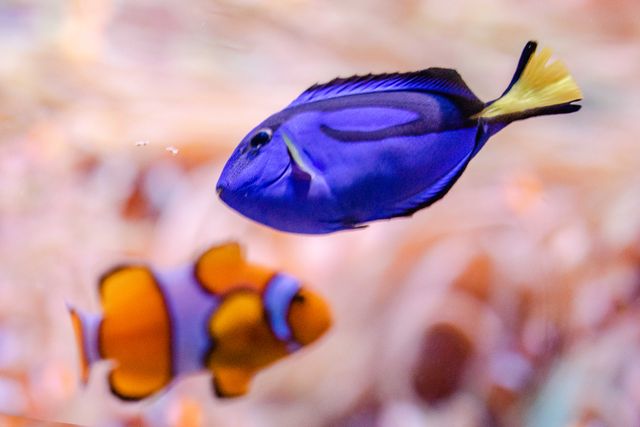
Do fish sleep? Yes, in their own way. Fish do not sleep exactly like people, and most cannot close their eyes, but they do have regular rest periods when they slow down, hover or tuck into a safe spot. Research on zebrafish even shows sleep-like brain activity similar to ours.
If you have ever peeked at your aquarium late at night and found your fish hanging motionless, you may have wondered whether it was asleep, sick or something in between. This guide explains how fish rest without eyelids, what scientists have discovered, how to spot a sleeping fish, how different species rest, whether sharks sleep, and how to help your aquarium fish get good rest.
Key takeaways
- NOAA says most fish rest, even though they do not sleep the way land mammals do.
- Except for sharks, most fish have no eyelids, so they rest with their eyes open.
- A 2019 Stanford study found sleep-like brain patterns in zebrafish.
- Many sharks must keep swimming to breathe, but some can rest on the seafloor.
- Aquarium fish benefit from a regular light and dark schedule.
In this guide
Do Fish Sleep? The Short Answer
The NOAA Ocean Service explains that although fish “do not sleep in the same way that land mammals sleep, most fish do rest.” During these periods they reduce their activity and metabolism while staying alert to danger. NOAA adds that these quiet spells may serve the same restorative purpose that sleep does for people.
| Question | Quick answer | Source |
|---|---|---|
| Do fish sleep? | They rest in a sleep-like state | NOAA |
| Do they close their eyes? | Most cannot; they lack eyelids | NOAA |
| Is their brain activity sleep-like? | Yes, in zebrafish studies | Stanford Medicine |
| Do sharks sleep? | Many rest; true sleep is still unclear | UF/IFAS, Britannica |
| Do pet fish need darkness? | Yes, a regular light and dark schedule helps | WSU |
How Do Fish Sleep Without Eyelids?
Because most fish lack eyelids, they cannot shut their eyes the way we do. NOAA puts it simply: “except for sharks, most fish don’t have eyelids.” Instead of closing their eyes, fish rest by staying still and lowering their activity. NOAA describes some fish hovering in place while others squeeze into a safe crevice in mud or coral. The Pacific sand lance, for example, burrows into the sand to rest and save energy.
Some fish go further. In a National Geographic report by Jason Bittel, marine ecologist Michael Heithaus explains that parrotfish “make these kind of mucus bags, and they just sit in them at night on the reef,” a habit that helps protect them from predators and parasites. If the cocoon is disturbed, the fish wakes and swims away quickly.
Pet Care Tip: Never tap on the glass to “wake” a resting fish. Sudden noise and vibration may stress fish, especially in a small tank.
Do Fish Sleep Like Humans? What the Science Shows
For years, scientists debated whether fish truly sleep or only rest. A 2019 study published in Nature, described by Stanford Medicine, helped settle part of that question. Researchers led by Louis Leung and Philippe Mourrain recorded brain activity in young zebrafish and found two sleep states:
| Zebrafish sleep state | Similar human sleep stage | What happens |
|---|---|---|
| Slow bursting sleep | Slow-wave sleep | Slower, quieter brain activity |
| Propagating wave sleep | REM (paradoxical) sleep | The brain looks awake while the fish is asleep |
Stanford reports that these neural signatures suggest sleep-related brain activity evolved at least 450 million years ago, before animals moved onto land. The researchers noted that sleeping zebrafish lose muscle tone and do not react to stimuli, and that they keep their eyes open because they have no eyelids.
Mourrain told National Geographic that “all animals that have been carefully examined show sleep.” So, do fish sleep in a real, biological sense? The zebrafish evidence suggests that at least some do. Scientists still have plenty to learn, especially about the many species that live in the deep sea or rarely seem to stop moving.
Signs Your Aquarium Fish Is Resting
Pet owners often ask, do fish sleep in tanks the same way they would in the wild? They do rest, and you can learn to recognize it. A resting fish may:
- Stay mostly still, often near the bottom, among plants or under decorations.
- Hover in one spot with slow, gentle fin movements.
- Look a little paler at night, something some owners notice.
- React slowly when you walk past or the room light changes.
- Return to normal swimming when the lights come on or food arrives.
Zebrafish research found that sleeping fish do not react to stimuli, so a slower response is a normal part of rest. The key is that a healthy fish wakes up and behaves normally again. If your fish stays inactive during the day or shows other warning signs, it may be unwell rather than asleep.
When to call the vet: Test your water and contact an aquatic veterinarian if your fish rests constantly during the day, lies on its side, gasps at the surface, has clamped fins, stops eating or shows spots, fuzz or sores.
How long do fish sleep?
There is no single answer, because rest patterns vary by species and setting. Day-active fish such as goldfish tend to rest through much of the night, while others rest at different times. In a home aquarium, your light schedule strongly shapes when fish rest, so the question of when and how long do fish sleep in your tank depends partly on you. A steady routine helps them settle into a natural rhythm.
Sleep Habits of Different Fish
Fish rest in many different ways, depending on their habitat and lifestyle.
| Fish | How it rests | Source |
|---|---|---|
| Goldfish | Active by day, resting at night | WSU fish veterinarian |
| Parrotfish | Sleeps inside a mucus cocoon on the reef | National Geographic |
| Pacific sand lance | Burrows into sand to rest | NOAA |
| Zebrafish | Shows slow-wave and REM-like sleep states | Stanford Medicine |
| Blind cavefish | Rest during the day in some populations | National Geographic |
The Washington State University Ask Dr. Universe column quotes fish veterinarian Dr. Nora Hickey, who explains that goldfish are diurnal, meaning they are active in the day and sleep at night. Other day-active aquarium fish follow a similar rhythm, which is one reason a steady day and night schedule matters in a home tank.
Do Sharks Sleep?
Sharks are a special case. Britannica explains that many sharks are obligate ram ventilators, meaning they must keep swimming to push water over their gills. Others can pump water over their gills while still, and sharks with spiracles, small openings behind the eyes, can rest on the seafloor. Britannica names nurse, wobbegong, lemon and some reef sharks among those that rest this way.
Whether sharks truly sleep is still unclear. Armando Ubeda of UF/IFAS Extension writes that the question has “no simple answer, mainly because of the lack of data.” National Geographic reports that some carpet sharks shut their eyes while resting and can be roused with a stimulus.
How to Help Aquarium Fish Get Good Rest
Pet fish depend on you for a healthy day and night rhythm. Dr. Hickey of WSU recommends a regular light and dark schedule, with lights turned on and off at the same time every day, and suggests using a timer. She adds that “receiving food at the same time every morning might help even more than light.”
- Use a light timer: keep the schedule consistent, even on weekends.
- Give them darkness: do not leave the aquarium light on all night.
- Feed on a routine: regular feeding times help set your fish’s daily rhythm.
- Add hiding spots: plants, caves and driftwood give shy fish a safe place to rest.
- Keep the room calm: place the tank away from loud speakers, doors and heavy foot traffic.
- Look after water quality: test regularly and do partial water changes, because poor water can make fish sluggish.
Choosing the right species also makes a difference. Our guide to freshwater fish for a home aquarium can help you pick fish that suit your tank, and our list of pets for apartments explains why fish can be a good fit for small spaces.
Example Scenario (illustrative)
Nina in Phoenix, Arizona, keeps a goldfish named Mango and often leaves the tank light on late into the night. Mango starts hiding more and looks dull. Nina sets a timer so the light switches on at 8 a.m. and off at 8 p.m., and feeds him at the same time each morning. Within a couple of weeks, Mango is active and colorful during the day and rests calmly at night.
Do Fish Sleep? FAQs
Do fish sleep at night?
Many do. Goldfish, for example, are active during the day and rest at night, according to a Washington State University fish veterinarian. Some species, such as certain cavefish, rest at other times.
Do fish close their eyes when they sleep?
Most cannot. NOAA notes that, except for sharks, most fish do not have eyelids. Researchers have seen some carpet sharks shut their eyes while resting.
How can I tell if my fish is sleeping?
A resting fish usually stays still near the bottom, among plants or close to the surface, moves its fins slowly and reacts more slowly than usual. It should wake and swim normally when the lights come on or food arrives.
Should I turn off my aquarium light at night?
Yes. A WSU fish veterinarian recommends a regular light and dark schedule, with lights switched on and off at the same time every day, ideally on a timer.
Do sharks sleep?
Scientists are still unsure. Many sharks must keep swimming to breathe, but some species with spiracles can rest on the seafloor, according to Britannica. UF/IFAS Extension notes that there is little data on shark sleep.
Is it bad if my fish lies at the bottom of the tank all day?
It can be. Daytime resting that is unusual for your fish, especially with clamped fins, gasping or loss of appetite, may signal poor water quality or illness. Test the water and ask an aquatic veterinarian.
Final Verdict
Do fish sleep? Yes, in a fish-sized way. Most fish rest with their eyes open, slowing their bodies and staying alert to danger, and zebrafish studies show sleep-like brain activity much like ours. Give your aquarium fish a steady light and dark schedule, regular meals and safe hiding spots, and contact an aquatic vet if resting turns into daytime lethargy.
Your next steps
- Explore more fish guides in our fish section.
- Set a timer for your aquarium light today.
- Find more pet care guides on our pets page.
Share a photo of your aquarium on our Facebook page.
About the author
Written and reviewed by the Pets Store Home Editorial Team: pet owners and animal lovers who check every guide against trusted scientific and veterinary sources. This article is general information, not a substitute for professional veterinary advice. Always talk to an aquatic veterinarian about your own fish’s health.
How we checked this guide: we used the NOAA Ocean Service, Stanford Medicine, National Geographic, Britannica, UF/IFAS Extension and Washington State University’s Ask Dr. Universe (quoting fish veterinarian Dr. Nora Hickey). We review this article every 12 months, or sooner if guidance changes.
Last reviewed: November 2026
Sources
- NOAA Ocean Service – Do fish sleep? (accessed November 2026)
- Stanford Medicine – Neural sleep patterns emerged at least 450 million years ago (2019) (accessed November 2026)
- National Geographic – Do fish sleep? (Jason Bittel, 2025) (accessed November 2026)
- Britannica – Do Sharks Sleep? (accessed November 2026)
- UF/IFAS Extension – Shark Bits: Do sharks sleep? (Armando Ubeda) (accessed November 2026)
- Washington State University – Ask Dr. Universe: goldfish and light (Dr. Nora Hickey) (accessed November 2026)
[…] Which foreign pets are legal in Washington State? […]