
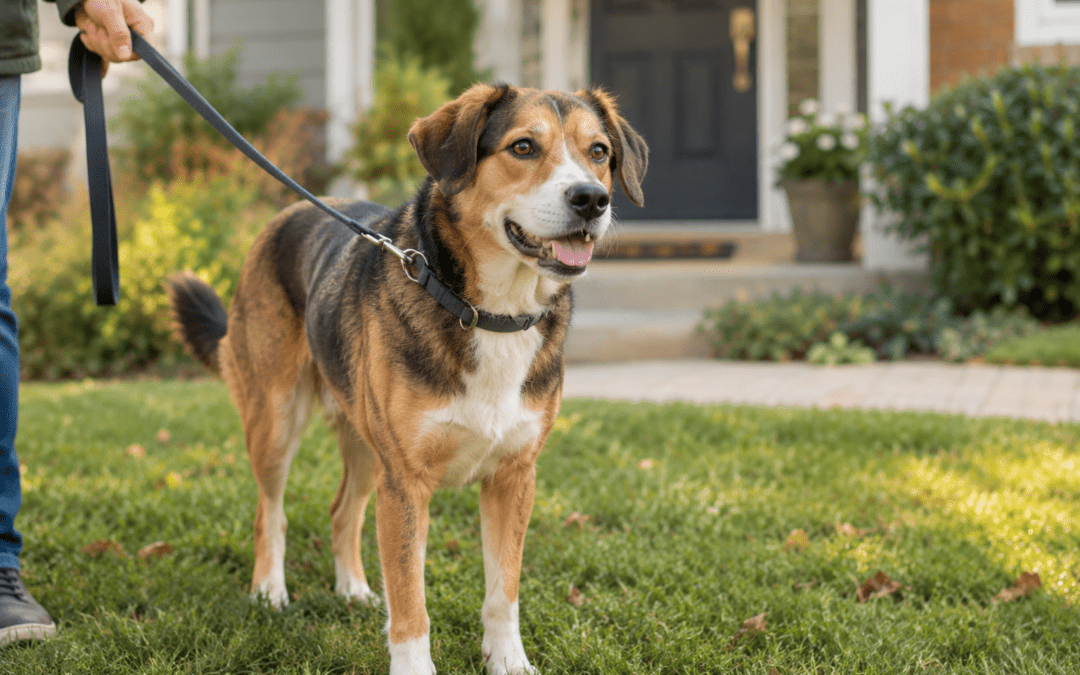
Learning how to potty train an older rescue dog comes down to three things: a predictable schedule, close supervision, and rewarding every success outdoors. Most adult rescues can learn new bathroom habits, whether they never lived indoors or were house-trained before and are having accidents in a new home. Start with a vet check to rule out medical causes, then treat your dog like a puppy who’s just arrived: frequent trips outside, calm praise, and no punishment.
Your dog isn’t being spiteful. A new home, new smells, unfamiliar surfaces, and a changed routine can all unsettle bathroom habits. This guide gives you a step-by-step plan, a sample schedule, crate and senior-dog advice, and clear signs that accidents may be medical.
Key takeaways
- Older rescue dogs can learn; PetMD says training can take anywhere from a few weeks to a few months.
- Take your dog out on waking, after meals, naps, and play, before bed, and at frequent intervals in between.
- Reward outdoor potty breaks right away with praise and a small treat.
- Never punish accidents; the AKC warns it can make a dog afraid to potty in front of you.
- Sudden accidents, straining, or drinking more than usual need a vet visit. Straining with little or no urine is an emergency.
In this guide
- Can an older rescue dog be potty trained?
- Why rescue dogs have accidents indoors
- Step-by-step potty training plan
- Daily bathroom schedule
- Reward outdoor success
- Supervise and prevent accidents
- Should you use a crate?
- How to handle accidents
- Senior dogs and mobility problems
- When accidents may be medical
- FAQs
How to Potty Train an Older Rescue Dog: Can They Still Learn?
Yes. In PetMD’s veterinarian-written guide to potty training an older dog, the author’s message is simple: old dogs can learn new tricks. The same basics that work for puppies work for adult dogs. You just may need to undo some old habits first.
Progress varies from dog to dog. PetMD notes training can take anywhere from a few weeks to a few months. Some dogs settle in quickly; others need more time, or extra veterinary or behavioral support. Patience matters more than any deadline.
Why a Rescue Dog May Have Accidents Indoors
Before you work out how to potty train an older rescue dog, it helps to understand why accidents happen. Common reasons include:
- No indoor history: some dogs lived outdoors, in kennels, or on the street and simply never learned that inside is off-limits.
- A new routine: American Humane points out that adopted adults don’t automatically know your schedule or even where the door is.
- Stress and change: a move, new people, or new pets can disrupt habits, even in a dog who was reliable before.
- Unfamiliar surfaces: a dog used to concrete or gravel may hesitate on grass, and the reverse.
- Old smells: lingering urine odor from a previous pet can draw a dog back to the same spot.
- Medical problems: infections, kidney disease, diabetes, pain, and incontinence can all cause accidents (see the medical section below).
American Humane adds that a dog who was kept caged long-term, with no way to avoid soiling its space, may find housetraining harder, and professional help is strongly recommended. Don’t assume any rescue dog was reliably house-trained before adoption, even if the shelter believed so.

Step-by-Step Plan: How to Potty Train an Older Rescue Dog
Here’s the full plan at a glance. These steps follow the same principles trainers use for how to house train an adult dog of any background, and each is explained in more detail below.
- Book a vet check. PetMD advises having the dog examined before assuming accidents are behavioral.
- Set fixed mealtimes. Avoid leaving food down all day so bathroom needs become more predictable.
- Take frequent, scheduled trips outside on a leash to the same spot.
- Reward success immediately with praise and a small treat.
- Supervise indoors and watch for signs your dog needs to go.
- Manage unsupervised time with a crate, pen, or gated room your dog is comfortable in.
- Clean accidents with an enzymatic cleaner and never punish.
- Expand freedom slowly as your dog becomes reliable.
- Keep a potty log to spot patterns and share with your vet or trainer.
Create a Consistent Daily Bathroom Schedule
The schedule is the backbone of how to potty train an older rescue dog. A potty training schedule for adult dogs should be built around your dog’s natural rhythms. The AKC recommends going out first thing in the morning, after meals, several times during the day, and before bed. For adult dogs having frequent accidents, the AKC’s rescue-dog guide suggests trips about every two hours, including after every meal.
That’s a starting point, not a rule. The San Francisco SPCA suggests beginning with leashed walks at two-hour intervals, while American Humane says intervals while a dog is learning can be as short as every 10 minutes or as long as once an hour. Once your dog succeeds consistently for several days, American Humane suggests stretching the interval gradually.
| Time or situation | Suggested action |
|---|---|
| First thing in the morning | Take your dog straight outside on a leash |
| After breakfast | Offer another potty break |
| During the morning | Regular outdoor trips, about every two hours to start |
| After lunch or the next meal | Take your dog outside |
| After naps and play | Offer a potty break |
| After dinner | Take your dog outside |
| Before bedtime | Final bathroom trip of the day |
Illustrative example only, based on AKC, SF SPCA, and American Humane guidance. Senior dogs, small dogs, dogs with medical conditions, and dogs still learning may need more frequent breaks. Adjust to your dog.
Don’t expect your dog to hold its bladder for a fixed number of hours. Meals help too: the AKC suggests picking up the bowl 10 to 15 minutes after serving, and American Humane suggests removing uneaten food after 20 minutes, because eating all day means eliminating all day. Keep fresh water available unless your vet advises otherwise.
Reward Outdoor Potty Success
If you’re learning how to potty train an older rescue dog, positive reinforcement potty training is the most important habit you’ll build. Go outside with your dog on a leash, even in a fenced yard, as PetMD and the AKC recommend. Stand quietly in the same spot and give your dog time to sniff.
- Reward immediately: praise warmly and offer a small treat the moment your dog finishes. American Humane suggests keeping small, high-value treats by the door and saving them only for outdoor success.
- Add a cue: PetMD suggests a calm cue such as “go potty.” Using the same phrase each time can help your dog link the words with the action.
- Follow with fun: American Humane suggests letting your dog play or move freely right after success, which makes going outside even more rewarding.
- Keep everyone consistent: PetMD stresses that the routine should be followed seven days a week by everyone in the household.
Pet Care Tip: Ask the shelter or rescue what surface your dog used before: grass, concrete, gravel, or pee pads. If your dog seems unsure on grass, start on a surface it knows, then move gradually to your preferred spot. Some dogs also find a busy street or yard scary; a quiet corner can help them relax enough to go. If your dog seems frightened outdoors, try to identify the trigger and get help from a qualified, reward-based trainer.
Supervise Your Dog and Prevent Indoor Accidents
Close supervision is the part of how to potty train an older rescue dog that stops accidents from becoming habits. The San Francisco SPCA’s advice is to supervise your dog at all times in the house during training. Watch for signs your dog needs to go:
- Sniffing the floor or heading to a spot where it had an accident before
- Circling, pacing, whining, or restlessness
- Barking or scratching at the door
- Suddenly leaving the room
If you see these signs, calmly take your dog outside right away. When you can’t watch closely, use baby gates, a playpen, an indoor leash tether near you, or a comfortable, dog-safe room. Avoid giving full access to the house too soon. The SF SPCA suggests adding one extra room only after two or three weeks with no accidents, then another room every two or three weeks.
Should You Use a Crate for an Older Rescue Dog?
Many people researching how to potty train an older rescue dog ask about crates. A crate can help some dogs, but only if your dog is comfortable in it. PetMD says a crate should let your dog stand up, lie down on its side, turn around easily, and reach fresh water. It should be introduced gradually, and your dog should never be forced in.
Crates aren’t right for every rescue dog. The ASPCA cautions that a dog who isn’t used to a crate, or who can’t control its bladder or bowels, may become more anxious and try to escape. The AKC’s rescue-dog guide suggests an exercise pen or a baby-gated room as an alternative to the crate when you’re away. Follow these rules:
- Never use a crate as punishment.
- Don’t confine a dog for long stretches just to prevent accidents.
- Don’t force a dog with crate anxiety, a history of confinement distress, or medical or mobility needs into a crate.
- Make sure your dog still gets exercise, social time, water, and regular bathroom breaks. American Humane warns that a crate should never replace training.
For a gentle approach, see our guide on how to crate train an adult rescue dog.
How to Handle Potty Training Accidents
Accidents are a normal part of house training a rescue dog. Even with a solid plan for how to potty train an older rescue dog, a rescue dog having accidents indoors is common in the first weeks. How you react matters:
- If you catch it in progress: calmly interrupt and take your dog outside to finish. Don’t yell or frighten your dog.
- If you find it later: just clean it up. PetMD advises you not to yell at or punish your dog.
- Clean thoroughly: use an enzymatic pet-odor cleaner, as the AKC, American Humane, and SF SPCA recommend. American Humane notes regular cleaners don’t remove urine odor that draws dogs back.
- Look for a pattern: note the time and place in your potty log.
Never hit your dog, rub its nose in an accident, or punish it after the fact. The AKC warns that punishment can make a dog afraid to potty in front of you, so it may hide to go elsewhere. American Humane adds that punishment teaches fear and makes housetraining harder.
Special Tips for Senior Dogs and Dogs With Mobility Problems
Potty training an older dog with stiff joints or other age-related changes takes extra support. The ASPCA notes that conditions causing pain or reduced mobility, such as arthritis, can make it harder for a dog to reach its usual bathroom area. An older dog peeing in the house may simply be struggling to get outside in time. Practical changes can help:
- Offer more frequent outdoor trips, and adjust your schedule to your dog’s needs.
- Make the route easy: a ramp instead of steps, a clear path to the door, and the closest suitable potty spot.
- Add nonslip rugs or runners on smooth floors.
- Help your dog up and outside if it struggles, using a support harness if your vet recommends one.
- If you can’t be home often enough, the ASPCA suggests a dog walker or indoor options such as potty pads.
These steps support your dog, but they don’t replace a vet visit when symptoms are new or getting worse. Our guide to behavior changes in older dogs covers other signs to watch for.
When Accidents May Signal a Medical Problem
Any plan for how to potty train an older rescue dog should include a vet check, because not every accident is a training issue. VCA Animal Hospitals lists several medical reasons a dog may urinate in the house, including urinary tract infection or inflammation, kidney disease, diabetes, Cushing’s disease, hormone-responsive incontinence, neurological problems, and side effects of some medications. The ASPCA adds arthritis, cognitive dysfunction, and other conditions that affect mobility or bladder control. Only a vet can work out the cause, usually with an exam, bloodwork, and urine tests.
See your veterinarian if:
- A previously house-trained dog suddenly starts having accidents
- Your dog urinates much more often or drinks noticeably more water than usual
- Your dog strains to urinate, has blood in the urine or stool, or seems painful
- Your dog leaks urine while sleeping or resting, which VCA describes as the most common sign of urinary incontinence
- Your dog has persistent diarrhea or other new digestive symptoms
- Your dog has trouble walking, getting up, or reaching the door
- Accidents continue despite a consistent, suitable training routine
Emergency warning: straining with little or no urine
If your dog keeps trying to urinate but produces only small squirts or no urine at all, get to a vet or 24/7 emergency hospital immediately. VCA explains this can mean a urinary obstruction, which is more common in male dogs, is very painful, and is life-threatening if complete. Don’t wait to see if it passes.
If your vet rules out medical causes and accidents continue, the ASPCA recommends working with a qualified professional, such as a Certified Applied Animal Behaviorist, a board-certified veterinary behaviorist, or a Certified Professional Dog Trainer (CPDT). Choose a trainer who uses reward-based methods.
Keep a simple potty log
A log helps you spot patterns and gives your vet or trainer real information. Track these details for two to three weeks:
| Time | Ate / drank | Went outside? | Accident? Where? |
|---|---|---|---|
| 7:00 a.m. | — | Yes, pee | No |
| 7:30 a.m. | Breakfast, water | Yes, pee and poop | No |
| 10:15 a.m. | Water | Missed | Yes, by back door |
Example Scenario (illustrative)
Tanya in Ohio adopts an 8-year-old mixed-breed dog who had spent years in an outdoor kennel. Wondering how to potty train an older rescue dog with no indoor history, she books a vet check first, then takes him out on a leash every two hours and after meals. She rewards every outdoor success and uses a baby gate instead of a crate, because he panics when confined. Her log shows accidents happening mid-morning, so she adds a 10 a.m. break.
How to Potty Train an Older Rescue Dog: FAQs
Can you potty train an older rescue dog?
Yes. Adult and senior rescue dogs can learn new bathroom habits with a consistent schedule, close supervision, and rewards for going outside. Start with a vet check to rule out medical causes.
How long does it take to potty train an older rescue dog?
It varies. PetMD says it can take anywhere from a few weeks to a few months. Some dogs need extra veterinary or behavioral support, so there’s no guaranteed timeline.
How often should I take my rescue dog outside?
Go out first thing in the morning, after meals, naps, and play, and before bed. The AKC suggests about every two hours to start for adult dogs having accidents, adjusted to your dog’s age, size, and health.
What should I do if my rescue dog keeps peeing inside?
See your vet to rule out a medical cause, then tighten supervision, increase outdoor trips, and clean accidents with an enzymatic cleaner. If accidents continue, work with a qualified, reward-based trainer or behaviorist.
Should I crate an older rescue dog during potty training?
Only if your dog is comfortable in a crate. Introduce it gradually and never use it as punishment. For dogs with crate anxiety or mobility needs, a gated room or exercise pen is often a better choice.
How do I potty train a rescue dog that has never lived indoors?
Treat your dog like a new puppy. Take it out often on a leash, reward every outdoor success, supervise closely indoors, and start on a familiar surface if grass is new. Dogs kept caged long-term may need professional help.
Why is my previously potty-trained older dog suddenly having accidents?
Sudden accidents can be caused by stress or a new routine, but also by medical problems such as urinary infections, kidney disease, diabetes, incontinence, or arthritis. Book a vet exam before assuming it’s behavioral.
Should I punish my rescue dog for indoor accidents?
No. Punishment can make your dog afraid to go in front of you, so it may hide accidents instead. Calmly clean up and reward outdoor success.
Final Verdict: How to Potty Train an Older Rescue Dog
If you’re deciding how to potty train an older rescue dog, the best approach is to rule out medical causes, then stick to a predictable schedule, supervise closely, reward every outdoor success, and never punish accidents. Use a crate only if your dog is comfortable in one, give extra support to seniors, and call your vet about any sudden or worsening accidents.
Your next steps
- Book a vet check and start a potty log today.
- If your dog seems anxious when left alone, read our guide on how to help a dog with separation anxiety.
- Browse more training and care guides in our dog care section.
Share your rescue dog’s progress with our community on Facebook.
About the author
Written and reviewed by the Pets Store Home Editorial Team: pet owners and animal lovers who check every guide against trusted US veterinary and animal-welfare sources. This article is general information, not a substitute for professional veterinary advice. Always talk to your veterinarian about your own pet’s health.
How we checked this guide: We used PetMD (written by Tiffany Tupler, DVM, CBCC-KA, and reviewed by Barri J. Morrison, DVM), the American Kennel Club, the ASPCA, American Humane, the San Francisco SPCA, and VCA Animal Hospitals for training methods and medical warning signs. We review this article every 12 months, or sooner if guidance changes.
Last reviewed: October 2026
Sources
- PetMD – How to Potty Train an Older Dog (accessed Oct 2026)
- American Kennel Club – How to Housetrain an Adult Dog (accessed Oct 2026)
- American Kennel Club – Housetraining a Rescue Dog (accessed Oct 2026)
- ASPCA – Behavior Problems in Older Dogs (accessed Oct 2026)
- American Humane – Housetraining Puppies and Dogs (accessed Oct 2026)
- San Francisco SPCA – House Training an Adult Dog (accessed Oct 2026)
- VCA Animal Hospitals – Testing for Inappropriate Urination (accessed Oct 2026)
- VCA Animal Hospitals – Urinary Incontinence in Dogs (accessed Oct 2026)
- VCA Animal Hospitals – Bladder Stones in Dogs (urinary obstruction) (accessed Oct 2026)
[…] Which foreign pets are legal in Washington State? […]