
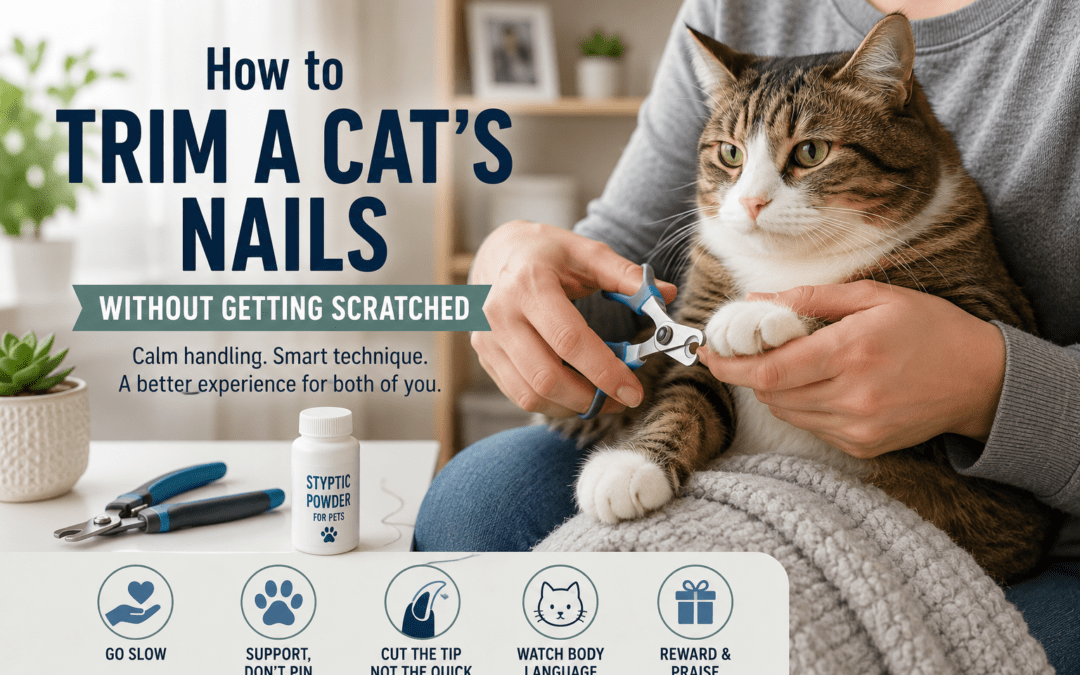
How to Trim a Cat’s Nails Without Getting Scratched
Quick answer: The key to trimming a cat’s nails without getting scratched is going slowly, restraining gently rather than forcibly, trimming only the sharp tip, and building up tolerance with short, positive sessions rather than trying to do all claws at once.
Key Takeaways
- Trim only the translucent tip of the claw, well clear of the pink “quick,” which contains a blood vessel and nerve.
- Wrapping your cat snugly in a towel (“purrito” method) can reduce struggling without needing to grip tightly.
- Short sessions – even just one or two nails at a time – are far less stressful than trying to finish all claws in one sitting.
- Treats and calm handling before, during, and after trimming help build positive associations over time.
- If a cat is extremely resistant, a groomer or vet can trim nails safely, or show you hands-on technique.
Why Trust This Guide?
This guide follows widely recommended low-stress handling techniques used by veterinarians and professional groomers for feline nail care, prioritizing gradual desensitization over restraint-heavy methods.
Last reviewed: September 2026
Most scratches during a nail trim don’t happen because a cat is “mean” — they happen because the cat is scared, has been restrained too tightly, or has had one bad clipping experience that it now associates with the whole process. Fix the handling and the pacing, and the scratching problem usually fixes itself.
Short version: work in short, calm sessions of one or two nails at a time, support the cat’s body instead of pinning it down, watch for early stress signals before they escalate into a swat, and build up tolerance gradually rather than trying to finish all eighteen nails in one sitting.
Why Cats Scratch During Nail Trims
A scratch during a trim is almost always a fear response, not aggression. Cats associate having their paws held with vulnerability — paws are how they’d normally run from danger — so unfamiliar pressure on a paw can trigger a flight-or-fight reaction before the cat even registers what’s happening.
Past experience compounds this fast. A single trim that involved being pinned down, over-restrained, or accidentally nicked at the quick is often enough for a cat to remember “nail time” as something to escape from the next time clippers appear. That’s why the fix usually isn’t a better restraint trick — it’s changing what the cat expects to happen.
Recognizing this early matters more than any specific holding technique. A cat that’s already tense before you’ve touched a single paw needs a different approach than one that’s simply unfamiliar with the process.
What You’ll Need
|
Clipper type |
Best for |
Watch out for |
|
Scissor-style |
Most cats; precise, controlled cuts |
Blades dull faster than guillotine style |
|
Guillotine-style |
Owners who want a clipper that stays sharp longer |
Some cats dislike the sound of the blade sliding |
|
Pliers-style |
Thick or older cats’ nails |
Bulkier to hold with one hand |
|
Nail grinder |
Gradual filing, smooth edges, no risk of a clean cut into the quick |
The vibration and noise stress many cats more than clippers |
Beyond the clipper itself, keep styptic powder (or plain cornstarch or flour as a backup) within reach in case you nick the quick, a small non-slip towel for cats who feel safer wrapped, and a stash of high-value treats set aside specifically for nail sessions so they don’t lose their novelty.
Understanding the Quick
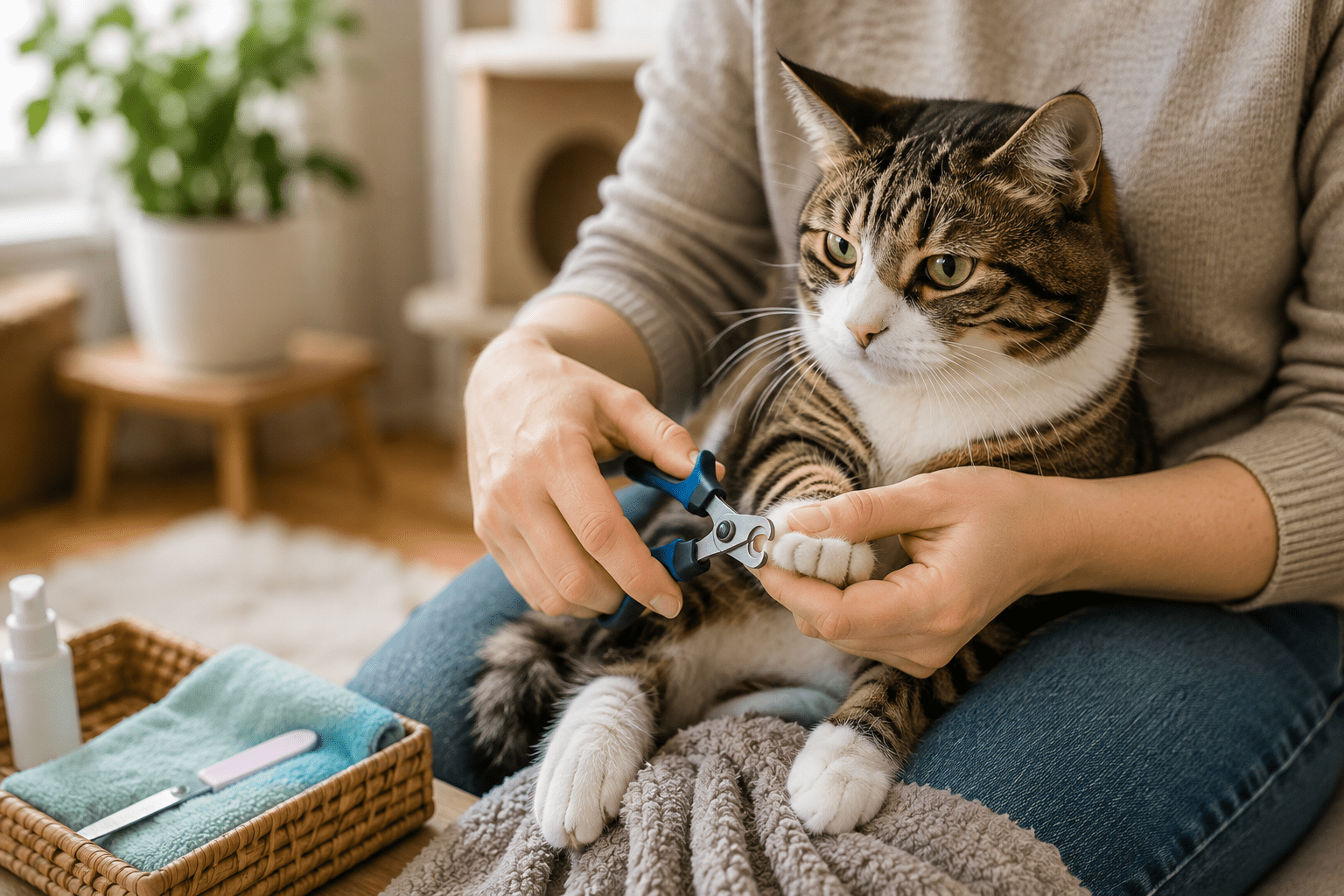
The quick is the blood vessel and nerve bundle running through the center of each nail. Cutting into it hurts and bleeds — which is exactly why a cat that’s been nicked once becomes so much harder to trim afterward.
On light-colored nails, the quick is easy to spot as a pink or reddish core visible through the nail. On dark or black nails, it isn’t visible at all, which is the single biggest reason people either cut too conservatively (leaving nails too long) or too aggressively (hitting the quick by guessing). For nails you can’t see through, trim only the thin curved tip — the hook — and stop well before the nail changes from a flat cross-section to a rounder one, which is where the quick typically begins.
Step-by-Step: How to Trim Without Getting Scratched
- Pick a calm moment. Right after a meal or during a drowsy stretch works better than right after play, when the cat is still keyed up.
- Support, don’t pin. Hold your cat in your lap or the crook of your arm, facing the same direction as you, with your hand supporting rather than clamping the body.
- Extend one nail at a time. Press gently on the top of the paw and the pad underneath to expose the nail — this shouldn’t require any real force.
- Cut at a 45-degree angle. Trim only the sharp curved tip, well clear of the quick, in one clean motion rather than a slow squeeze.
- Release and reward immediately. A treat right after each nail (or even just an attempt) keeps the session building a positive association instead of just tolerating one.
- Watch for stress signals between nails. Tail flicking, ear flattening, low growling, or a stiffening body means it’s time to pause — not push through to “get it over with.”
- Stop before your cat wants to. Ending a session while your cat is still relatively calm, even after just two or three nails, teaches it that nail time ends on a good note rather than a struggle.
Doing all four paws in one sitting is a nice goal, not a requirement. Several short sessions across a day or two beats one long one that ends in a scratch.
Restraint Methods Compared
|
Cat temperament |
Best restraint approach |
Why it works |
|
Relaxed, food-motivated |
Lap hold with treats between nails |
Minimal restraint keeps trust intact |
|
Mildly anxious |
Towel wrap (“purrito”) leaving one paw free at a time |
Reduces the cat’s ability to bolt without full pinning |
|
Very fearful or a first-timer |
Trim only while genuinely drowsy or sleepy, one or two nails |
Avoids triggering the fear response altogether |
|
Strong or squirmy |
Two-person approach, or a mesh grooming bag/hammock |
Distributes handling so no single point of restraint has to be forceful |
|
Senior cat |
Extra-gentle joint support, shorter sessions |
Older joints tire and ache faster, which reads as resistance |
Matching the method to the cat, rather than defaulting to the same restraint every time, is usually what separates a scratch-free trim from a fight.
Building Tolerance Through Desensitization
For a cat that resists every attempt, the fastest long-term fix is training the cat to accept paw handling separately from actual trimming.
Start by simply touching and gently massaging one paw at a time during calm moments — not during a trim attempt — and reward with a treat the instant the cat allows it, even for a second or two. Repeat this daily until the paw touch itself stops triggering a reaction.
Once paw handling is tolerated, introduce the clippers without cutting anything: let the cat see and sniff them, click them near (not on) a paw so the sound becomes familiar, and reward again. Only after both steps are boring to the cat should you attempt an actual trim — starting with a single nail.
This process is faster in kittens, who haven’t yet built up a negative association, but it works at any age. It just takes longer with an adult cat that’s already had a bad experience or two.
The Two-Person Technique
For cats that won’t tolerate one person doing both the holding and the cutting, splitting the roles helps:
Person one holds and comforts the cat — talking softly, keeping the body supported, and gently extending one paw at a time without applying the clipper.
Person two handles only the clipper, moving quickly and decisively once a nail is extended rather than lining up the cut slowly, which tends to build anticipation and tension.
This works especially well for cats that associate one specific person with “bad things happening” — splitting the roles can reset that association over time.
Troubleshooting Common Scenarios
Nails are solid black and I can’t see the quick. Trim only the very tip — the thin hooked point — in small increments. Stop as soon as the cross-section of the cut nail changes from flat and chalky to slightly rounder or you see a faint dark dot in the center; that’s the quick approaching.
My cat won’t let me touch its paws at all, ever. Skip trimming entirely for now and start at the desensitization stage above — daily brief paw touches with no clipper involved, for as long as it takes.
My cat scratches every single time, no matter what I try. This usually means the fear response is happening before you’ve even started, often from a past bad experience. Try trimming only while the cat is genuinely asleep or extremely drowsy, one nail at most per attempt, or bring in a groomer or vet tech to reset the association with a calmer, more practiced handler.
I can only get one or two nails done before my cat is done. That’s a completely normal outcome, not a failure — finish the rest over the following days rather than forcing a full session.
Aftercare: Building a Better Next Time
What happens in the two minutes after a trim matters almost as much as the trim itself. End every session — successful or not — with a favorite treat, calm praise, and a bit of normal affection, so the overall memory of “nail time” skews positive even if a few nails didn’t get done.
Avoid immediately following a trim with anything else the cat dislikes (a bath, a vet carrier, medication) — stacking two stressful things back to back teaches the cat to dread the first one even more.
If You Get Scratched or Cut the Quick
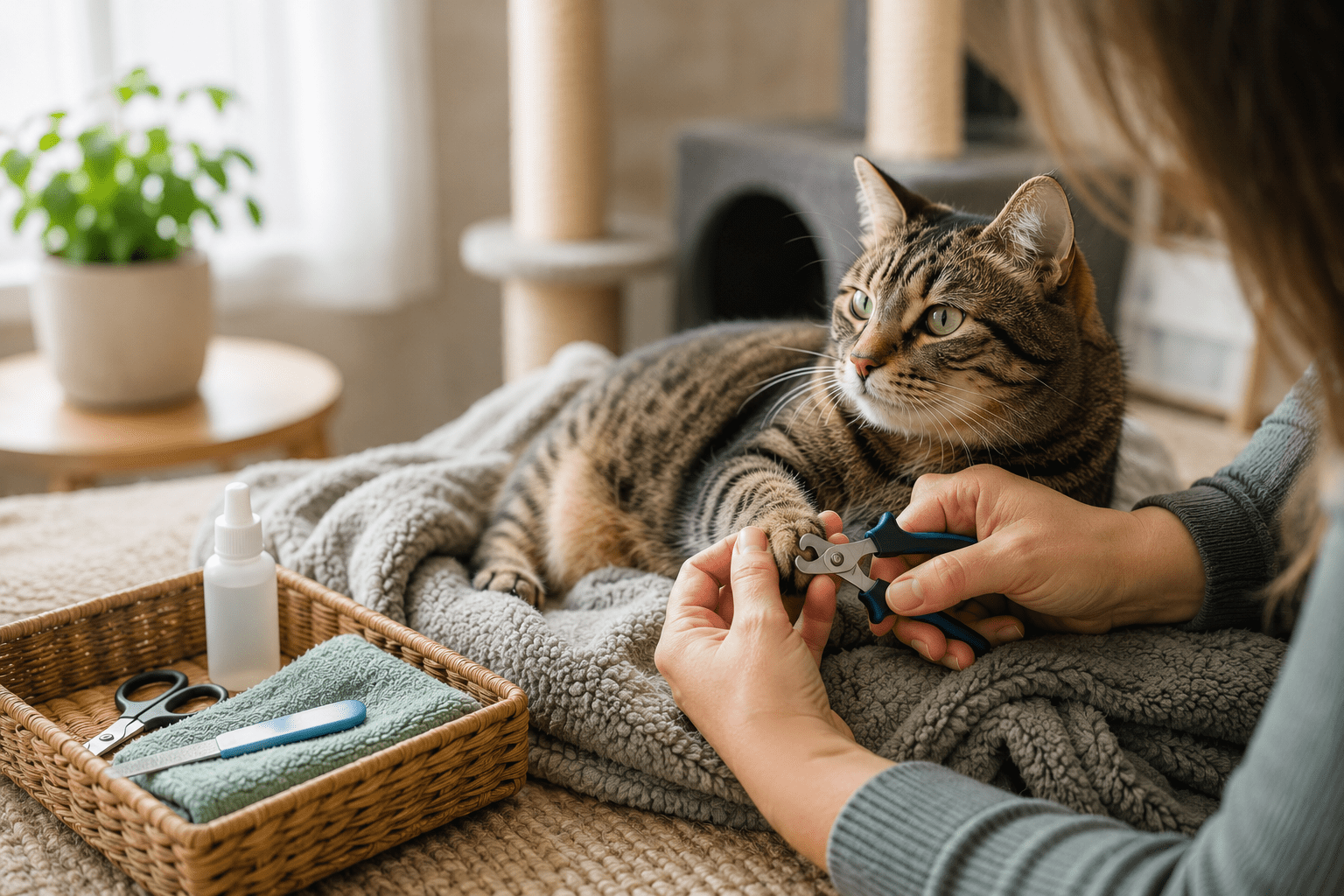
If you nick the quick, stay calm — your cat will pick up on your reaction more than the injury itself. Apply gentle pressure with a clean cloth, then styptic powder, cornstarch, or plain flour to the tip to stop the bleeding, which usually takes under a minute. If bleeding continues past ten minutes, or the paw shows swelling or limping afterward, contact a veterinarian.
If you’re scratched, clean the area with soap and water. Cat scratches can occasionally cause infection (sometimes referred to as cat scratch disease), so watch for redness, swelling, or warmth around the scratch over the following days and see a doctor if any of those appear.
When to Stop and Call a Professional
Some cats are simply not safe to trim at home, and that’s not a training failure on your part. Consider a groomer or veterinary tech if your cat shows open-mouth breathing, prolonged yowling, or repeated attempts to bite rather than just swat, or if you’ve tried gradual desensitization for several weeks without any progress. A single professional session can also reset a bad association that’s hard to undo from the same person the cat already distrusts.
Common Mistakes to Avoid
Rushing to finish all four paws in one sitting instead of stopping while the cat is still calm.
Restraining too tightly out of fear of a scratch — tighter restraint almost always increases resistance rather than reducing it.
Trying to trim right after an exciting play session instead of during a naturally calm window.
Guessing at the quick on dark nails instead of trimming in small, conservative increments.
Skipping the reward step, which turns nail time into something purely tolerated rather than something the cat can build a neutral or positive association with.
Waiting until nails are visibly overgrown and curling before starting a trimming routine, which makes the first few sessions harder than they need to be.
Myths About Cat Nail Trimming
“Indoor cats don’t need their nails trimmed.” Indoor cats without much scratching-post wear often need trims more regularly than outdoor cats, since outdoor activity naturally files nails down.
“Declawing solves the scratching-during-trims problem.” Declawing is an amputation of part of the toe bone, not a nail-care technique, and doesn’t address the root cause of a cat’s fear response during handling.
“A struggling cat just needs to be held tighter.” Increased restraint typically raises stress and resistance rather than calming a cat down — loosening your hold and shortening the session usually works better than gripping harder.
“You have to finish all the nails in one sitting or start over.” There’s no reset button — partial sessions across several days accomplish the same thing without the stress of a marathon trim.
Frequently Asked Questions
How often should I trim my cat’s nails?
Most indoor cats need a trim every two to four weeks, kittens grow nails faster and may need weekly attention, and senior or less active cats sometimes need trims more often since they wear their nails down less through activity.
Are human nail clippers safe to use on cats?
Cat-specific clippers are strongly preferred — the curved blade design matches a cat’s nail shape and reduces the risk of splitting or crushing the nail, which is more likely with flat human clippers.
What if my cat only tolerates one paw before getting upset?
That’s fine — trim what you can, stop before the cat escalates, and finish the remaining paws over the next day or two.
Should I use a nail grinder instead of clippers?
Grinders remove the risk of a clean cut into the quick, but the vibration and noise are a dealbreaker for many cats. If your cat tolerates clippers better, there’s no need to switch.
Is it normal for my cat to bleed a little from a trim?
A small amount of bleeding from a nicked quick is common and usually stops within a minute with light pressure and styptic powder. Bleeding that continues past ten minutes, or a paw that seems painful afterward, is worth a call to your vet.
My cat used to tolerate trims and suddenly doesn’t anymore — why?
A recent bad experience (even something unrelated, like a vet visit around the same time) can reset a cat’s tolerance. Going back to short, reward-heavy desensitization sessions usually rebuilds it.
Finally
Most cats aren’t scratching out of aggression during a nail trim — they’re reacting to fear, restraint, or a bad past experience. Shorter sessions, gentler support instead of pinning, matching your restraint method to your cat’s temperament, and rewarding every attempt (successful or not) will get you further than any single clipper or hold technique. If a cat genuinely can’t be trimmed safely at home even with patience, a groomer or vet tech is a completely reasonable option, not a last resort.
[…] Which foreign pets are legal in Washington State? […]