

Pet insurance that covers pre existing conditions
If a pet insurance claim just got denied, or you’re shopping for a policy and worried an old vet visit will come back to haunt you, “pre-existing condition” can feel like a vague, unfair label. It isn’t as vague as it seems. Insurers apply a fairly specific definition, and a few key distinctions decide almost everything about what happens next.
This guide walks through what actually counts as pre-existing, why the difference between a curable and an incurable condition matters more than anything else, how to check your own pet’s situation, and what to do if a claim gets denied. It won’t rank insurers or tell you which one to buy — policy terms and pricing change, and the right choice depends on your situation and current offers. Instead, it explains the mechanics so you can ask better questions before you sign anything.
Quick Answer
Most pet insurers won’t cover a condition that showed symptoms — diagnosed or not — before your policy started or during the waiting period. Curable conditions, like an ear infection, may become insurable again after a symptom-free stretch, often around six months to a year depending on the insurer. Incurable or chronic conditions, like arthritis or diabetes, are almost never covered by standard policies.
Key Takeaways
- A condition can count as pre-existing even if it was never formally diagnosed — a symptom noted once in old vet records is often enough.
- Curable vs. incurable is the single biggest factor in whether coverage is ever possible for that condition again.
- A pre-existing condition doesn’t disqualify your pet from insurance altogether — it excludes coverage for that specific issue, not everything else.
- A denied claim isn’t necessarily the final word; most insurers have a documented appeal process.
In this article: What Counts as Pre-Existing · Curable vs. Incurable · Self-Check Your Situation · How Insurers Verify It · Why “Managed” Isn’t “Cured” · Bilateral Exclusions · Appealing a Denied Claim · Alternatives
What Actually Counts as “Pre-Existing”
Across insurers, the definition is consistent: a pre-existing condition is any illness or injury that showed signs or symptoms before your policy’s effective date, or during the waiting period after you enrolled — whether or not a vet formally diagnosed it at the time.
That last part catches people off guard. If a symptom was ever noted in your pet’s records, even in passing, an insurer can point to it later. A single vague note like “occasional limping” from years ago can be enough for an insurer to classify a current limp as pre-existing, even if nobody diagnosed anything at the time.
Pet Care Tip: Before applying, request your pet’s complete vet history rather than relying on memory. You want to know exactly what’s on record before an insurer does.
Curable vs. Incurable: Why This Distinction Decides Everything
This is the split that determines whether a pre-existing condition is temporary or permanent from an insurance standpoint.
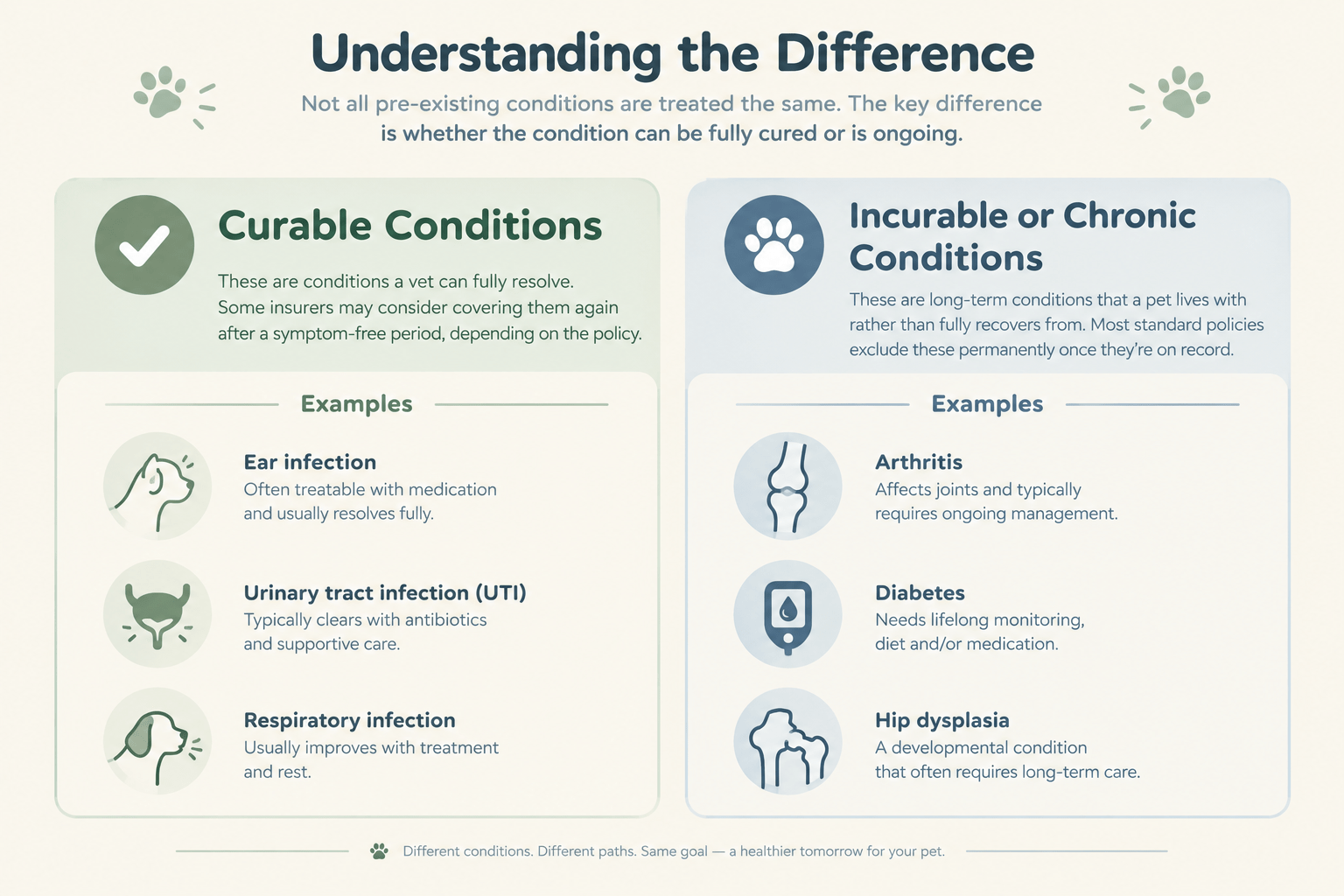
Curable conditions are ones a vet can fully resolve — ear infections, urinary tract infections, respiratory infections, and similar one-time issues. Several insurers will reconsider these for coverage after a defined symptom-free period. ASPCA Pet Health Insurance, for example, covers previously cured conditions again after 180 consecutive symptom-free days, with an exception carved out for knee and ligament issues.
Incurable or chronic conditions — arthritis, diabetes, hip dysplasia, ongoing allergies, cancer — are conditions a pet lives with rather than fully recovers from. Most standard policies exclude these permanently once they’re on record. AKC Pet Insurance is a notable exception: its policy states it covers both curable and incurable pre-existing conditions after 365 days of continuous coverage, with certain conditions like intervertebral disc disease and cruciate ligament disease eligible after 180 days instead. Coverage isn’t available in every state, so this varies by location.
Pet Care Tip: When you’re comparing policies, ask specifically how each one handles incurable conditions — not just curable ones. Most marketing materials focus on the more common curable case.
A Self-Check: Is Your Pet’s Situation Likely to Be Treated as Pre-Existing?
Before assuming the worst, walk through these questions:
- Did the symptom appear before your policy’s start date, or during the waiting period? If yes, it’s likely to be classified as pre-existing regardless of when it was formally diagnosed.
- Is it documented anywhere in vet records, even briefly? An offhand note counts, not just a formal diagnosis.
- Has it been fully resolved and symptom-free for the insurer’s specified window? If it’s curable and you can show a clean stretch, it may become insurable again.
- Is it a condition your pet will likely manage long-term rather than recover from? If so, expect it to stay excluded under most standard policies.
Pet Care Tip: Keep your own simple log — condition, first noted date, and any symptom-free stretches — separate from what’s in the vet’s file. It’s useful both for your own tracking and if you ever need to demonstrate a resolved condition.
How Pet Insurance Companies Actually Verify Pre-Existing Status
Insurers typically request your pet’s full veterinary history when you apply or when you file a claim, rather than taking your word for a clean bill of health. They compare the date a symptom first appears in those records against your policy’s effective date and waiting period. Some insurers review this upfront during enrollment; others only pull records when a claim is filed, which is why a policy can look fully approved at signup and still result in a denial
Why “Managed” Isn’t the Same as “Cured”
This is a common source of frustration. A condition that’s controlled with ongoing medication or care isn’t the same, from an insurer’s perspective, as one that’s actually resolved. Trupanion’s own guidance illustrates this with an allergy example: a dog diagnosed with allergies before getting a policy remains excluded for that condition even if years pass without symptoms, because the underlying diagnosis is still on record. The absence of flare-ups doesn’t erase the diagnosis.
The practical takeaway: if your pet’s condition requires ongoing management rather than a clean resolution, don’t expect a symptom-free stretch alone to reset its status with most insurers.
Pet Care Tip: If you’re unsure whether your pet’s condition would be considered “cured” versus “managed,” ask the insurer directly, in writing, before you rely on a symptom-free period to reapply for coverage.
Bilateral Exclusions, Explained Simply
A “bilateral exclusion” trips up a lot of pet owners. If your pet had a joint or ligament issue on one side of the body before enrollment, many policies will exclude that same type of condition on the opposite side too — even though the other leg has never actually been injured. A torn ligament in the left knee, for instance, can mean the right knee’s future ligament issues are excluded as well, on the reasoning that pets prone to one-sided joint problems are often prone to the same issue on the other side.
It’s worth asking any insurer directly whether they apply bilateral exclusions and to which conditions, since this isn’t always obvious from marketing pages.
If a Claim Is Denied for This Reason: Appeal Steps
A denial isn’t automatically the end of the conversation. A typical appeal process looks like this:
- Read the denial letter carefully. Identify exactly which policy provision was cited, the appeal deadline, and any documentation the insurer is asking for.
- Gather your supporting documentation. Complete vet records, invoices, your policy certificate, any pre-enrollment exam records, and a clear timeline of symptoms.
- Write a formal appeal. Address the specific reason for denial directly, reference the relevant policy language, and attach your documentation clearly.
- Submit before the deadline. Most insurers specify a window, commonly 30 to 60 days, and many accept appeals through an online portal or certified mail.
- Follow up. Check in periodically, keep a record of who you spoke with and when, and ask for a supervisor if the process stalls.
Pet Care Tip: Appeals tend to succeed when they address the exact reason for denial with specific evidence — a general complaint that “this isn’t fair” is far less effective than pointing to a dated vet record that contradicts the insurer’s timeline.
Alternatives When a Condition Truly Can’t Be Insured
If a condition is permanently excluded, insurance isn’t the only option for managing the cost:
- Veterinary financing programs (like CareCredit) let you spread out treatment costs over time.
- Wellness or membership plans through some vet practices cover routine and ongoing care outside traditional insurance.
- Breed- or condition-specific charitable funds and grants exist for certain chronic conditions — a quick search or a conversation with your vet’s office can surface options relevant to your pet’s specific diagnosis.
- A dedicated savings fund for your pet’s ongoing care, separate from general savings, can help absorb predictable recurring costs even without insurance.
Common Mistakes to Avoid
- Assuming an undiagnosed symptom doesn’t count. It often does, if it’s noted anywhere in the records.
- Not requesting full vet records before switching insurers. You want to know what’s on file before an insurer reviews it.
- Confusing “managed with treatment” for “cured.” Ongoing management doesn’t reset a condition’s pre-existing status with most insurers.
- Not confirming the exact symptom-free window required. These vary by insurer and by condition — don’t assume a generic figure applies to your policy.
- Giving up after a denial without requesting the reason in writing or appealing. Many denials are appealable with the right documentation.
Editor’s Insights
- Ask any insurer directly how they define “cured” versus “managed” before you count on a symptom-free window resetting coverage.
- If you’re adopting a pet with limited medical history, treat any documented symptom — however minor — as potentially relevant to future coverage.
- Compare how each insurer handles incurable conditions specifically, not just their curable-condition policy, since this is where coverage differs most.
- Keep every piece of correspondence with an insurer in writing, especially around denials and appeals.

Special Case: Adopted or Rescue Pets
If you adopted a pet with an unknown or incomplete medical history, there’s often no clean record to check against. Ask the shelter or rescue directly what medical records they do have, even partial ones, before applying for insurance. Enrolling as soon as possible after adoption — before any new symptoms have a chance to appear — is the most direct way to limit how much falls into “pre-existing” territory for a pet whose history you can’t fully verify.
Which Situation Applies to You?
- Did a symptom appear before your policy started or during the waiting period, even if undiagnosed at the time? → Likely to be treated as pre-existing.
- Was it fully resolved and symptom-free for the insurer’s specified window? → May become insurable again if it’s a curable condition.
- Is it a condition your pet is expected to manage long-term? → Unlikely to be covered by a standard policy, regardless of symptom-free stretches.
How Insurers Typically Treat Different Condition Types
|
Condition type |
Example |
Typical treatment |
|
Curable, resolved |
UTI, ear infection, respiratory infection |
May become insurable again after a symptom-free window — commonly around 180 days, though this varies by insurer |
|
Curable, recent/unresolved |
An injury still healing |
Excluded until it’s documented as fully resolved |
|
Incurable or chronic |
Arthritis, diabetes, ongoing allergies |
Generally excluded permanently under most standard policies; a small number of insurers offer coverage after an extended waiting period — confirm current terms directly |
|
Bilateral |
A ligament issue in one leg |
The opposite side may be excluded too, even without a prior injury there |
Checklists
Before You Apply
- Request your pet’s complete veterinary history
- Note any symptoms in the records, even minor or undiagnosed ones
- Ask the insurer directly how they define and verify “pre-existing” and “cured”
- Confirm the waiting period separately from any pre-existing exclusions
If Your Claim Is Denied
- Request the specific denial reason in writing
- Gather all relevant vet documentation and a symptom timeline
- Confirm the appeal deadline and submission method
- Keep a written record of every follow-up conversation
Frequently Asked Questions
Can I get pet insurance if my pet already has a health condition?
Yes. A pre-existing condition excludes coverage for that specific issue, not for insurance overall — your pet can still be covered for new, unrelated illnesses or injuries.
Does an undiagnosed symptom count as pre-existing?
Often, yes. If a symptom appears anywhere in your pet’s vet records before your policy started, an insurer can treat it as pre-existing even without a formal diagnosis at the time.
How long until a curable condition can be covered again?
It varies by insurer and condition. Some use a 180-day symptom-free window; others require longer. Confirm the specific term with any insurer you’re considering.
What’s the difference between a waiting period and a pre-existing exclusion?
A waiting period is a set time after enrollment before any claims are accepted. A pre-existing exclusion is separate — it applies to conditions that showed symptoms before the policy started or during that waiting period, and can last for the life of the policy for chronic conditions.
Why doesn’t a symptom-free period always mean my pet’s condition is “cured”?
Because insurers distinguish between a condition that’s fully resolved and one that’s simply being managed without flare-ups. A managed condition can still be classified as pre-existing even after a long quiet stretch.
What is a bilateral exclusion?
It’s when an insurer excludes a condition on one side of the body because a related issue was already documented on the other side — common with joint and ligament conditions.
Can I appeal a denied claim for a pre-existing condition?
Yes, most insurers have a formal appeal process. Success generally depends on addressing the specific reason for denial with clear supporting documentation.
Are there alternatives if my pet’s condition can’t be insured at all?
Yes — veterinary financing programs, wellness or membership plans, condition-specific charitable grants, and a dedicated savings fund are all options worth exploring.
Related Reading
- Adopting a Dog: A Complete Adjustment Checklist
- How to Potty Train an Older Rescue Dog: A Week-by-Week Guide
- Senior Dog Care Basics: What Changes as Your Dog Ages
- Understanding Your Dog’s Body Language and Anxiety Signals
-
Sources & References
- ASPCA Pet Health Insurance, “Pet Insurance and Pre-existing Conditions”
- AKC Pet Insurance, “Pre-Existing Conditions Coverage for Pets”
- Trupanion, “Does Trupanion cover pre-existing conditions?”
- Spot Pet Insurance, “Pre-Existing Conditions in Pet Insurance: What You Should Know”
- State Farm, “Does Pet Insurance Help Cover Pre-existing Conditions?”
- BestMoney, “How to Appeal a Denied Pet Insurance Claim”
Written and reviewed by the Pets Store Home editorial team. This article is for general education only and is not financial or insurance advice. Policy terms, waiting periods, and coverage details vary by provider and change over time — confirm current details directly with any insurer before purchasing a policy.
Last reviewed: September 2026
Where to Go From Here
Understanding the curable-versus-incurable split, and knowing that an undiagnosed symptom can still count against you, puts you in a much stronger position than most pet owners walking into a pet insurance application or a claims conversation. If you’ve recently adopted a pet with limited medical history, our guide to adjusting after adoption covers what else to expect in those first few months, from routines to trust-building — the same period when getting insurance sorted out matters most.
[…] Which foreign pets are legal in Washington State? […]