
Written by the Pets Store Home Team — pet care writers and researchers focused on practical, well-sourced buying guides for prospective pet owners.
Quick answer: Rare dog breeds are breeds with very small global populations, often numbering in the low thousands or even hundreds. Standouts include the Norwegian Lundehund (a six-toed puffin hunter), the Azawakh (a West African sighthound), the hairless Xoloitzcuintli, and the split-nosed Catalburun, which may have fewer than 200 purebreds left worldwide. Most became rare through geographic isolation, loss of their original working role, or simply never being bred commercially at scale.
Key Takeaways
- Rarity in dog breeds is usually measured by annual kennel club registrations, not by health or quality.
- The Norwegian Lundehund has six fully functional toes per foot and a uniquely flexible neck and shoulders, adaptations for climbing sea cliffs to hunt puffins.
- Some rare breeds, like the Catalburun, have fewer than 200 purebreds remaining worldwide.
- Owning a rare breed usually means longer waitlists, higher prices, and fewer local vets familiar with breed-specific health issues.
- The AKC recognized three new breeds in January 2026: the Russian Tsvetnaya Bolonka, the Basset Fauve de Bretagne, and the Teddy Roosevelt Terrier.
Why Trust This Guide
This guide draws on current AKC breed registration data, veterinary and breed-club sources on rare and endangered dog breeds, and 2026 reporting on newly recognized breeds. Population estimates for rare breeds shift year to year and vary by source, so we’ve noted them as approximate ranges rather than precise counts.
What Makes a Dog Breed “Rare”?
Rare dog breeds are typically defined by how few of them exist relative to popular breeds, most often measured through annual registration numbers with kennel clubs like the American Kennel Club. A breed can become rare for several different reasons, and understanding which one applies often explains a lot about what owning that breed is actually like.
Some breeds are rare because they were developed for a narrow, specific purpose that’s largely disappeared. Others come from small geographic regions and were never bred widely outside their homeland. Still others simply never caught on commercially, even though they’ve existed for centuries. None of these reasons have anything to do with the quality or health of the breed itself. Rarity is about population size and popularity, not merit.
The Norwegian Lundehund: Built to Hunt Puffins
The Norwegian Lundehund is one of the most physically unusual dog breeds in existence, and its rarity is tied directly to the job it was built for. Bred in Norway to climb steep, narrow sea cliffs and retrieve puffins from their burrows, the Lundehund evolved a set of adaptations found in no other breed. It has six fully developed toes on each foot, with two of them positioned like an opposable thumb, giving it extra grip on rock. Its shoulders are flexible enough to let its front legs splay out to the side, its neck can bend backward far enough to touch its spine, and its ears can fold shut to keep out dirt and debris while squeezing through tight burrows.
Once puffin hunting declined as a food source in Norway, the breed’s population collapsed, and a distemper outbreak in the 20th century nearly wiped it out entirely. Today there are an estimated 1,500 to 3,000 Norwegian Lundehunds worldwide, making it one of the rarest breeds recognized by major kennel clubs.
The Azawakh: A Desert Sighthound
The Azawakh comes from the West African Sahara, where nomadic groups such as the Tuareg bred it for hunting game and guarding livestock across open desert terrain. Its lean, athletic build lets it reach high sprint speeds over short distances, similar to other sighthounds like the Greyhound, but its bond with its family is famously intense and its wariness of strangers is far more pronounced. Outside West Africa, the Azawakh remains uncommon, and most Western breeders work from a relatively small founding gene pool, which keeps global numbers low.
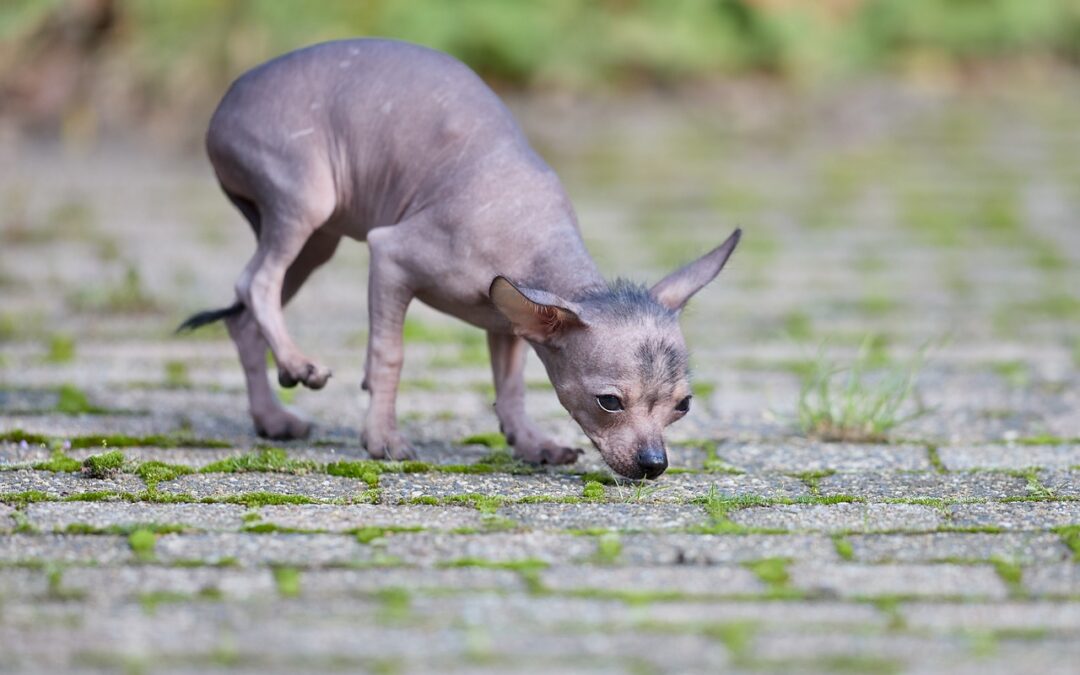
The Xoloitzcuintli: An Ancient Hairless Breed
The Xoloitzcuintli, often shortened to “Xolo,” is one of the oldest documented dog breeds in the Americas, with roots tracing back thousands of years to ancient Mesoamerica. Its most recognizable trait is a completely hairless body, caused by a dominant gene that also affects tooth development, though a coated variety exists within the same breed standard. Despite its long history, the Xolo remained a niche breed outside Mexico for most of its existence and is only slowly gaining wider recognition.
The Catalburun: A Split-Nosed Rarity
Few breeds are rarer than the Catalburun, a Turkish pointing breed best known for a split or “double” nose, where the nostrils are separated by a visible gap rather than forming a single continuous shape. Breeders and owners have long claimed this unusual feature improves scenting ability, though it hasn’t been rigorously studied. What is well documented is the breed’s scarcity: estimates suggest fewer than 200 purebred Catalburuns remain worldwide, nearly all of them in Turkey, making it one of the rarest working dog breeds still in existence.
Other Notably Rare Breeds
Beyond these four, several other breeds regularly appear on rare-breed lists compiled from kennel club registration data. The Sloughi, a smooth-coated North African sighthound, and the Otterhound, a large English hunting breed with a rough double coat and webbed feet originally developed to hunt otters, both consistently rank among the least-registered breeds in the United States. The Mudi, a Hungarian herding breed, is believed to number only a few thousand worldwide. The Peruvian Inca Orchid, a hairless breed with ancient roots in Peru, and the Grand Basset Griffon Vendéen, a French scent hound, round out a list of breeds that remain genuinely uncommon even among dedicated dog enthusiasts.
Newly Recognized Rare Breeds in 2026
The American Kennel Club welcomed three new fully recognized breeds on January 1, 2026: the Russian Tsvetnaya Bolonka, a small companion breed with a curly, colored coat; the Basset Fauve de Bretagne, a compact French scent hound with a wiry, tan-colored coat; and the Teddy Roosevelt Terrier, a small, energetic American terrier bred for versatility on farms. New recognition status typically means very low registration numbers initially, since these breeds are just beginning to build a presence within the mainstream kennel club system.
What Owning a Rare Breed Actually Involves
Choosing a rare breed comes with practical trade-offs that are worth understanding before committing. Waitlists are often measured in months or years rather than weeks, since there may be only a handful of active breeders in an entire country. Prices tend to run higher than for popular breeds, reflecting both scarcity and the cost breeders incur maintaining small, carefully managed gene pools. You may also need to travel significant distances to meet a breeder or pick up a puppy, since rare-breed breeders are thinly spread geographically.
Veterinary care is another consideration. A local vet may have limited or no firsthand experience with a rare breed’s specific health predispositions, which makes it worth asking breed clubs for guidance on finding vets who do, or being prepared to do extra research yourself. Pet insurance can also be more limited for uncommon breeds, since some insurers base premiums on breed-specific claims data that simply doesn’t exist yet for very rare breeds.
Genetic Health in Small Populations
Small population size creates a genuine health consideration that responsible breeders take seriously: a limited gene pool increases the risk of inherited conditions becoming concentrated within a breed over generations. Reputable rare-breed breeders typically participate in international studbooks or breed-preservation programs specifically to manage this risk, sometimes importing dogs from other countries to widen genetic diversity. When researching a rare breed, ask breeders directly about their approach to genetic diversity and any health testing protocols specific to that breed, rather than assuming standard testing panels developed for more common breeds will apply.
Finding a Responsible Rare-Breed Breeder
Because rare breeds have so few breeders to begin with, national and international breed clubs are usually the most reliable starting point, often maintaining lists of vetted breeders and waitlists directly. A responsible breeder of a rare breed should be transparent about the size of the breed’s global population, willing to discuss genetic diversity efforts, and upfront about realistic wait times rather than promising a fast turnaround that would be unusual for the breed. Patience is part of the process: rushing into a purchase from an unfamiliar source to skip a long waitlist is one of the most common ways buyers end up with a poorly bred or even misrepresented dog.
Popular Breeds vs. Rare Breeds: What Changes
If you’re weighing a rare breed against a more established, widely available one, it helps to know what you’re trading off. Popular purebreds and well-established designer crosses typically offer shorter wait times, more predictable pricing, a larger pool of breeders to compare, and vets who are more likely to have direct experience with the breed. For a sense of what that looks like in practice, guides like this one on French Bulldog coat colors and traits and this breakdown of Golden Retriever puppy pricing cover two of the most in-demand, widely available breeds in the US, useful as a point of comparison if a rare breed’s waitlist or cost ends up being a dealbreaker.
Rare Breeds and Preservation Efforts
Because population decline is an ongoing risk rather than a solved problem, many rare breeds now have dedicated preservation organizations working alongside national kennel clubs. These groups track global population estimates, coordinate international breeding exchanges to widen genetic diversity, and in some cases work directly with countries of origin to support local breeding programs. The Norwegian Lundehund Club of America, for instance, has historically coordinated with Norwegian breeders and international studbooks specifically because the breed’s post-distemper population bottleneck left so little genetic diversity to work with domestically.
This preservation work matters for prospective owners too, not just breed historians. A breeder actively involved with a preservation program is generally a stronger sign of long-term commitment to the breed’s health than one operating independently, and these organizations are often the best first stop for anyone seriously considering a rare breed, since they can provide realistic guidance on population trends, waitlist expectations, and which regions have active breeding programs.
Rescue and Adoption: A Less Common Path for Rare Breeds
Adoption is worth mentioning, though it works differently for rare breeds than for popular ones. Because rare breeds have so few individuals in total, breed-specific rescues are uncommon or nonexistent for the rarest breeds, and available dogs are far less predictable in timing than with a popular breed rescue. That said, national breed clubs sometimes maintain informal rehoming networks for dogs whose circumstances change, and it’s worth asking a breed club directly whether any rescue or rehoming resources exist before assuming a breeder is the only path. For breeds with a somewhat larger population, like the Mudi or Otterhound, occasional rescue listings do appear, usually circulated through breed club mailing lists or social media groups rather than mainstream shelter listings.
Is a Rare Breed Right for You?
Rare breeds tend to suit owners who are drawn to a specific breed’s history or working heritage, are comfortable with a long and sometimes uncertain wait, and are willing to do extra legwork on veterinary care and breed research. They’re a less natural fit for anyone who wants a puppy quickly, expects predictable pricing, or wants easy access to a large community of local owners for support and socialization. There’s no wrong answer here, but knowing which category you fall into before you start searching will save considerable frustration.
Bottom Line
Rare dog breeds like the Norwegian Lundehund, Azawakh, Xoloitzcuintli, and Catalburun exist in the hundreds or low thousands worldwide, shaped by geography, lost working roles, or simply never having been bred at commercial scale. None of that makes them lesser dogs, but it does mean longer waitlists, higher costs, and a bigger personal research burden than choosing a widely available breed. Going in with realistic expectations about wait times, genetic diversity, and specialized veterinary care is the difference between a smooth experience and a frustrating one.
FAQ: Rare Dog Breeds
What is the rarest dog breed in the world?
Estimates vary, but breeds like the Catalburun (with an estimated fewer than 200 purebreds worldwide) and the Norwegian Lundehund (roughly 1,500-3,000 worldwide) are consistently cited among the rarest.
Why do some dog breeds become rare?
Common reasons include losing an original working role, coming from a small or isolated geographic region, or simply never being bred at commercial scale outside a small group of enthusiasts.
Are rare dog breeds less healthy than common breeds?
Not inherently, but small populations do carry a higher risk of concentrated inherited conditions, which is why responsible rare-breed breeders often manage genetic diversity through international studbooks or import programs.
How much do rare dog breeds cost?
Costs vary widely by breed, but rare breeds typically cost more than popular ones due to scarcity, and buyers should expect waitlists measured in months or years rather than weeks.
What rare breeds did the AKC recognize most recently?
The AKC fully recognized three new breeds on January 1, 2026: the Russian Tsvetnaya Bolonka, the Basset Fauve de Bretagne, and the Teddy Roosevelt Terrier.
Where can I find a breeder for a rare dog breed?
National and international breed clubs are typically the most reliable starting point, since they often maintain vetted breeder lists and manage waitlists directly.
[…] Which foreign pets are legal in Washington State? […]