
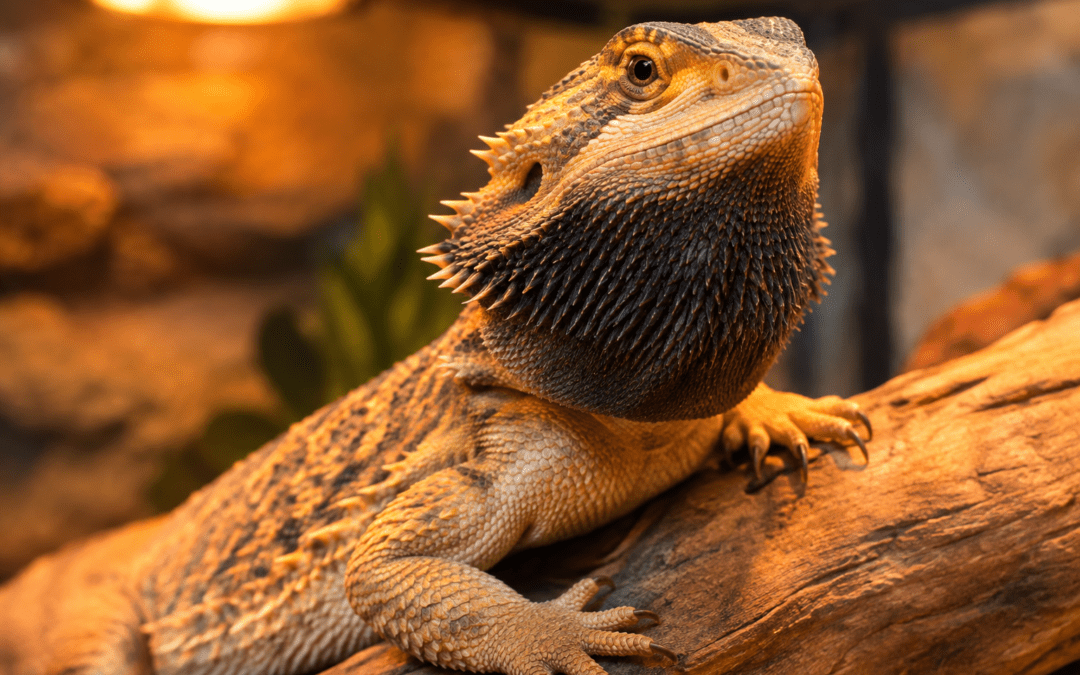
Quick Answer: A stressed bearded dragon usually shows a darkened or fully black beard, glass surfing (pacing and clawing at the enclosure walls), reduced appetite, dulled color, and reduced activity. Most of these signs are mild and resolve once the cause — usually temperature, enclosure size, handling, or a new environment — is corrected within a few days. Signs that don’t improve within 3-5 days, or that come with weight loss, discharge, or labored breathing, need a reptile-experienced veterinarian rather than home troubleshooting.
Signs a Bearded Dragon Is Stressed
Most guides to bearded dragon stress hand you a list of symptoms and stop there. The harder — and more useful — question is what to do with that list: which signs are genuinely urgent, which ones are just a lizard adjusting to a Tuesday, and how you tell true stress apart from brumation or a normal shed, both of which mimic it closely. This guide organizes stress signs by how urgently they matter, maps them to the part of the body they show up in, and separates them from the two conditions owners most often confuse them with.
Key Takeaways
- Stress signs exist on a spectrum — a darkened beard on day one in a new home is different from a black beard that persists for two weeks, and treating every sign as an emergency (or dismissing every sign as nothing) both lead to worse outcomes.
- Stress marks and beard darkening are not always emotional distress; according to VCA Animal Hospitals, they can also reflect temperature regulation, shedding, or normal social signaling.
- Reduced appetite and lethargy are the two symptoms most often confused between stress, brumation (seasonal dormancy), and genuine illness — and the difference matters for how you respond.
- Life stage changes the picture: juveniles pace and explore more than adults as a normal part of development, and gravid females show nesting-related restlessness that isn’t stress in the usual sense.
- Persistent appetite loss, labored or open-mouth breathing, discharge, or weight loss are not stress signs to manage at home — they call for a reptile veterinarian.
Why Bearded Dragons Show Stress Signs at All
A bearded dragon can’t tell you something is wrong, so its body does the talking instead. Visible signs like beard darkening, color changes, and pacing are outward signals of an internal stress response — the same general category of physiological reaction (elevated heart rate, altered hormone levels, changes in immune function) that most vertebrates experience under threat or discomfort.
In reptiles specifically, environmental stress is also linked to disease risk. The Merck Veterinary Manual notes that environmental stress is a contributing factor in septicemia (a serious bloodstream bacterial infection) and other illness in captive reptiles, alongside trauma and parasites. That’s the practical reason stress signs are worth taking seriously rather than waiting out indefinitely — chronic, unresolved stress doesn’t just look unpleasant, it can raise the risk of the animal getting sick.
The Stress Severity Scale: From Normal Adjustment to Emergency
Not every sign on this page means the same thing. A useful way to sort them is by how long they last and what else comes with them.
Mild / normal adjustment — Expected during a home change, a cage rearrange, or the first few days after purchase. Includes brief glass surfing, a temporarily darker beard, or a day of reduced appetite. Often settles within 24-72 hours as the dragon adjusts, though timing varies by individual.
Moderate / needs a fix, not a vet — A sign that persists for several days and points to something correctable: a black beard that doesn’t lift after a week, appetite loss lasting several days without illness signs, or repeated daily glass surfing. This tier calls for troubleshooting temperature, lighting, enclosure size, or handling frequency — covered later in this guide.
Severe / contact a vet — Weight loss, lethargy that doesn’t improve with correct husbandry, or any sign from the next section’s “illness” list can point to genuine illness rather than ordinary stress, and are worth a veterinary evaluation rather than more at-home troubleshooting. VCA Animal Hospitals is direct on this point: any behavioral or physical change from a bearded dragon’s normal baseline is cause for concern and warrants veterinary evaluation,
since several serious diseases (including atadenovirus infection and metabolic bone disease) can present initially with the same appetite loss and lethargy as ordinary stress. A few signs are more urgent than “contact a vet soon” — labored or open-mouth breathing, nasal or mouth discharge, seizures, or a gravid female straining without laying should be treated as same-day emergencies, not something to monitor for a few more days.
Stress Signs by Body Region
Rather than one long list, it helps to know where on the dragon’s body to look.
Beard: Puffing (a normal display, not necessarily distress) and darkening to gray or black are the most recognizable signs. A dark or black beard can signal stress, temperature regulation, or — in males especially — a normal territorial or breeding-season display, so context (does it happen only around other dragons, or constantly and alone?) matters more than the color change by itself.
Body and skin: Overall color dulling, and “stress marks” — darker striped or blotchy patterns most visible on the chin and belly, usually most noticeable in the morning. These marks can appear from cooler-than-ideal temperatures or an unfamiliar environment without reflecting deep emotional distress, so they’re a prompt to check husbandry rather than an alarm on their own.
Posture and limbs: Flattening the body against the substrate (“pancaking”) to absorb more heat or appear less visible, and arm waving — a slow, deliberate lifting and lowering of one front leg. VCA Animal Hospitals notes arm waving is generally read as a submission signal toward a dominant animal or reflection, not exclusively a stress behavior.
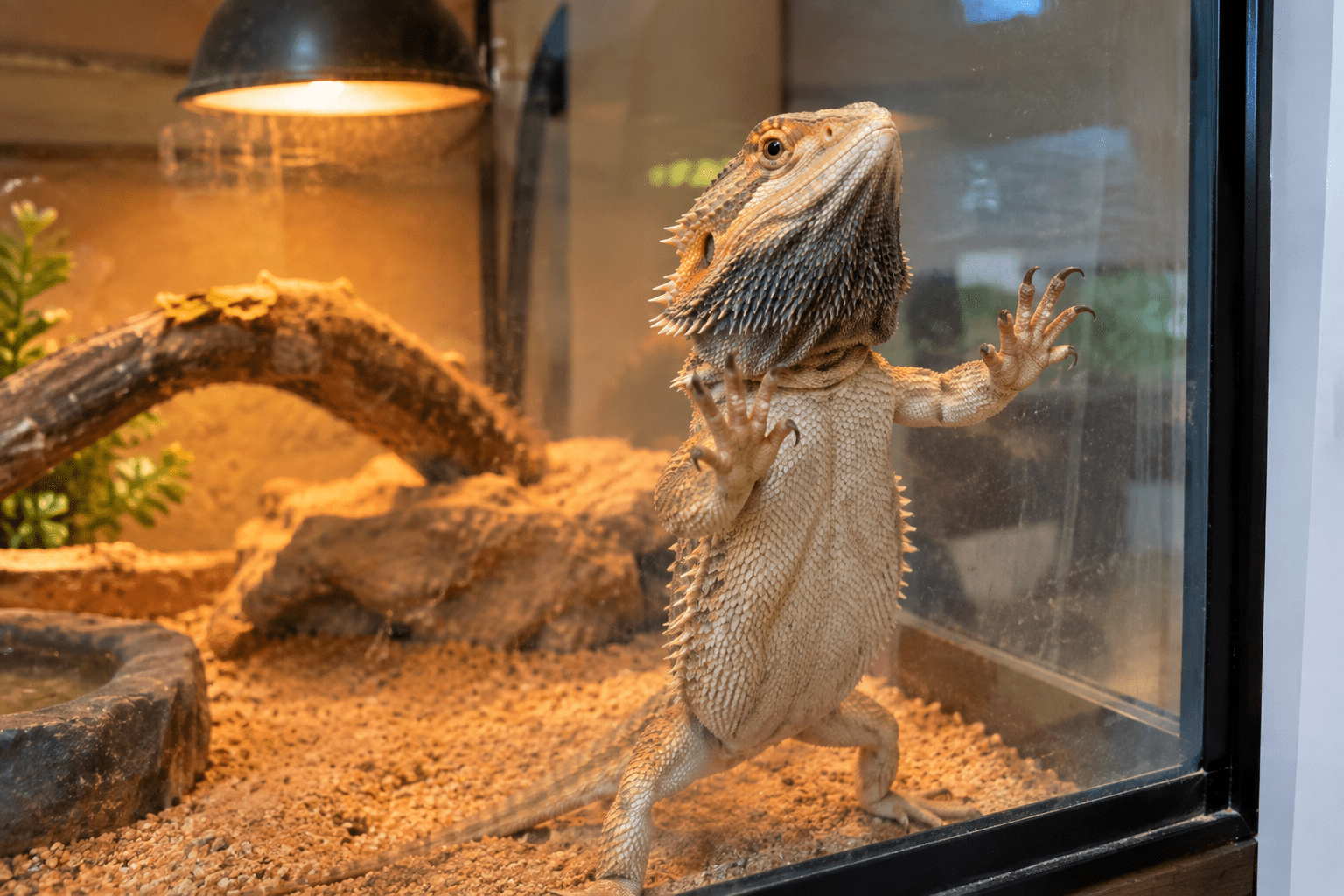
Movement: Glass surfing — repeatedly pushing against and pacing along the enclosure walls — and, less commonly, clawing or head-pressing at the glass. Reduced movement and lethargy are the opposite-direction version of the same problem: a normally active dragon that goes quiet.
Eyes and mouth: Open-mouth “gaping” for thermoregulation is normal in a healthy, active dragon. Open-mouth breathing that looks labored, combined with discharge from the eyes, nose, or mouth, is not a stress sign — per the Merck Veterinary Manual, these are hallmark signs of respiratory infection and need same-week veterinary attention.
Appetite and behavior: Refusing food, hiding more than usual, and increased defensiveness or biting when previously calm.
Is It Stress, Brumation, or Shedding? The Confusion Most Owners Run Into
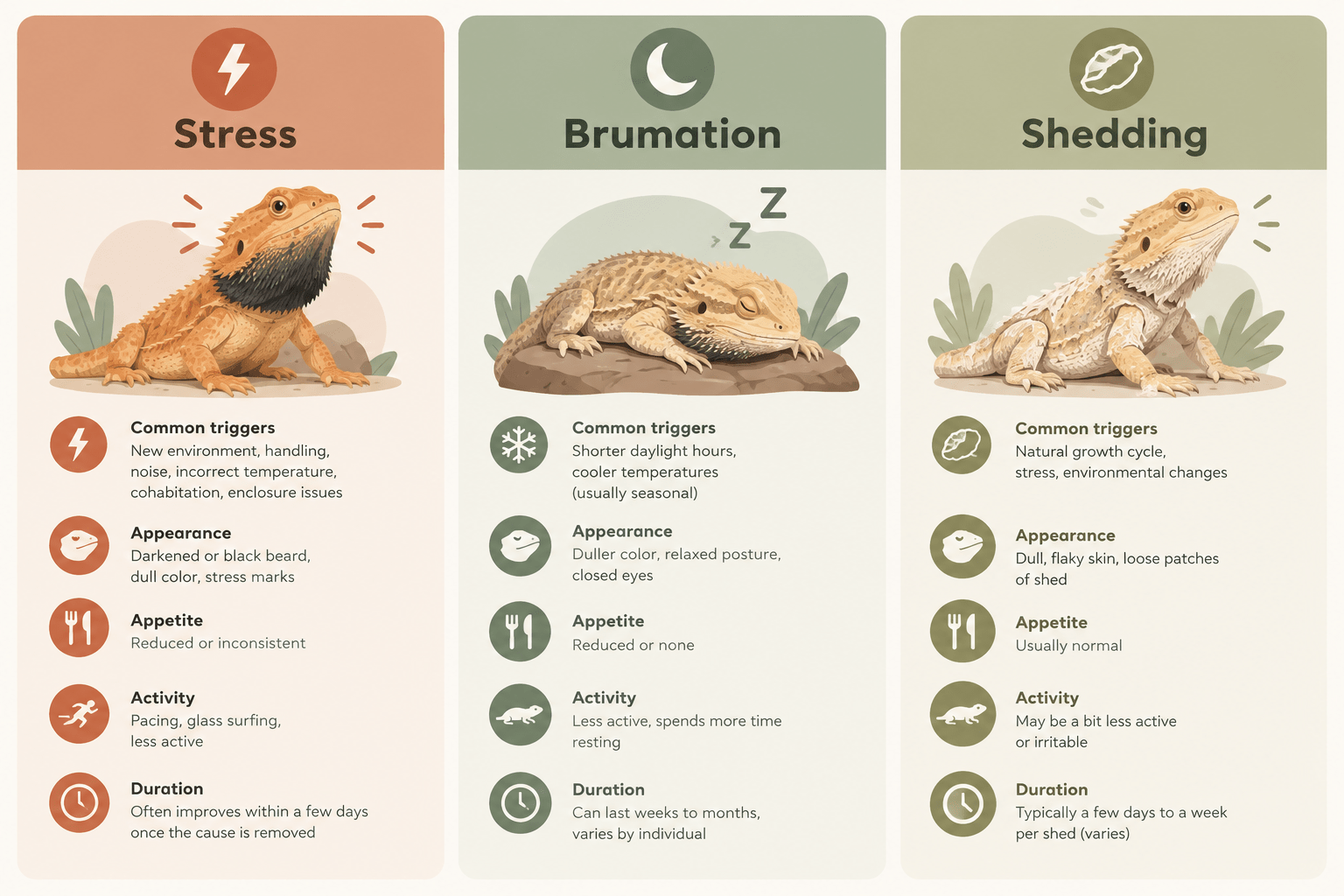
Three very different conditions — stress, brumation, and shedding — can all produce the same surface picture: reduced appetite, lower activity, and darker coloring. Telling them apart changes what you should actually do.
| Category | Stress | Brumation | Shedding |\n| — | — | — | — |\n| Typical trigger | New environment, handling, cohabitation, incorrect husbandry | Cooler temperatures, shorter daylight, usually seasonal | Natural growth/skin cycle |\n| Appetite | Reduced, tied to the trigger | Reduced or absent | Mildly reduced, brief |\n| Activity | Glass surfing/pacing, or lethargy | Sluggish, may still move and drink occasionally |
Roughly normal to slightly reduced |\n| Color | Darkened beard or stress marks | Darker overall coloring | Dulled, patchy just before the shed |\n| Typical duration | Improves once the trigger is fixed | Weeks to a few months | Days |\n| Worth a vet check when… | Signs persist despite husbandry fixes | Happens outside a cool, seasonal context, or continues beyond a couple of weeks | Doesn’t resolve once the shed completes |\n
Brumation is a bearded dragon’s natural seasonal slowdown, not true hibernation — VCA Animal Hospitals notes dragons may still move around occasionally and seek water during it. It’s typically triggered by cooler ambient temperatures and shorter daylight, most often in adults over a year old, and can last anywhere from a couple of weeks to a few months (see our bearded dragon brumation guide for a fuller seasonal timeline).
Ambient temperature is a helpful clue here, not a strict diagnostic rule: VCA Animal Hospitals notes that natural brumation is closely tied to genuinely cool conditions, so a dragon that goes off food and gets sluggish while its enclosure and room stay at a normal, comfortably warm temperature is less likely to be brumating. Temperature alone doesn’t confirm or rule out illness, though — any appetite loss that’s prolonged or doesn’t fit the seasonal pattern is worth discussing with a reptile veterinarian regardless of room temperature.
Shedding causes a temporary dulling of skin color and sometimes mild irritability or reduced appetite in the day or two before old skin lifts, but it doesn’t typically cause the sustained black-beard or glass-surfing pattern seen with stress, and it resolves as soon as the shed completes.
Stress, by contrast, is usually tied to an identifiable trigger — a recent move, a new enclosure-mate, incorrect temperatures, overhandling — and tends to improve once that trigger is addressed, rather than resolving on a seasonal or shedding timeline.
If appetite loss and lethargy last beyond what fits any of these patterns, or show up alongside weight loss, respiratory signs, or discharge, treat it as a possible illness rather than any of the above.
What Actually Causes Bearded Dragon Stress
Enclosure and environment: Undersized housing is a common and correctable cause — general veterinary husbandry guidance recommends an enclosure at least three times the dragon’s total body length, with two hiding spots (one warm, one cool) and a defined basking area (see our full bearded dragon enclosure size and setup guide for exact dimensions and setup).
Incorrect temperature gradients and inadequate UVB lighting are close behind; a dragon that can’t reach its preferred basking range or properly regulate day/night cycles is under chronic low-grade stress even without an obvious trigger.
Handling: Both too much handling and handling done incorrectly (grabbing rather than scooping, handling right after feeding, or handling a dragon that’s actively trying to retreat) can push a normally docile dragon into defensive behavior.
Social and territorial factors: Seeing its own reflection, or the presence of another dragon, can trigger territorial beard-darkening and aggression, since bearded dragons are naturally solitary-leaning animals outside of breeding.
Life-stage and hormonal factors: Breeding-season behavior in males and nesting-related restlessness in gravid females (covered next) are hormonally driven and distinct from ordinary environmental stress.
Illness and pain: Underlying disease — respiratory infection, parasites, or metabolic bone disease — produces stress-like signs as a symptom rather than a cause, which is exactly why signs that don’t resolve with husbandry fixes need veterinary evaluation rather than more troubleshooting at home.
Age Matters: Juveniles, Adults, and Gravid Females
A one-size-fits-all reading of stress signs misses real differences by life stage.
Juveniles are naturally more active and exploratory than adults — some pacing and investigating of enclosure boundaries is a normal part of a young dragon’s development rather than a reliable stress signal on its own. Juveniles also need more frequent calcium supplementation and faster-growing bodies mean husbandry mistakes show up faster, so persistent stress signs in a young dragon are worth correcting quickly.
Adults have a more stable behavioral baseline, which actually makes deviations more meaningful — a normally calm adult dragon that suddenly starts glass surfing or refusing food is a clearer signal than the same behavior in a juvenile.
Gravid (egg-carrying) females commonly show increased digging, restlessness, and reduced appetite in the days before laying eggs, which can look like stress or even illness to an owner unfamiliar with the pattern. This is a normal reproductive behavior tied to nest-site seeking, not a welfare problem by itself — though a female showing prolonged straining without successfully laying eggs (a condition called egg binding, or dystocia) does need prompt veterinary care.
Multi-Dragon Households: Cohabitation Stress
Veterinary guidance on housing multiple bearded dragons together is genuinely mixed. VCA Animal Hospitals notes that dragons can share a cage if space is sufficient and they get along, with the caveat that only one adult male should ever be present since adult males will fight.
The Merck Veterinary Manual takes a more cautious general position on reptile husbandry broadly, advising that ideally only a single species — and by extension, often a single individual — be kept per enclosure to minimize competition and stress. In practice, most cohabitation problems show up as one dragon consistently dominating the basking spot or food, tail-nipping, or one animal visibly losing condition compared to the other.
If you notice these signs, separate the dragons into individual enclosures rather than waiting to see if it resolves. Monitor each dragon’s appetite, weight, and basking behavior independently afterward — the subordinate animal often improves in activity and appetite once housed alone, which can help confirm that cohabitation was a factor. Recovery time varies by individual, though, and any dragon that doesn’t noticeably improve after separation should still be evaluated by a vet rather than assumed to just need more time.
Transport and Vet-Visit Stress
Car travel and unfamiliar environments are a common but under-discussed stress trigger. A secure, appropriately sized carrier with substrate the dragon is used to, a stable temperature (a towel-wrapped heat pack in cold weather, never direct sunlight through a car window in warm weather), and a short, direct trip all reduce the load.
Some glass surfing, darkened coloring, or reduced appetite in the 24-48 hours after a car trip or a vet visit is common and typically resolves on its own; it’s the same “new environment” stress response covered earlier, just condensed into a shorter window. If appetite hasn’t returned and activity hasn’t normalized within two to three days of returning home, treat it the same as any other persistent stress sign.
How to Calm a Stressed Bearded Dragon
Start with the environment, since incorrect temperature, humidity, or lighting is the most common underlying cause. Verify basking and cool-zone temperatures with an actual thermometer rather than judging by feel, confirm the UVB bulb is within the manufacturer’s recommended distance from the basking spot and hasn’t exceeded its replacement window, and check that the enclosure meets the minimum size and hide-spot guidance covered earlier. If a reflection or a cage-mate is the likely trigger, add a background to the glass or separate the dragons.
Reduce handling to short, calm sessions during a stress episode rather than skipping it entirely — brief, gentle interaction can help some dragons acclimate, while lengthy or forceful handling of an already-stressed animal usually backfires (our bearded dragon supliments tips for beginners guide covers proper technique). Offer food as usual rather than trying to entice with unusual treats (see our bearded dragon diet and feeding guide for feeding ratios by age), and make sure fresh water is available daily, since dehydration can compound stress-related appetite loss.
Tracking Whether It’s Working
Rather than relying on a general impression that your dragon “seems better,” track a few concrete markers day to day: how quickly it returns to basking after a disturbance, whether daily food offered is being eaten (and how much), and how often glass surfing happens per day. A simple daily log for a week is enough to show a real trend — steadily shortening recovery times and returning appetite are good signs that your fix is working, while flat or worsening numbers after several days of correct husbandry are a signal to involve a vet rather than keep adjusting on your own.
When to Contact an Exotic Veterinarian
How quickly to act depends on which signs you’re seeing, per Merck Veterinary Manual and VCA Animal Hospitals guidance on reptile illness.
Same-day emergency — don’t wait:
- Open-mouth breathing that looks labored, wheezing, or nasal/mouth discharge or bubbles
- Seizures or loss of muscle control
- A gravid female straining to lay eggs without success
- Sudden, significant weight loss
Contact a vet soon (within a few days):
- Appetite loss that persists after temperature, lighting, and enclosure size are confirmed correct
- Lethargy that doesn’t improve once husbandry is corrected
- Swelling, unusual skin spots, or incomplete shedding with skin discoloration
- Any sudden behavior change in a previously stable adult dragon
Common Mistakes Owners Make
Assuming every stress mark or darkened beard means serious emotional distress, when it’s often a normal temperature-regulation or social response that resolves on its own. Confusing brumation with illness (or the reverse) by not checking ambient temperature first. Increasing handling to “comfort” a stressed dragon, which frequently prolongs the stress response instead of shortening it. Waiting weeks on a cohabitation problem hoping the dragons “work it out,” rather than separating early. And treating appetite loss as automatically minor, when it’s one of the symptoms most likely to also indicate genuine illness.
Practical Examples
A newly purchased juvenile paces and glass-surfs for its first three days home, with a beard that darkens on and off. Temperatures check out correctly and the behavior fades by day four — normal adjustment, no action needed beyond patience.
An adult dragon that has eaten well for two years suddenly refuses food for over a week in mid-winter, with the room running around 65°F. Given VCA’s brumation guidance, this pattern (cool ambient temperature plus seasonal timing) points toward brumation rather than stress or illness, though a baseline vet check is still reasonable for an older dragon before assuming it.
Two adult dragons housed together for a month; one has stopped basking and lost visible body condition while the other looks fine. This is a cohabitation-stress pattern, not a shared-cause issue — separate immediately and monitor the subordinate dragon’s recovery.
FAQ
What does a black beard mean on a bearded dragon?
It can indicate stress, but also temperature regulation, shedding, or a normal territorial/breeding display in males — context (does it happen constantly, or around triggers like other dragons) matters more than the color alone.
Are stress marks permanent?
No. According to veterinary sources, they’re typically temporary and fade once the underlying temperature or environmental factor is corrected.
How long does it take a bearded dragon to adjust to a new home?
It varies by individual, but many dragons show reduced stress signs within a few days to about a week when husbandry (temperature, UVB, enclosure size) is correct from the start. Some take longer, and signs that persist beyond two weeks are worth discussing with a vet.
Can stress make a bearded dragon sick?
Indirectly, yes — the Merck Veterinary Manual notes environmental stress is a contributing factor in serious infections like septicemia in reptiles, which is why prolonged, unresolved stress shouldn’t be ignored.
Is glass surfing always a bad sign?
Brief glass surfing during a home change or enclosure rearrange is common and usually temporary. Persistent daily glass surfing after the dragon has had time to settle points to an ongoing issue — usually enclosure size, temperature, or a reflection — that needs addressing.
How do I know if it’s brumation and not stress or illness?
Ambient temperature is a useful clue, not a hard rule. Per VCA Animal Hospitals, natural brumation is closely tied to cooler conditions, so it’s less common in a home kept at a normal, comfortably warm temperature. But temperature alone can’t confirm or rule out illness — if your dragon is lethargic and off food, it’s worth a vet check regardless of room temperature, especially if it continues beyond a week or two.
Should I handle my bearded dragon more or less if it seems stressed?
Less, and more gently — short, calm sessions rather than none at all, avoiding lengthy or forceful handling until the underlying cause is resolved.
Can two bearded dragons live together without stress?
It’s possible with enough space and no more than one adult male, but veterinary opinion on cohabitation is mixed, and most owners see fewer stress-related problems housing dragons individually.
Written by the Pets Store Home Team — pet care writers and researchers who base exotic-pet guides on veterinary and academic sources rather than other blogs; every medical or husbandry claim above is cross-checked against a cited source (Merck Veterinary Manual, VCA Animal Hospitals, or a university veterinary teaching hospital) rather than stated from general knowledge. Last reviewed: September 2026
Conclusion
Most bearded dragon stress signs aren’t emergencies — they’re information. A darkened beard on day one in a new enclosure and a black beard that persists for two weeks are not the same event, even though they look identical in a photo. Sort what you’re seeing by how long it’s lasted and what else comes with it, rule out brumation and shedding before assuming stress, and reach for a reptile veterinarian only when signs are severe or simply won’t resolve with correct husbandry. That framework — not a longer list of symptoms — is what actually tells you what to do next.
Could Diet Be Part of the Problem?
Stress in bearded dragons isn’t always about enclosure setup or handling — diet imbalances can contribute too, particularly a diet too heavy in sugary treats and too light on proper greens. Our guide to what fruits bearded dragons can eat explains how to keep treats in proportion so they support rather than undermine your dragon’s overall health.
Diet Trouble Can Look Like Stress — Rule It Out First
Before assuming a stressed dragon is purely a behavioral or environmental issue, it’s worth double-checking the diet. Our guide on what fruits bearded dragons can safely eat covers feeding ratios and common mistakes that can leave a dragon looking off even when the enclosure setup is fine.
[…] Which foreign pets are legal in Washington State? […]