

Signs your cat is in pain but hiding it
The signs your cat is in pain but hiding it are easy to miss, because cats are wired to mask discomfort. This guide walks through the subtle signs that actually show up when a cat is hurting, how to use a real, vet-developed facial scoring tool to check for yourself in just a few minutes, and how to judge whether what you’re seeing can wait for a routine appointment or needs care today.
Quick Answer
Cats hide pain instinctively, so look for subtle changes rather than obvious distress: reduced grooming, hiding more than usual, reluctance to jump, a hunched posture, appetite or litter box changes, and a tense, squinted facial expression. The Feline Grimace Scale — checking ear position, eye squint, and muzzle tension — can help you gauge what you’re seeing. When in doubt, a vet visit is the safest next step.
Key Takeaways
- Cats evolved to hide pain, so the absence of obvious distress doesn’t mean the absence of pain.
- The Feline Grimace Scale is a free, vet-developed tool you can learn to use at home — but a facial score is a screening aid, not a stand-alone diagnosis.
- Sudden, severe, or rapidly worsening symptoms deserve prompt veterinary attention. Some emergencies can also develop gradually, so judge urgency by the signs themselves, not by onset alone.
- A behavior change can point to pain or to a conflict with another cat, and the two can also happen at the same time, so ruling one in doesn’t rule the other out.
In this article: Why Cats Hide Pain · The Core Signs (and Why They Happen) · Using the Feline Grimace Scale · How Urgent Is This? · Why Purring Isn’t Always Contentment · Senior Cats · Pain or Conflict? · The Medication Danger · Preparing for Your Vet Visit · FAQ
Why Cats Hide Pain in the First Place
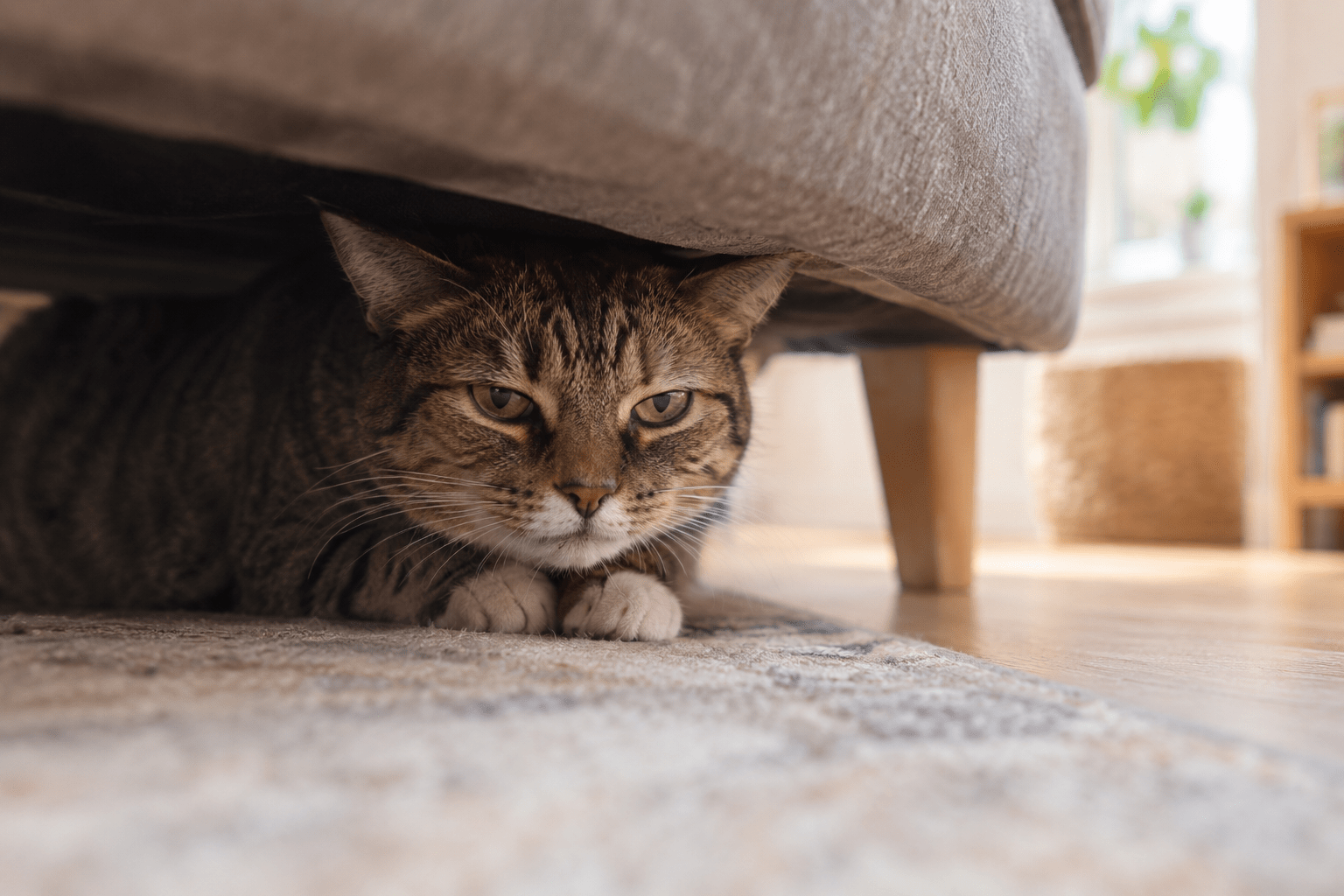
In the wild, an animal that visibly limps or cries out signals weakness to predators and rivals, and cats carry that instinct even though there’s no predator waiting outside a living room window. Showing pain openly was a liability for their ancestors, so the trait that kept a wild cat alive is the same one that makes a housecat’s pain so easy for an owner to miss.
That means the signs worth watching for are rarely dramatic. They’re small shifts in routine and posture that only stand out if you know to look for them — which is the entire point of this guide.
Pet Care Tip: Take a short “baseline” video of your cat moving around normally while healthy. Subtle changes in gait or posture are much easier to spot against a real comparison than against memory alone.
Recognizing the Signs Your Cat Is in Pain But Hiding It
Most lists of cat pain signs just name the behavior. Understanding why it happens makes it easier to recognize and take seriously:
- Reduced or excessive grooming. Grooming requires twisting into positions that are genuinely uncomfortable with joint or abdominal pain, so a cat may stop grooming areas that are hard to reach — or over-groom one specific spot that hurts.
- Hunched or stiff posture. A tucked, tense stance often means a cat is guarding a painful area, the same way a person favors a sore back.
- Reluctance to jump or climb. Landing puts real force through joints, so a cat with sore hips, knees, or a spine may simply stop attempting it rather than jump awkwardly.
- Appetite changes. Dental pain, nausea, or abdominal discomfort can all make eating unpleasant, even when a cat is otherwise hungry.
- Litter box avoidance. Getting in and out of a box, or the squatting posture itself, can be painful with joint or urinary issues — a cat may start eliminating just outside the box rather than fully inside it. (If the discomfort seems localized around the tail or rear rather than the litter box habit itself, our guide to cat pain after glands expressed covers that specific pattern.)
- Vocalization changes. New or increased growling, hissing, or crying — especially when touched in a specific spot — is a direct signal of discomfort.
- Irritability when touched or picked up. A previously affectionate cat pulling away or swatting during normal handling is worth noting, not dismissing as “a mood.”
- Changes in eye appearance. Squinting or a fixed, distant stare can reflect discomfort the same way a wincing expression does in a person.
Pet Care Tip: Notice which specific behavior changed, not just that something changed. A cat avoiding jumping but still eating normally points somewhere different than a cat eating less but moving normally.
How to Use the Feline Grimace Scale at Home
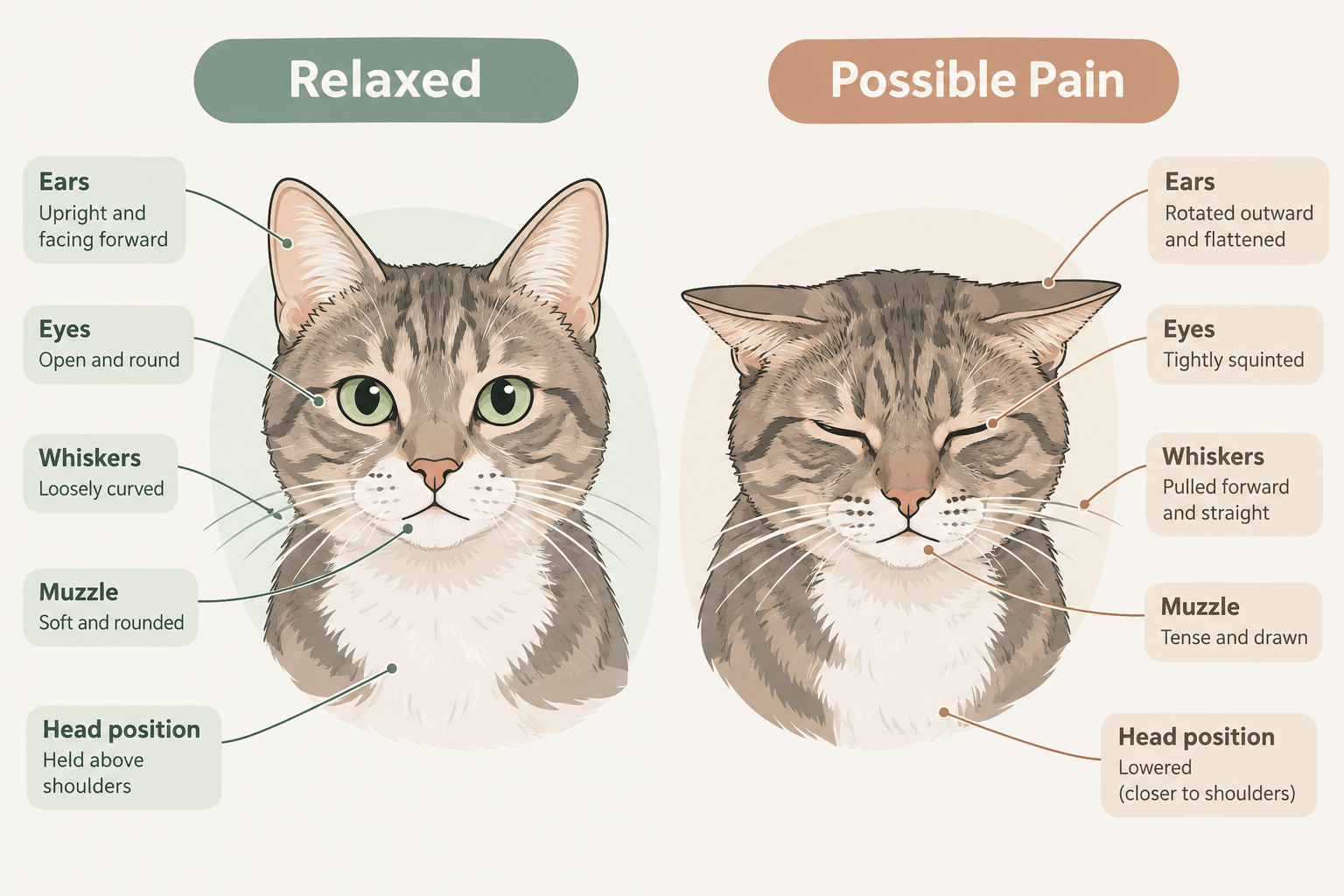
The Feline Grimace Scale is a real pain-assessment tool developed and validated by researchers at the University of Montreal, published in a peer-reviewed study, and used by veterinary professionals — and it’s free for any cat owner to learn. It scores five features of a cat’s face, each from 0 (no pain) to 2 (likely significant pain):
- Ear position: forward and upright (0) vs. rotated outward and pulled apart (2).
- Eye tightening: open and round (0) vs. fully closed or tightly squinted (2).
- Muzzle tension: relaxed and rounded (0) vs. tense, with a flattened or oval shape (2).
- Whisker position: relaxed and curved (0) vs. pointed forward or held straight (2).
- Head position: held above the shoulder line (0) vs. dropped level with or below the shoulders (2).
Add the five scores together for a raw total out of 10. The scale’s original validation study identified a score of 0.4 out of 1.0 (4 out of 10) as the point that best balanced sensitivity (about 91%) and specificity (about 87%) for flagging cats who might benefit from pain relief. The researchers describe this as a guide for treatment decisions, not a fixed diagnostic line — it’s a screening tool, not a diagnosis. A high score is a reason to have your cat evaluated, not a conclusion on its own.
The scale is also most reliable for acute, sudden-onset pain. Chronic conditions like arthritis often produce subtler or different facial changes, so a cat with ongoing pain can score lower than you’d expect and still need treatment. If your cat’s face looks fairly normal but other signs — the behavioral ones covered above — point to pain, don’t let a low or borderline score talk you out of a vet visit.
A free official app (iOS and Android) walks you through scoring with reference photos if you’d rather not score by eye alone.
Pet Care Tip: Check your cat’s face from a calm, resting state rather than right after a stressful event like a car ride — fear and pain can look similar at a glance, so give your cat a few minutes to settle before scoring.
How Urgent Is This? Chronic vs. Emergency Care
Not every pain sign carries the same urgency, and getting this right matters for both your cat’s safety and your own peace of mind.
Signs that usually allow time for a routine visit are ones that developed gradually and aren’t paired with any of the emergency signs below: a slow decline in activity over weeks, mild stiffness after resting, or a gradual drop-off in grooming. Track these, use the Grimace Scale check above, and book a routine exam.
Signs that need same-day or emergency care, regardless of how they started, include: inability to stand or walk normally, crying out in pain, sudden collapse, any labored, rapid, or open-mouth breathing, and straining to urinate with little or no urine actually produced.
That last one deserves its own warning: in male cats especially, a blocked urethra is a true emergency, not a “wait and see” situation, and it can be fatal without prompt treatment. The detail that matters most is output, not just effort: a cat straining but still passing normal amounts of urine is a different — still worth a prompt vet visit — situation than a cat straining and producing nothing or just a few drops, which needs emergency care right now. If you’re not sure whether your cat is actually producing urine, treat it as an emergency and go immediately.
One nuance worth being direct about: how suddenly something started is a clue, not a verdict. A sudden, severe symptom usually does mean something acute, but a gradually worsening problem can also become an emergency — a slowly progressing urinary blockage is a good example — and occasionally a sudden-looking symptom turns out to be minor. When any of the emergency signs above are present, act on them immediately rather than waiting to see whether they settle down, and don’t pause to complete a Grimace Scale score first — call your vet or an emergency animal hospital right away.
|
Sign Pattern |
Likely Meaning |
What to Do |
|
Gradual reduced grooming, mild stiffness over weeks |
Possible chronic pain (e.g., arthritis) |
Schedule a routine vet visit; track with the Grimace Scale |
|
Straining to urinate with little or no output |
Possible urinary blockage — true emergency, especially in male cats |
Emergency vet care immediately, don’t wait |
|
Sudden collapse, crying out, labored or rapid breathing |
Acute emergency |
Emergency vet care immediately |
|
Hiding only when a specific other cat is around |
Possible social conflict — doesn’t rule out pain |
See the multi-cat section below; monitor and consider a vet visit if it persists |
|
Squinted eyes, flattened ears, tense muzzle |
Grimace Scale suggests pain |
Vet visit for diagnosis — don’t self-medicate |
Emergency signs checklist — go now, don’t wait for anything else on this list:
- Inability to stand or walk normally
- Crying out in pain
- Labored, rapid, or open-mouth breathing
- Straining in the litter box with little or no output
- Sudden collapse
Pet Care Tip: Even one emergency sign is enough on its own — you don’t need multiple signs or a completed Grimace Scale score to justify calling for immediate care.
Why Purring Isn’t Always Contentment
Purring is easy to read as a sign a cat is happy and comfortable, but veterinary behaviorists have long noted that cats also purr when stressed, frightened, or in pain — it’s thought to function partly as a self-soothing mechanism, not only a social signal of contentment. A cat purring at the vet’s office or while clearly guarding a sore leg isn’t necessarily telling you it feels fine.
The practical takeaway: don’t let purring override other signs you’re noticing. If a cat is purring but also hiding, not grooming, or reluctant to move, treat the fuller picture as more reliable than the purr alone.
Pet Care Tip: Pay attention to the context around the purring — purring during play or petting reads differently than purring while curled tightly in a hidden corner.
Senior Cats: Why the Bar for Suspicion Should Be Lower
Chronic joint pain, arthritis in particular, becomes common as cats age, and it’s frequently written off as a cat simply “slowing down” rather than something a vet could help with. Because older cats are especially practiced at masking discomfort, subtle changes — a bit less jumping, slightly stiffer mornings, a little more time spent sleeping in one spot — deserve a lower threshold for a wellness check than the same changes would in a younger cat.
A senior cat doesn’t need to show dramatic symptoms to be a reasonable candidate for a pain-focused vet visit; “just getting older” and “living with treatable pain” can look identical from the outside.
Pet Care Tip: Bring up subtle mobility changes at your senior cat’s next routine exam even if you’re not sure they’re significant — vets can often catch early joint pain a casual observation would miss.
Is It Pain or a Multi-Cat Conflict? A Possible Clue, Not a Diagnosis
In a multi-cat household, hiding, reduced grooming, and litter box avoidance can also show up when one cat is being quietly bullied or avoided by another — a social problem that can look a lot like a physical one from the outside. Our guide to cat-on-cat aggression covers that dynamic in more depth if it sounds familiar.
One pattern that can help you think it through: pain-driven signs often persist regardless of which other cats are around, while conflict-driven signs more often line up with a specific cat, location, or time of day.
Treat this as a possible clue rather than a reliable test — it isn’t a way to rule pain in or out on its own, and the two aren’t mutually exclusive. A cat in pain can be an easier target for a housemate’s bullying, and stress from a conflict can, in some cases, make an existing pain condition feel worse. If the pattern points toward conflict, that’s a reason to also address the household dynamic — not a reason to skip a vet visit if anything else about your cat’s behavior is concerning.
Pet Care Tip: Try a few days of separate resources — a second litter box and feeding station in a different room — as one way to observe whether the behavior tracks with access to another cat, alongside keeping a vet visit on the calendar, not instead of one.
What Never to Do: The OTC Medication Danger
Never give a cat human pain medication. Acetaminophen (Tylenol) is genuinely dangerous to cats even in small amounts: according to VCA Animal Hospitals, it damages red blood cells’ ability to carry oxygen and can cause delayed liver damage, with symptoms ranging from swelling and lethargy to pale or bluish gums and, without prompt treatment, death. Aspirin and ibuprofen carry their own serious risks and are not safe substitutes.
Cat-safe pain relief exists, but it requires a vet’s diagnosis and a prescription-strength or vet-approved option dosed correctly for a cat’s body. There is no safe amount of guesswork here.
Pet Care Tip: If a human medication is ever given by accident, don’t wait to see if symptoms appear — call your vet or an animal poison control line immediately, since early treatment makes a real difference in outcomes.
Preparing for Your Vet Visit: What to Document
A short video of the behavior in question — reluctance to jump, an odd gait, hesitation at the litter box — often tells a vet more in ten seconds than a verbal description can in five minutes. Treat the visit as a partnership: the more specific, dated information you bring, the faster your vet can narrow down what’s actually going on. This is about observation, not diagnosis — you’re gathering information for your vet to interpret, not trying to reach a conclusion yourself.
Before you call the vet, gather:
- When the behavior started and how it’s changed since
- Whether it’s constant or triggered by something specific (time of day, after activity, a particular room or cat)
- A short video and a few photos
- Your cat’s Feline Grimace Scale score, if you took one, and the date
- Confirmation that no human or OTC medication has been given
Pet Care Tip: If you scored your cat using the Feline Grimace Scale, bring that score and the date you took it — it gives your vet a concrete starting point rather than a general impression.
Practical Examples
The following are illustrative scenarios written to show how the patterns described above might play out — not documented case studies.
A windowsill that went unused. A cat stops using its favorite perch for about a week. A Grimace Scale check shows a tense muzzle and lowered head, prompting a vet visit that same week — early arthritis, caught and managed before it worsened.
A hiding cat that wasn’t in pain. In a two-cat household, one cat starts hiding and skipping meals shortly after a new cat joins the home. A vet exam rules out a medical cause, and separating feeding areas resolves the behavior within days.
“Just getting old.” A family assumes their 12-year-old cat’s reduced jumping is simply old age until a routine exam finds joint pain that responds well to a vet-guided treatment plan.
Common Mistakes to Avoid
- Assuming no visible injury means no pain. Cats hide even significant pain effectively — the absence of an obvious wound proves very little.
- Writing off changes in a senior cat as “just old age” without a vet check to confirm there’s nothing treatable going on.
- Giving human pain medication because “it’s just a little Tylenol.” Even small amounts can be dangerous or fatal to cats.
- Assuming purring always means a cat is fine. Purring can also happen during stress or pain.
- Ruling out pain because signs point to a multi-cat conflict. The two can coexist, so evidence of one doesn’t rule out the other.
Editor’s Insights
- Check both sides of your cat’s face when scoring the Grimace Scale — discomfort can sometimes show more on one side than the other.
- In multi-cat homes, jot down which cat is present when a behavior happens — useful raw material for the “pain or conflict” question above, even though it’s not a definitive test on its own.
- A cat suddenly seeking more affection or becoming unusually clingy can be a pain sign too, not automatically a sweet new phase.
- A same-week wellness exam is a reasonable ask even when nothing looks dramatic — vets would rather see a cat that turns out fine than miss one that needed help.
Frequently Asked Questions
How can I tell if my cat is in pain if there’s no visible injury?
Look for subtle behavior changes rather than a wound: reduced grooming, reluctance to jump, appetite or litter box changes, and a tense, squinted expression on the Feline Grimace Scale.
What is the Feline Grimace Scale and how do I use it?
A free, validated screening tool that rates five facial features — ear position, eye tightening, muzzle tension, whisker position, and head position — each from 0 to 2. Its validation study found a score of 0.4 out of 1.0 (4 out of 10) to be the best general marker that pain relief may be worth discussing with your vet — but it’s a screening guide, not a diagnosis, and is less reliable for chronic pain than for sudden, acute pain.
Can purring mean my cat is in pain?
Yes. Purring can be a self-soothing response to stress or pain, not only contentment, so don’t let it override other signs you’re noticing.
Is it normal for older cats to slow down, or could it be pain?
It can be either — which is why subtle changes in a senior cat deserve a lower threshold for a vet visit, since chronic joint pain is common and easily mistaken for normal aging.
What human medications are dangerous to give a cat for pain?
Acetaminophen (Tylenol), aspirin, and ibuprofen are all unsafe for cats; acetaminophen can be fatal even in small amounts. Never give any human medication without a vet’s direction.
How do I tell the difference between pain and a conflict with another cat?
Pain-driven signs tend to persist regardless of which cats are present, while conflict-driven signs often track with a specific cat or location — but the two can overlap, so this is a clue, not a definite answer.
When is a cat’s pain an emergency vs. something that can wait for a routine appointment?
Sudden collapse, crying out, labored breathing, or straining to urinate with no output are emergencies — go now, regardless of how gradually things seemed to build up. Gradual changes with no emergency signs present can typically wait for a scheduled visit.
Should I take a video of my cat’s symptoms before the vet visit? Yes — a short video often communicates more than a verbal description, especially for symptoms that come and go.
Related Reading
- Why Is My Cat Acting Different All of a Sudden?
- Sudden Changes in Cat Behavior: What They Mean and When to Worry
- Redirected Aggression in Cats
- Cat on Cat Aggression
- Cat Behavior Disorders
- Cat in Pain After Glands Expressed
Sources & References
- PetMD, “How To Tell If a Cat Is in Pain”
- AAHA, “Signs of Pain in Cats: How to Tell If Your Cat Is Hurting”
- GoodRx Health, “14 Signs Your Cat May Be in Pain and How to Tell for Sure”
- Evangelista et al., “Facial expressions of pain in cats: the development and validation of a Feline Grimace Scale”, Scientific Reports (2019) — scoring method and the pain-relief screening threshold
- Feline Grimace Scale (Université de Montréal), felinegrimacescale.com
- IMPROVE International, “How to Assess Pain in Cats Using the Feline Grimace Scale”
- VCA Animal Hospitals, “Acetaminophen Toxicity in Cats”
- PetMD, “Urinary Tract Blockage in Cats” — urinary blockage emergency criteria
- Vets Now, “Why Is My Cat Struggling to Breathe?” — breathing difficulty as an emergency sign
Written by the Pets Store Home editorial team and fact-checked against the veterinary and research sources cited above. This article has not been reviewed by a licensed veterinarian and is not a substitute for professional veterinary advice — if you’re concerned your cat may be in pain, please consult a veterinarian.
Last fact-checked: September 2026 — claims in this article, including the Feline Grimace Scale scoring threshold, the urinary-blockage and breathing-difficulty emergency criteria, and the acetaminophen toxicity details, were checked against the published sources listed above.
Where to Go From Here
Learning to spot the signs your cat is in pain but hiding it — rather than waiting for the obvious ones — is one of the most protective habits a cat owner can build, and a tool like the Feline Grimace Scale is meant to help you decide how urgently to act, not to replace a vet’s exam. If you’ve noticed other unexplained shifts in your cat’s behavior alongside these signs, our guide to sudden changes in cat behavior covers the wider picture of what else could be going on.
[…] Which foreign pets are legal in Washington State? […]