
Why Do Monkeys Have Big Eyes? The Science of Primate Vision (2026)
Why do monkeys have big eyes? Most monkeys do not have unusually large eyes for their size; their forward-facing, close-set eyes in flat faces just make them look big. The truly huge-eyed primates are night-active species, such as owl monkeys and tarsiers, whose oversized eyes gather more light so they can see and hunt in the dark.
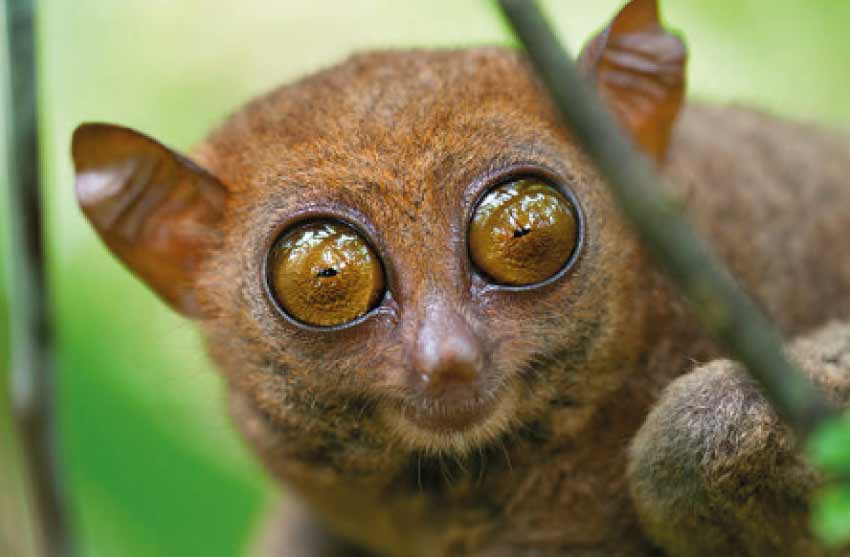
People often ask “why do monkeys have big eyes” after seeing a wide-eyed baby monkey or a viral photo of a “monkey with big eyes” that turns out to be a tarsier. This guide explains how primate eyes evolved, why night monkeys need bigger eyes, how forward-facing eyes give depth perception, how monkeys see color and which big-eyed primates are not monkeys at all.
Key takeaways
- Why do monkeys have big eyes? Usually they only look big, because primates have forward-facing, close-set eyes.
- Owl monkeys, the only mostly nocturnal monkeys, have large round eyes packed with light-sensitive rod cells.
- Tarsiers, which are primates but not monkeys, probably have the largest eyes for their head size of any mammal.
- Across mammals, body size matters most for eye size; activity pattern has only a modest effect.
- Monkeys and apes evolved eye shapes for sharp, detailed daytime vision.
- All Old World monkeys see in three colors; most New World monkey males see two.
In this guide
Why Do Monkeys Have Big Eyes? The Short Answer
The answer depends on the monkey. Daytime monkeys, like macaques, baboons and capuchins, have eyes that suit their body size and are built for sharp vision in bright light. Their eyes look striking because primates have flat faces with both eyes pointing forward. Night-active primates are different: they evolved much larger eyes to collect as much light as possible.
| Primate | Active | Eyes | Is it a monkey? |
|---|---|---|---|
| Macaques, baboons, capuchins | Day | Forward-facing, built for detail and color | Yes |
| Owl (night) monkey | Mostly night | Large, round, rod-rich | Yes |
| Tarsier | Night and twilight | Enormous, fixed in place | No, a separate primate group |
| Lorises, galagos (bushbabies) | Night | Large, sensitive night vision | No, strepsirrhine primates |
Summary based on National Geographic, Smithsonian Magazine, the American Museum of Natural History and an open primate biology textbook (Volsche, 2022). Classification notes are general biology.

Why Monkey Eyes Look So Big
Part of the answer to “why do monkeys have big eyes” is about face shape, not eye size. An open primate biology textbook, Introduction to Evolution & Human Behavior by Dr. Shelly Volsche, lists these shared primate traits:
- Forward-pointing eyes set close together, rather than on the sides of the head
- Eyes protected by bone, which frames them in the face
- Vision that generally matters more than smell, as it does for hearing too
- Widespread color vision in day-active species
Put together, a flat face with two forward-facing, bone-framed eyes creates the wide-eyed look people notice. Baby monkeys can look even more big-eyed, since their faces are small and rounded. Adult eye size, however, generally tracks body size, as research covered later in this guide shows.
Why do primates have forward-facing eyes?
Forward-facing eyes overlap their fields of view, which helps judge depth. The Volsche textbook explains that primate features are partly linked to life in trees. It also describes the visual predation hypothesis, which suggests these traits evolved to help early primates catch insects among branches. Interestingly, the same text notes that stereoscopic vision evolved separately in carnivores that judge distances to catch fast prey.
Why Do Monkeys Have Big Eyes at Night? Meet the Owl Monkey
If you want a monkey with truly large eyes, look at the owl monkey, also called the night monkey (genus Aotus). In a National Geographic report by Ed Yong, the owl monkey is described as the only monkey that is mostly active at night, with large round eyes that hint at its lifestyle.
The same report explains how its eyes changed. Owl monkeys have relatively few cone cells, which detect color, and many more rod cells, which work better in dim light. Researchers Michael Dyer and Rodrigo Martins found that the owl monkey evolved from day-active ancestors around 15 million years ago and has lost one of the cone types other monkeys use.
| Owl monkey fact | Details |
|---|---|
| Eyes | Large, round and brown; bright reddish-orange eyeshine |
| Range | Central and South America, from Panama to northeastern Argentina |
| Weight | About 0.5 to 1.3 kg (1.1 to 2.9 lb) |
| Diet | Fruit, nectar, leaves and insects |
| Activity | Most active several hours after dusk and before dawn |
Facts for the gray-bellied night monkey (Aotus lemurinus) and its relatives. Source: Animal Diversity Web, University of Michigan (Aotus lemurinus account). Pound conversions are ours.
Pet Care Tip: Big eyes make primates look cuddly, but monkeys are wild animals with complex needs. Some states, including Washington, ban them as pets. If you love big-eyed animals, consider a legal, easier pet and support primate conservation instead.
Tarsiers: The Big-Eyed Primates That Are Not Monkeys
Many viral “big-eyed monkey” photos actually show tarsiers. These small Southeast Asian primates are not monkeys; they belong to their own primate group. According to Smithsonian Magazine, tarsiers probably have the largest eyes relative to head size of any mammal species.
The American Museum of Natural History notes that each of the Philippine tarsier’s eyes is about the size of its brain. Smithsonian adds that tarsier eyes do not move in their sockets, so these nocturnal hunters turn their heads instead to look around. Most species are only 4 to 6 inches long and weigh 3 to 6 ounces, and they eat insects, lizards and occasionally birds.
Other big-eyed primates
Lorises, galagos (bushbabies) and lemurs are strepsirrhine primates. The Volsche textbook says many in this group show adaptations for night life, such as large eyes and sensitive night vision, often with less color vision. Like tarsiers, they are primates but not monkeys.
Why Do Monkeys Have Big Eyes? The Science of Eye Size
Bigger eyes help in the dark because a larger eye can let in more light. But eye size is not only about day or night. In a University of Texas at Austin study, anthropologist Chris Kirk and Amber Heard-Booth found that body size is always a major influence, and that across mammals, activity pattern has only a modest effect on eye size.
The shape of the eye matters too. A 2012 study led by Margaret Hall found that most day-active mammals still carry eye shapes from a nocturnal past. Anthropoid primates, the group that includes monkeys, apes and humans, are the only mammal group that re-evolved eye shape for fine, detailed daytime vision, with small corneas relative to eye length.
| Factor | Effect on primate eyes |
|---|---|
| Body size | Larger animals have larger eyes overall |
| Night activity | Can favor larger eyes and many rod cells (owl monkeys, tarsiers) |
| Day activity | Favors sharp, detailed vision and color (most monkeys) |
| Life in trees | Favors forward-facing eyes for judging distance |
Summary of University of Texas at Austin research and the Volsche primate textbook.
How Monkeys See Color
Eye size is only part of the story. Color vision differs a lot between monkey groups. A 1999 study in Genome Research by Dulai, von Dornum, Mollon and Hunt explains that all Old World primates have three-color (trichromatic) vision. Most New World monkeys have a single variable opsin gene, so all males see in two colors and only some females see three. The howler monkey is the one New World monkey with full three-color vision.
The owl monkey, as National Geographic reports, has lost one cone type entirely, trading color vision for better night sight. That trade-off helps explain why the answer to “why do monkeys have big eyes” is so different for night and day species.
7 questions to explore about primate eyes
- Is this primate active by day or by night?
- Is it a monkey, an ape, a tarsier or a lemur-like primate?
- Does it live in trees or on the ground?
- How large is it compared with its eyes?
- Does it see in two colors or three?
- Does it have eyeshine at night?
- Is it endangered in the wild?
Example Scenario (illustrative)
Ava, a fourth-grade teacher in Portland, shares a viral photo of a “tiny monkey with huge eyes.” A student asks, “Why do monkeys have big eyes?” Ava looks it up and discovers the animal is a tarsier, not a monkey. The class compares tarsiers with owl monkeys and day-active macaques to see how lifestyle shapes eyes.
| Common myth | The fact |
|---|---|
| All monkeys have huge eyes | Most have eyes that fit their size; owl monkeys are the big-eyed exception |
| Tarsiers are monkeys | They are a separate primate group |
| Bigger eyes always mean night life | Body size matters most; activity has a modest effect |
| All monkeys see the same colors | Color vision varies between Old and New World monkeys |
What most people get wrong
Many people ask “why do monkeys have big eyes” while looking at a tarsier, slow loris or bushbaby. Those animals are primates, but not monkeys. Among true monkeys, only the night-active owl monkey has truly oversized eyes; most others simply have forward-facing eyes in flat faces.
Why Do Monkeys Have Big Eyes? FAQs
Which monkey has the biggest eyes?
The owl monkey, the only mostly nocturnal monkey, has notably large, round eyes for seeing at night.
Do monkeys see better than humans?
Old World monkeys share our three-color sight, and their eyes are built for detailed daytime vision like ours. Night monkeys see better in dim light but with less color.
Why do baby monkeys have big eyes?
Their faces are small and rounded, which can make their eyes look larger relative to the head than in adults.
Is a tarsier a monkey?
No. Tarsiers are primates, but they form their own group separate from monkeys.
Can monkeys see in the dark?
Owl monkeys can, thanks to rod-rich eyes. Most other monkeys are active by day, with eyes built more for detail and color than for darkness.
Why do monkeys’ eyes face forward?
Overlapping vision helps judge distance, which is useful for moving through trees and catching food.
Do monkey eyes glow at night?
Owl monkeys show bright reddish-orange eyeshine, according to Animal Diversity Web.
Final Verdict: Why Do Monkeys Have Big Eyes?
Why do monkeys have big eyes? Most only look that way because primates have forward-facing eyes in flat faces. The owl monkey truly has large eyes to see at night, while tarsiers, which are not monkeys, have the biggest eyes of all. Lifestyle, body size and evolution shape every primate’s eyes.
Your next steps
- Visit an accredited zoo to see primates up close and safely.
- Learn why primates are banned as pets in some states in our guide to what exotic pets are legal in Washington State.
- Explore legal, beginner-friendly options in our cheap exotic pets list, or browse our Other Pets section.
Share your favorite big-eyed animal facts on our Pets Store Home Facebook page.
About the author: Written and reviewed by the Pets Store Home Editorial Team, animal lovers who check every guide against trusted scientific sources. This article is general educational information.
How we checked this guide: Owl monkey facts come from National Geographic and Animal Diversity Web. Tarsier facts come from Smithsonian Magazine and the American Museum of Natural History. General primate traits come from Dr. Shelly Volsche’s open textbook.
Eye size research comes from the University of Texas at Austin, and color vision from a 1999 Genome Research study. We review this article every 12 months.
Last reviewed: October 2026.
Sources (accessed October 25, 2026)
- National Geographic: From Day to Night, a Lesson in Eye Evolution with the Owl Monkey
- Animal Diversity Web: Aotus lemurinus
- Smithsonian Magazine: Two New Species of Big-Eyed Tarsiers Discovered in Indonesia
- American Museum of Natural History: Philippine Tarsier Eyes
- Volsche, S. (2022). Introduction to Evolution & Human Behavior: The Primate Order
- UT Austin: Eye Size Determined by Maximum Running Speed in Mammals
- UT Austin: Effects of Prehistoric Nocturnal Life on Mammalian Vision
- Dulai et al. (1999). The Evolution of Trichromatic Color Vision. Genome Research
[…] Which foreign pets are legal in Washington State? […]