
How Long Can a Hamster Go Without Water
There’s no single, veterinary-established number of hours or days that tells you how long a hamster can safely go without water — despite that figure being repeated across many pet sites. What veterinary sources do confirm is that dehydration in hamsters is closely tied to illness (diarrhea, or “wet tail,” is a well-documented cause) and heat, and that it can become serious quickly enough to need prompt veterinary care rather than a wait-and-see approach.
Unlike food, which hamsters can stockpile in their cheek pouches, water can’t be stored. This guide covers the warning signs to watch for, why a hamster might stop drinking even with water available, which hamsters carry extra risk, and when a situation becomes an emergency rather than something to monitor at home.
Quick Answer: There’s no reliable, universal number of hours or days — treat any such figure as a rough estimate, not a medical threshold. What’s well supported by veterinary sources is that dehydration is often linked to illness or heat, can progress quickly, and needs prompt attention. Check your hamster’s water source is genuinely working, watch for the signs below, and contact a vet experienced with small animals if you’re concerned.
Key Takeaways
- No single figure for “how long” applies to every hamster — species, age, health, and heat all change the picture.
- A water bottle can look full while a jammed sipper tube delivers nothing — test it, don’t just glance at it.
- Diarrhea (“wet tail”) is a well-documented cause of rapid dehydration in hamsters, especially young ones, and needs prompt veterinary treatment.
- Babies, pregnant/nursing females, seniors, and sick hamsters generally have less margin for error.
- Heat above roughly 27°C (80°F) raises the risk of heat-related illness in small rodents, which can look similar to — but isn’t the same as — simple dehydration.
- Mouth breathing, panting, or collapse are emergency signs that need immediate veterinary attention, whatever the underlying cause turns out to be.
In this guide: What “no water” means · Warning signs · Emergency signs · Species and size · Why hamsters stop drinking · Higher-risk hamsters · Heat and dehydration · Bottle vs bowl · What to do · Common mistakes · Checklists · FAQ
What Counts as “No Water” for a Hamster?
Three situations get lumped together as “no water,” with different risk levels:
- True zero access — an empty or non-functional bottle.
- A bottle that looks full but isn’t dispensing — often riskier than an obviously empty one, since nobody notices until symptoms appear.
- No bottle, but watery vegetables offered — cucumber or watermelon add some moisture but don’t replace a working water source.
Pet Care Tip: Watch whether the water level actually drops day to day, not just whether the bottle looks full — a stalled level is your earliest warning.
Warning Signs of Dehydration
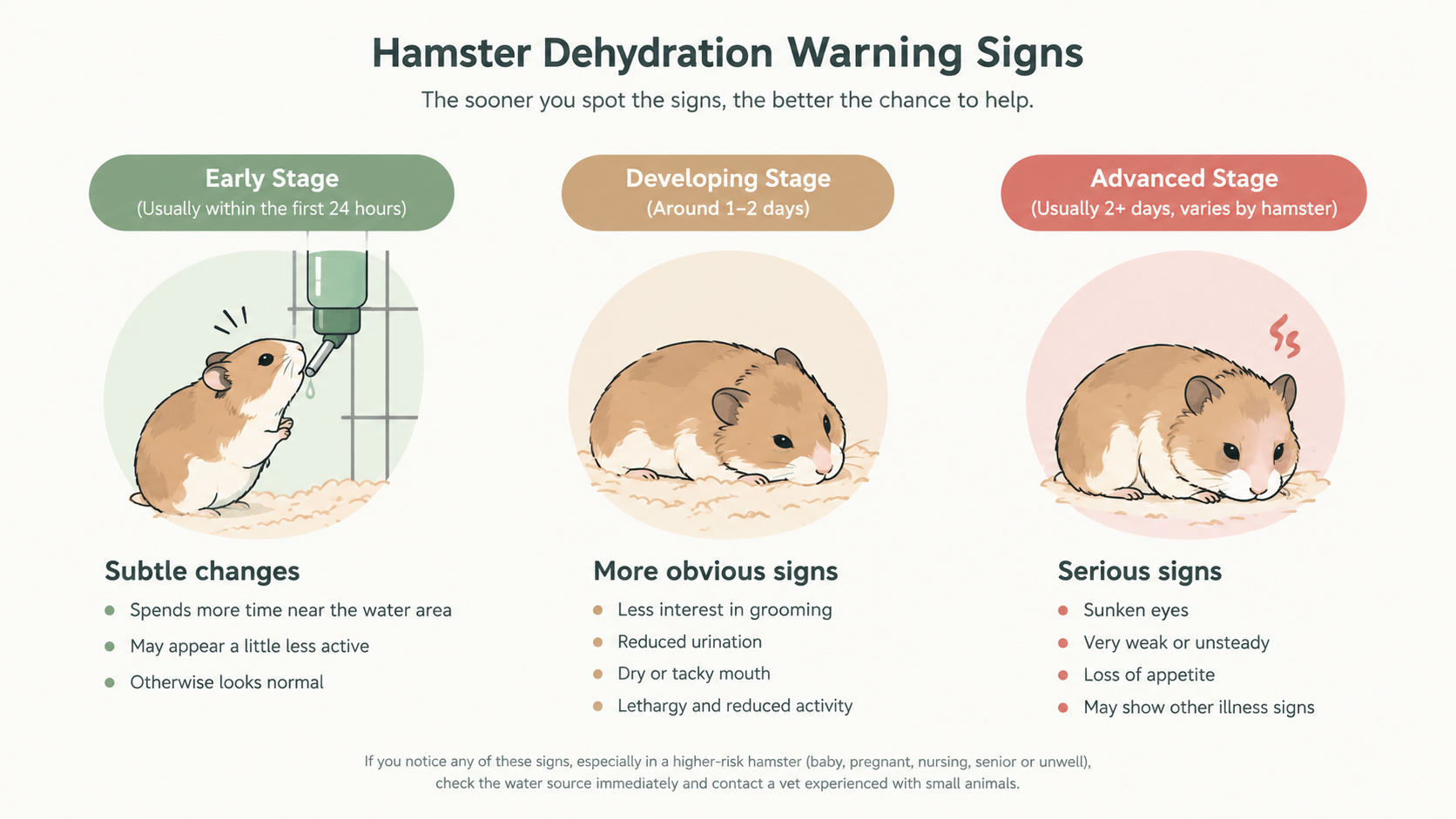
Many pet sites quote precise hour-by-hour countdowns; veterinary sources don’t support a single fixed timeline, since diarrhea/illness and heat both accelerate the process considerably (PDSA; VCA Animal Hospitals). Watch instead for a general progression:
- Early: more time near the water area, otherwise few visible changes — your best window to fix an access problem.
- Developing: a dry or tacky mouth, reduced urination, lethargy, less interest in grooming.
- Advanced: sunken eyes, noticeable weakness, reduced activity.
Any developing or advanced sign is a reason to contact a vet rather than wait. Skin elasticity (“skin tenting”) is sometimes suggested as a home check, but it’s not a reliable stand-alone test — behaviour, appetite, and grooming changes are more useful reasons to seek assessment.
Emergency Signs Requiring Immediate Veterinary Attention
Some signs point to a more urgent emergency than dehydration alone. VCA Animal Hospitals notes that small rodents are vulnerable to heat stroke above roughly 27°C (80°F), with symptoms including panting, salivation, weakness, and convulsions — a life-threatening, immediate-vet situation. Diarrhea (“wet tail”) can also cause rapid dehydration, weight loss, and weakness requiring urgent treatment (VCA; PDSA). Treat any of the following as an emergency, regardless of suspected cause:
- Mouth breathing, panting, or laboured breathing
- Collapse or inability to stand
- Seizures or severe disorientation
- A cold body or unresponsiveness
Species and Size
Body size affects fluid reserve relative to metabolism, but there’s no measured, published comparison of exactly how much faster one hamster species dehydrates than another — so treat the table below as relative context, not a precise ranking.
|
Species |
Documented size |
Practical relevance |
|
Syrian (Golden) |
~110–140g adult weight (Merck Veterinary Manual) |
Largest common pet hamster; more body mass may help a little, but doesn’t replace constant water access |
|
Chinese, Campbell’s, Winter White, Roborovski |
Merck notes other varieties are “slightly smaller” than Syrians, without giving exact per-species figures |
Smaller body size generally means less fluid reserve relative to a Syrian; Roborovski is typically the smallest of these |
Campbell’s and Campbell’s/Winter White hybrid lines also carry a well-documented genetic predisposition to diabetes (ExoCare Veterinary Medical Center), which can affect drinking and urination patterns — worth mentioning to a vet if you notice changes in either.
Why Your Hamster Might Stop Drinking
A hamster with water available but not drinking is arguably more concerning than an empty bottle, since the cause is usually medical:
- Diarrhea/”wet tail” — a well-documented cause of dehydration in hamsters, especially young ones, caused by bacterial disruption of gut flora (Merck Veterinary Manual; VCA Animal Hospitals). Needs prompt veterinary treatment.
- Dental problems — Merck notes overgrown or misaligned teeth can cause facial swelling and discomfort that may affect eating and drinking.
- Diabetes — particularly in Campbell’s/Winter White hybrid lines, linked to genetics, high-sugar diets, and low activity (ExoCare Veterinary Medical Center).
- Stress or a new environment, or a bottle style the hamster struggles to use.
If water is confirmed available and your hamster still isn’t drinking, that’s a reason to see a vet rather than wait.
Hamsters at Higher Risk
- Babies and recently weaned hamsters — wet tail, a major dehydration cause, is particularly common in young hamsters (VCA Animal Hospitals).
- Pregnant and nursing females — water demand rises during gestation and lactation.
- Seniors and sick hamsters — age or existing illness reduces the buffer before dehydration becomes dangerous.
Pet Care Tip: For a pregnant/nursing hamster, a second water bottle removes the single point of failure during a higher-risk period.
Heat and Dehydration
Small rodents, including hamsters, are vulnerable to heat-related illness once temperatures climb past roughly 27°C (80°F), with panting, salivation, weakness, and convulsions as warning signs requiring immediate cooling and veterinary care (VCA Animal Hospitals). This is a distinct emergency from simple dehydration, though the two can overlap — keep the cage out of direct sun and away from heaters, and check water more often in hot weather.
Bottle vs Bowl, and Testing for a Blockage
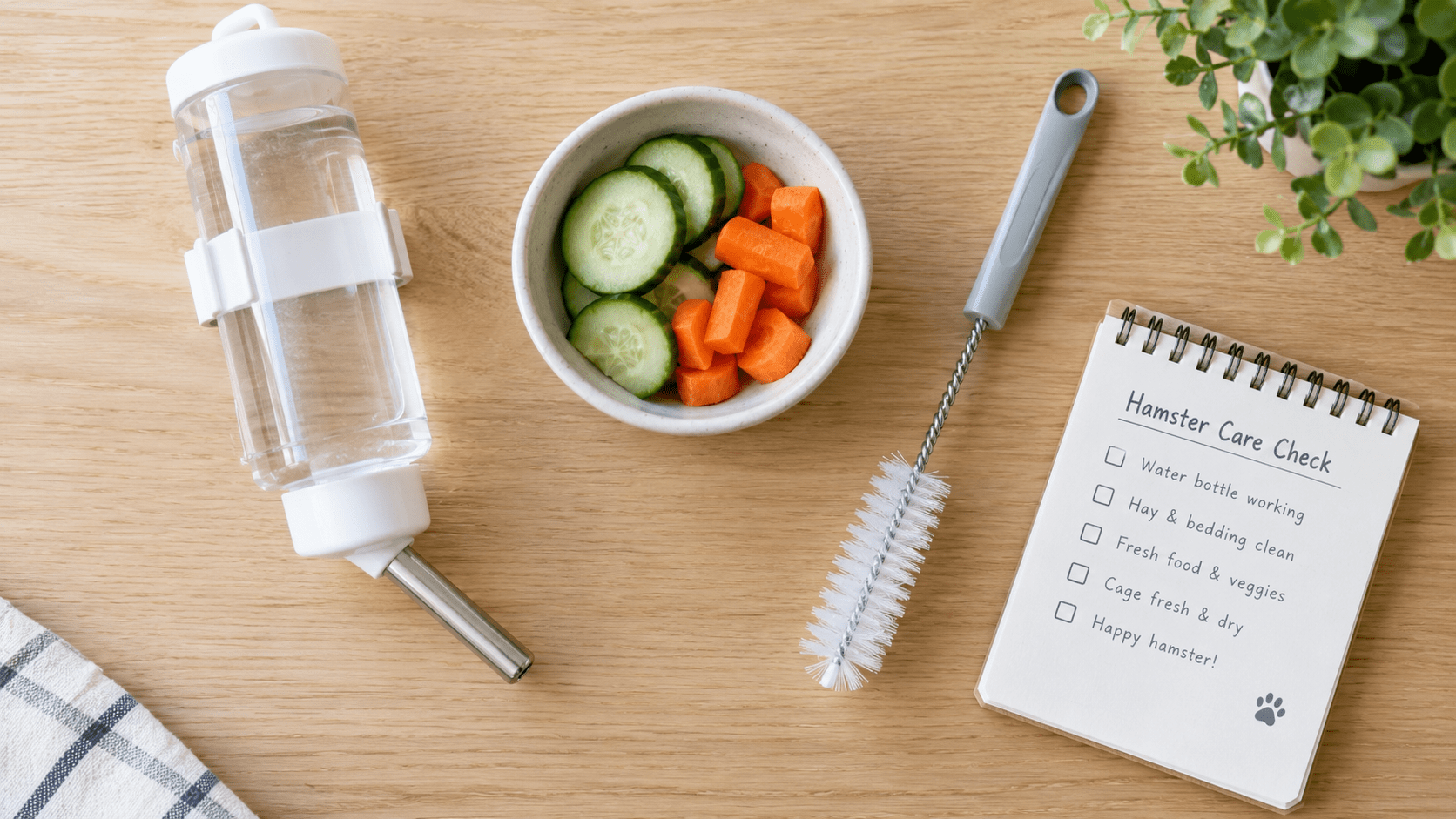
Water bottles with a metal spout are generally recommended over bowls, which tip easily and can be contaminated by bedding (PDSA). Bottles aren’t foolproof — a sipper tube can jam while looking full. To check:
- Tap the ball bearing in the tip gently — a drop should form.
- Watch the water level over a few hours rather than trusting appearance alone.
- Clean and check the bottle daily, and replace tubes that show mineral buildup (PDSA).
What to Do If You’re Concerned
- Confirm the water source is actually working, and offer a shallow backup dish.
- Offer water gently — never force it into the mouth, which risks aspiration.
- Contact a vet experienced with small animals promptly for any developing/advanced warning sign, and immediately for any emergency sign above.
- Don’t give electrolyte solutions or human sports drinks without veterinary guidance.
- If your hamster refuses to drink despite confirmed access, see a vet — this points to an underlying medical cause.
This guide does not replace veterinary care. When in doubt, treat it as urgent.
Practical Examples
A single bottle left over a long weekend: if it jams on day one, developing warning signs may already be present by the time an owner returns — the most common real-world failure isn’t neglect, it’s an unverified single water source.
A hamster refusing to drink with water available: this pattern more often traces back to dental pain, wet tail, or diabetes than to simple stubbornness, and is a reason to see a vet rather than wait.
Common Mistakes
- Assuming a full-looking bottle is a working one.
- Treating watery vegetables as a water replacement.
- Waiting to “see if it gets better” once developing or advanced signs appear.
- Applying one survival estimate to every hamster regardless of species, age, or health.
- Treating mouth breathing or panting as “just” dehydration instead of an emergency sign.
Editor’s Insights
- Behaviour, appetite, and grooming changes are more reliable early warnings than any single physical test like skin tenting.
- A second water source is cheap insurance during any absence longer than a day.
- Refusal to drink despite available water usually points to an underlying illness — diarrhea, dental pain, or diabetes are the most commonly documented causes.
Decision Framework: Should I Be Concerned Right Now?
- Is the water source confirmed working, or could it be jammed?
- Are developing signs (lethargy, reduced grooming) or advanced signs (sunken eyes, weakness) present?
- Is this hamster in a higher-risk group (baby, pregnant/nursing, senior, or unwell)?
- Is your hamster refusing to drink despite available water?
- Is any emergency sign present (mouth breathing, panting, collapse, seizures)?
A “yes” to question 5 is always an immediate vet visit; a “yes” to 2 or 4 — or to 1 for a higher-risk hamster — is a same-day concern.
Vacation and Absence Checklist
- Confirmed both bottles are actually dispensing, not just visually full
- Arranged daily water checks during your absence
- Left extra fresh food alongside water, not as a substitute
- Kept the cage away from direct sun, heaters, or draughts
- Left vet contact details and a note on warning signs
Concern Response Checklist
- Verified the water source is working right now
- Checked for developing/advanced signs (see above)
- Checked for emergency signs — treat any as immediate
- Offered water gently, plus a small water-rich food
- Contacted an exotics-experienced vet if any sign is present
FAQ
How long can a hamster go without water before it dies?
There’s no reliable, universal figure — it’s commonly repeated online but not backed by a fixed veterinary threshold. Dehydration linked to illness or heat can become serious quickly, so treat it as a reason for prompt veterinary attention rather than a countdown.
How long can a hamster be left alone with a water bottle but no one checking on it?
Bottles can fail without warning, so a verified backup source is safer than relying on any single bottle for an extended period, whatever the length.
Can cucumber or watermelon replace a water bottle?
No — they add moisture but not nearly enough on their own.
Why would a hamster stop drinking with water available? Most commonly diarrhea/wet tail, dental pain, or diabetes (especially in Campbell’s/Winter White lines) — see a vet rather than waiting.
Do baby hamsters face more risk?
Yes — wet tail, a major dehydration cause, is particularly common in young hamsters.
Does heat increase the risk?
Yes — above roughly 27°C (80°F), small rodents are also at risk of heat stroke, a separate emergency from simple dehydration that needs immediate cooling and vet care.
Is the skin-tent test reliable?
Not on its own. Behaviour, appetite, grooming, and eye appearance are more useful signs to combine with a vet’s assessment.
Is mouth breathing a sign of dehydration?
It can indicate heat stroke or respiratory distress rather than dehydration specifically — treat it as an emergency regardless of the cause.
Individual hamsters vary, and these sources don’t establish a fixed survival timeline — treat this article as general guidance, not a substitute for a vet’s assessment of your specific hamster.
Written and reviewed by the Pets Store Home editorial team. This article is for general information only, has not been reviewed by a licensed veterinarian, and is not a substitute for veterinary advice. If you suspect your hamster is dehydrated or unwell, contact a vet experienced with small animals promptly. Last reviewed: September 2026.
Conclusion
There’s no fixed countdown for how long a hamster can go without water — what matters in practice is catching problems early. Verify your hamster’s water source is genuinely working, watch for the warning signs above, and treat emergency signs like laboured breathing or collapse as urgent regardless of the cause. When in doubt, a same-day call to a vet experienced with small animals beats waiting to see what happens.
[…] Which foreign pets are legal in Washington State? […]