

Quick Answer: For most dogs, no — daily scrambled eggs as an unsupervised extra on top of regular food usually push past the standard 10%-of-daily-calories treat guideline once you actually do the math for your dog’s size. Eggs can be a daily component for some dogs, but only inside a vet- or nutritionist-formulated diet that accounts for the calcium balance eggs affect — not as a casual daily add-on. And for dogs with pancreatitis history, kidney disease, obesity, or an egg allergy, the answer is more cautious regardless of the math.
Can Dogs Eat Scrambled Eggs Every Day?
Every major pet-nutrition site agrees on roughly the same answer to this question: not daily, stick to a couple of times a week, and follow the “10% of daily calories” treat rule. What almost none of them show you is the actual arithmetic behind that rule — so the advice lands as a number to memorize rather than something you can check for your own dog. This guide walks through that math with a real example, explains the specific situation where daily eggs genuinely are fine, and covers the health conditions and life-stage factors that change the answer.
Key Takeaways
- The “10% rule” isn’t a fixed number of eggs — it’s a calorie calculation, and doing it for your own dog’s weight tells you whether daily scrambled egg fits or not.
- Daily eggs can be appropriate, but usually only as part of a vet- or nutritionist-formulated homemade diet that accounts for how eggs affect calcium balance — not as an everyday extra on top of regular food.
- Cooking matters medically, not just for taste: raw egg whites contain a protein that blocks biotin absorption, a risk that scrambling eliminates.
- Dogs with a history of pancreatitis, kidney disease, obesity, or a known egg allergy need a more cautious answer than the general “10% rule” provides.
- Puppies and seniors don’t fit the same size-based bucket adult dogs do — growth needs and weight-gain risk both change the calculation.
Why “It Depends on the Math” Is the Real Answer
Most guides answer this question with a size chart: extra-small dogs get a quarter egg, extra-large dogs get up to two. That’s a reasonable starting point, but it skips the actual reasoning, which is more useful because it works for any food, not just eggs.
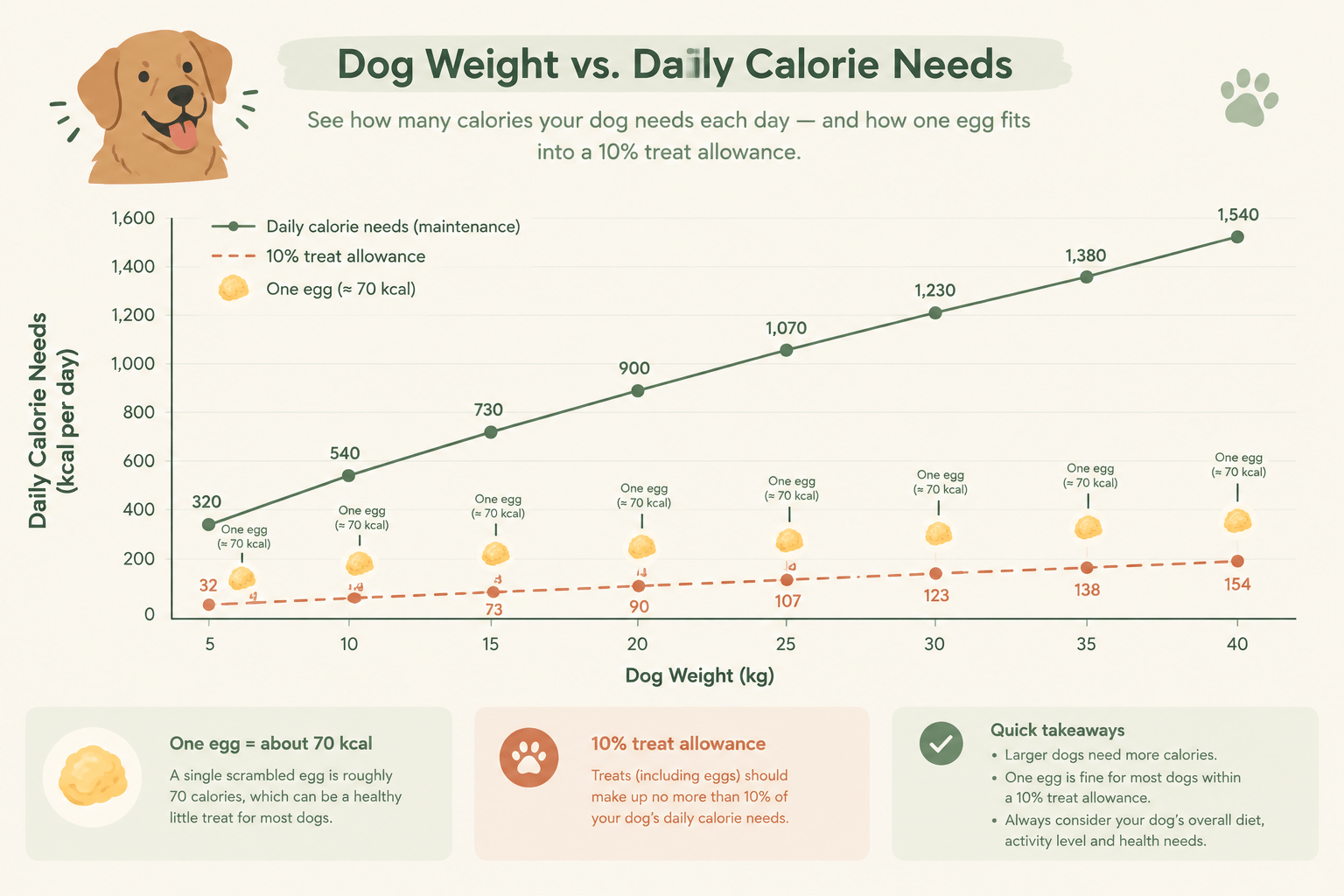
Veterinary nutrition guidance calculates a dog’s baseline daily energy need — called Resting Energy Requirement, or RER — using the formula RER (kcal/day) = 70 × (body weight in kg)^0.75, per the Merck Veterinary Manual. This is a resting baseline, not the dog’s full daily calorie allowance; actual daily needs (called Maintenance Energy Requirement, or MER) are typically higher than RER once you account for a dog’s activity level and life stage, and can vary meaningfully between individual dogs even at the same weight.
Here’s what that looks like for a roughly 20kg (44lb) adult dog: RER = 70 × 20^0.75 ≈ 70 × 9.46 ≈ 662 kcal/day. A single large scrambled egg runs about 70-75 calories. Measured against just the RER baseline, that’s already close to 10-11% — right at or slightly over the treat-calorie ceiling before you’ve even accounted for the dog’s actual, higher daily calorie budget.
For a moderately active dog whose real daily allowance sits comfortably above RER, one egg typically lands somewhat under 10% of total calories. For a sedentary, overweight, or calorie-restricted dog — whose realistic daily allowance sits closer to the RER baseline — that same single egg can tip past 10% on its own, before any other treats or table scraps.
The takeaway isn’t a specific number of eggs to memorize. It’s that “how many calories does my dog actually need in a day” is the question that determines the answer, and it changes dog to dog, not just size-bucket to size-bucket.
What the 10% Treat Rule Actually Means (and Its Limits)
The widely used guidance that treats and extras — anything outside a complete, balanced dog food — should stay under about 10% of a dog’s total daily calories exists to prevent nutritional imbalance: dog foods are formulated to hit specific vitamin and mineral targets, and Merck Veterinary Manual guidance on treat and topper feeding notes this limit is meant to keep the base diet’s nutritional balance from being diluted.
That 10% figure assumes eggs are functioning as a treat or topper on top of an otherwise complete diet — which is the situation almost every pet owner asking “can I feed this every day” is actually in. It’s a different situation from eggs being deliberately built into the diet itself, which is the exception covered next.
The Exception: When Daily Eggs Are Actually Fine
Daily egg feeding does show up in some dogs’ diets without being a problem — but almost always inside a homemade diet formulated by a veterinarian or veterinary nutritionist, not as an unsupervised daily topper.
The reason this distinction matters nutritionally: eggs affect a diet’s calcium-to-phosphorus balance, and getting that ratio wrong over a long period is a real nutritional risk in homemade feeding, particularly for growing puppies and large-breed dogs. A formulated diet that includes daily egg accounts for this by balancing calcium elsewhere in the recipe; an ad hoc daily egg added to commercial kibble at home does not.
In practice, that means “my vet said eggs are fine for my dog” often refers to a specific, calculated diet plan — not a blanket green light to add a daily scrambled egg to whatever the dog is already eating. If you’re feeding a complete commercial diet and want to add egg regularly, the calorie math above, not the diet-formulation exception, is the relevant rule.
Cooked vs. Raw: Why It Changes the Daily-Feeding Calculus
This guide assumes cooked, scrambled eggs, and that distinction matters more for a daily-feeding question than it does for an occasional one.
Raw egg whites contain a glycoprotein called avidin, which binds biotin and prevents its absorption — the Merck Veterinary Manual lists this among the antinutritional factors in raw food that cooking destroys. An occasional raw egg is unlikely to cause a problem, but regular, ongoing raw feeding without accounting for this creates a real, if slow-building, risk of biotin deficiency, which can show up as poor coat and skin condition, or in more severe cases, more significant health effects.
Cooking — including simply scrambling the eggs — deactivates avidin and removes this risk entirely, which is one practical reason scrambled eggs are the safer default for anything approaching daily feeding.
Raw eggs also carry the ordinary Salmonella risk associated with raw poultry products. If you’re scrambling eggs in a kitchen where you’re also preparing your own food, treat the raw egg and its shell like you would for your own cooking: wash hands and surfaces after handling, and don’t let raw egg residue cross-contaminate other food prep areas.
Does Egg Cholesterol Actually Matter for Dogs?
Eggs are relatively high in dietary cholesterol, which sometimes worries owners drawing on general human-health advice. Canine lipid metabolism doesn’t map directly onto human cardiovascular risk in the same way, and veterinary sources generally treat elevated blood lipids (hyperlipidemia) in dogs as being driven primarily by overall dietary fat content, genetics, and underlying conditions rather than dietary cholesterol specifically.
VCA Animal Hospitals notes that triglyceride levels commonly rise for several hours after any meal — more so with a high-fat diet — and that certain breeds (Miniature Schnauzers among them) are genetically predisposed to elevated lipids regardless of diet.
In practice, this means egg cholesterol itself isn’t the primary daily-feeding concern for most healthy dogs — total calorie and fat load is. That distinction doesn’t disappear for dogs with a diagnosed lipid or pancreatic condition, covered next, where fat content specifically becomes the limiting factor.
Dogs Who Should Not Have Daily Eggs, Regardless of Size
The calorie math above assumes a generally healthy dog. A few conditions change the answer regardless of weight or breed size:
Pancreatitis history: The Merck Veterinary Manual identifies dietary fat as a central factor in managing pancreatitis, with a low-fat diet recommended for dogs recovering from or prone to the condition — and VCA Animal Hospitals notes fat specifically demands more pancreatic secretion and slows digestion, which is exactly what a recovering pancreas doesn’t need. A whole egg’s fat content, fed daily, works against that management goal.
Kidney disease: Dogs with kidney disease are typically managed on protein- and phosphorus-controlled diets, and eggs are a concentrated protein and phosphorus source — daily egg feeding should only happen as part of a vet-directed renal diet plan, not as an independent addition.
Obesity or active weight management: For a dog on a calorie-restricted plan, the RER-based math above skews unfavorably fast — a dog eating close to its resting energy requirement has far less calorie headroom for daily extras of any kind, eggs included.
Known egg allergy: This is a separate issue from moderation entirely — a dog with a diagnosed or suspected egg allergy shouldn’t have eggs in any amount, let alone daily, and should be evaluated by a vet before reintroducing egg in any form.
Life Stage Matters Too
Size-based feeding charts also miss meaningful differences by age.
Puppies are growing, which means both higher calorie needs relative to body weight and more sensitivity to nutritional imbalance — particularly around the calcium-phosphorus ratio that eggs can affect, which matters more during a growth phase than in a stable adult. Daily egg for a puppy is more of a “check with your vet first” situation than for a healthy adult.
Senior dogs often have lower activity levels and a higher baseline risk of weight gain, which — following the same RER logic covered earlier — means their realistic daily calorie allowance may sit closer to their resting energy requirement, leaving less room for daily extras before crossing the 10% threshold.
Adults are the baseline case the worked example above covers directly.
How to Scramble Eggs for Frequent Feeding, Safely
If the math works out for your dog, preparation still matters:
Cook the eggs fully and plain — no oil, butter, salt, or seasoning, all of which add unnecessary fat, sodium, or (in the case of some seasonings like onion or garlic powder) genuine toxicity risk. A dry non-stick pan or a small amount of water instead of oil works well for scrambling. Let the eggs cool before serving.
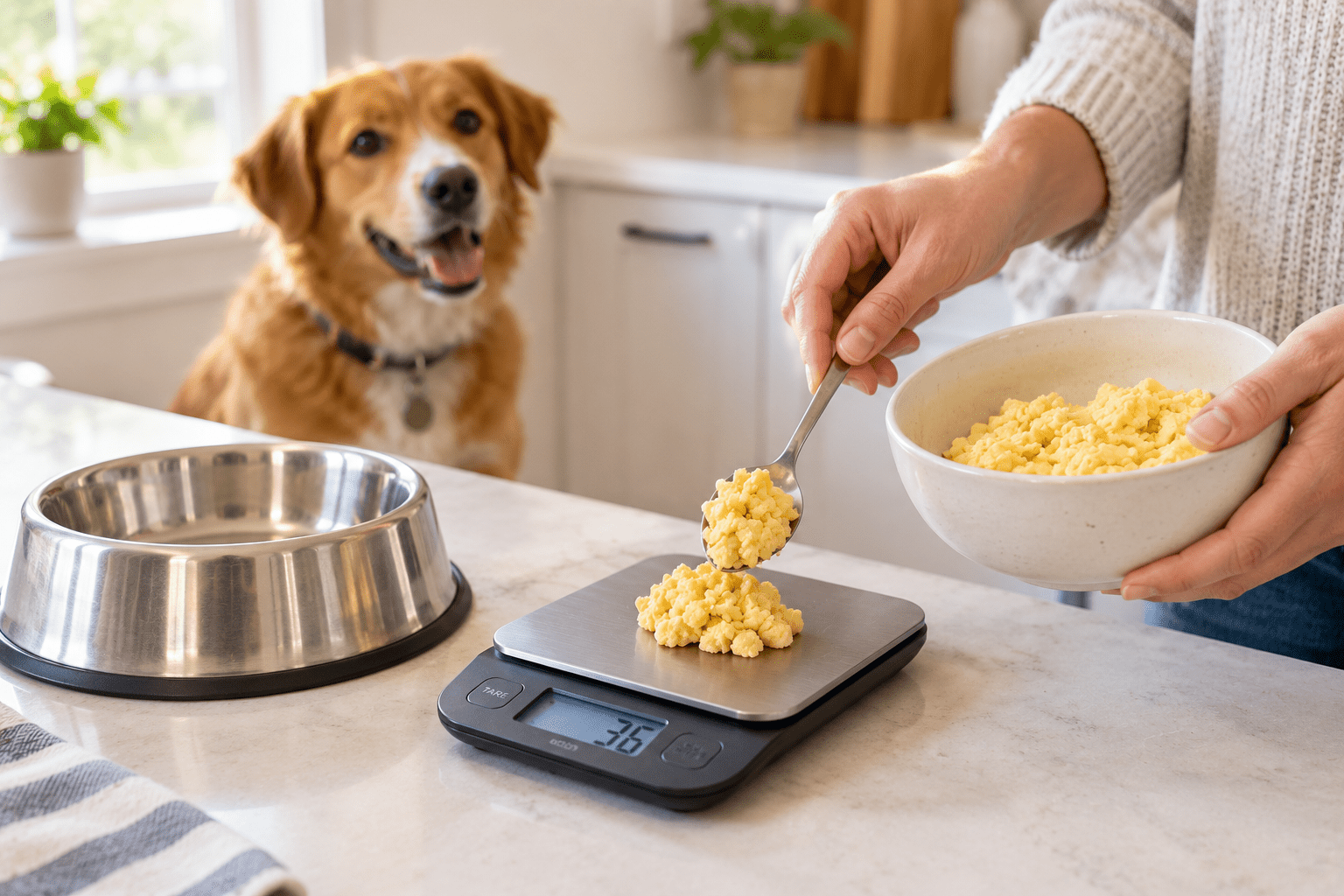
Portion according to your dog’s actual calorie allowance from the RER/MER calculation above, not a generic size bucket — a food scale is more reliable than eyeballing a portion. And if you’re preparing eggs for your dog alongside your own breakfast, keep raw-egg handling separate from other food prep to avoid cross-contamination, the same way you would cooking for yourself.
Simple Decision Framework: Should Your Dog Have Eggs Today?
Run through this before adding egg to today’s meal:
Is your dog at a healthy weight, without a pancreatitis, kidney disease, or diagnosed lipid disorder history? Does your dog have no known egg allergy? Have you checked that today’s portion, added to everything else your dog is eating, stays within roughly 10% of their actual daily calorie needs (not just their RER baseline)? If the answer to all three is yes, a scrambled egg is a reasonable addition. If any answer is no, skip it that day, or ask your vet whether a specific amount fits your dog’s individual health plan.
Common Mistakes Owners Make
Treating “10% rule” as a fixed number of eggs rather than a percentage of your specific dog’s calories — a rule that shrinks fast for a small or sedentary dog. Assuming a vet’s approval of eggs in a formulated homemade diet also applies to adding daily egg on top of regular kibble, which is a different nutritional situation.
Ignoring a pancreatitis or kidney diagnosis because eggs are perceived as a “natural” or “healthy” food. And feeding raw eggs regularly without accounting for the biotin/avidin issue that cooking eliminates.
Practical Examples
A healthy, moderately active 20kg adult dog with no health conditions: the RER-based math above suggests a daily scrambled egg is likely to fit comfortably within a 10% treat allowance, though checking against their specific food’s calorie content is worth the extra step.
An overweight dog on a vet-directed weight-loss plan: their reduced calorie budget sits close to RER, meaning a daily egg could use up a disproportionate share of their allowance — better treated as an occasional addition, or skipped in favor of a lower-calorie approved treat.
A dog on a vet-formulated homemade diet that already includes daily egg as a planned ingredient: no separate calculation needed, since the calcium balance and total calories were already accounted for when the diet was designed — the concern in this guide applies to unsupervised additions, not planned diet components.
FAQ
How many calories are in one scrambled egg?
A large egg is roughly 70-75 calories before any added fat from cooking oil or butter, which is why cooking it plain matters for the calorie math.
Can eggs replace a meal for my dog?
No — a single egg or even a few eggs don’t provide the balanced nutrition (complete vitamin and mineral profile) of a formulated dog food, and shouldn’t substitute for a regular meal unless specifically built into a vet-formulated diet.
Is raw egg ever safe to feed daily?
Regular raw egg feeding carries both a Salmonella exposure risk and a biotin-absorption risk from avidin in the raw white, both of which cooking resolves — daily raw egg specifically is the situation where that risk compounds most, so cooked is the safer choice for frequent feeding.
Can puppies eat scrambled eggs every day?
It’s worth checking with your vet first — puppies’ higher sensitivity to calcium-phosphorus balance during growth makes daily egg more of a case-by-case decision than it is for a healthy adult.
Do eggs cause allergies in dogs?
Egg is a recognized potential food allergen in dogs. A dog with a suspected or diagnosed egg allergy shouldn’t be fed egg in any amount, and any allergy suspicion should be worked up by a vet before reintroducing it.
Can dogs with pancreatitis ever have eggs?
Only under veterinary guidance — since fat content is the central concern in pancreatitis management, and a whole egg’s fat works against a low-fat management plan, this is a conversation to have with your vet rather than a default yes or no.
Will daily eggs affect my dog’s cholesterol?
Egg cholesterol specifically isn’t generally considered the primary concern for healthy dogs the way it is in human cardiovascular health; overall dietary fat, genetics, and underlying conditions are the bigger drivers of elevated blood lipids in dogs, per veterinary guidance on canine hyperlipidemia.
What’s the safest way to prepare eggs for a dog?
Fully cooked, plain, no oil/butter/salt/seasoning, cooled before serving, and portioned against your dog’s actual calorie allowance rather than a generic size chart.
Written by the Pets Store Home Team — pet care writers and researchers who cross-check every medical or nutritional claim against the veterinary and academic sources cited above rather than other blogs. This article has not yet been reviewed by a credentialed veterinarian; add a named DVM or veterinary nutritionist reviewer here before publishing if one is available. Last reviewed: September 2026
Conclusion
The real answer to “can dogs eat scrambled eggs every day” isn’t a number to memorize — it’s a calculation worth running for your own dog: their actual daily calorie needs, checked against what one egg actually costs. For most healthy adult dogs eating a complete commercial diet, that math tends to land in “occasional, not daily” territory once you account for the full 10% treat ceiling.
Daily eggs genuinely work for some dogs, but almost always inside a diet a vet or nutritionist has specifically built around them — and for dogs with pancreatitis, kidney disease, obesity, or an egg allergy, the health condition matters more than the math. Run the calculation, check your dog’s specific situation against it, and that “every day” question has a real answer instead of a rule of thumb.
[…] Which foreign pets are legal in Washington State? […]