
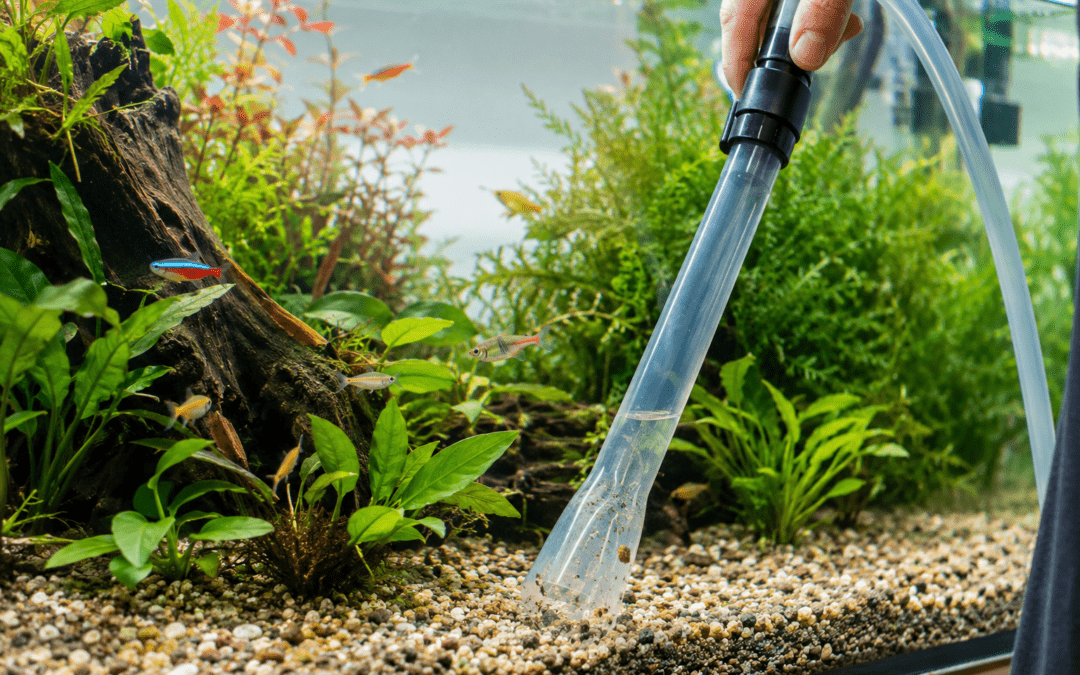
Quick Answer: Fish usually get hurt by cleaning not because the tank was dirty, but because the cleaning disturbed the bacteria that process fish waste, or because untreated or mismatched-temperature water shocked them. The safe approach: change water in moderation rather than all at once, use a dechlorinator matched to your water supply, clean filter media gently in removed tank water, match new water’s temperature, and let water test results tell you when your routine needs to change.
Quick Decision Box
- Ammonia or nitrite reading detected → investigate immediately and take corrective action based on the reading (see the emergency table below).
- Parameters stable and tank visibly fine → stick to your regular routine maintenance; there’s no benefit to cleaning more than that.
- Fish showing distress (gasping, erratic swimming) → test the water right away and increase surface agitation/aeration.
- Adding tap water → condition it for what your water utility actually treats with.
- Cleaning filter media → rinse gently in removed tank water to preserve the biological colony living on it.
How to Clean a Fish Tank Without Killing Fish
Ten different care guides will give you ten different water-change percentages, from 10% to 75%. That disagreement isn’t really about safety — it’s that most guides skip the mechanism behind fish deaths after cleaning and default to a memorized number instead. This guide starts with that mechanism — where the bacteria that process fish waste actually live, and what genuinely disturbs them — then builds a safe process, an emergency response plan, and a “what not to do” checklist around it.
Key Takeaways
- Cleaning problems usually trace back to disturbed biofiltration capacity or chemical/temperature shock — not simply “not cleaning enough.”
- The bacteria that process ammonia live mainly on surfaces — filter media, substrate, decor — not dissolved in the water itself, which changes what actually puts them at risk.
- Use a regular maintenance routine as your baseline, and let water-test results tell you when that routine needs to change.
- Not every water utility disinfects the same way, and not every dechlorinator is formulated for the same disinfectant — check what you’re actually treating for.
- Copper from old plumbing is a real risk, especially for invertebrates, but there’s no single guaranteed fix — it depends on your specific water source.
The Mechanism: Where Fish Waste Actually Goes
Fish release ammonia directly through their gills into the surrounding water. According to the Merck Veterinary Manual, unionized ammonia is toxic at very low concentrations — a level around 0.05 mg/L is enough to cause measurable gill damage, and concentrations near 2 mg/L are lethal to many fish outright.
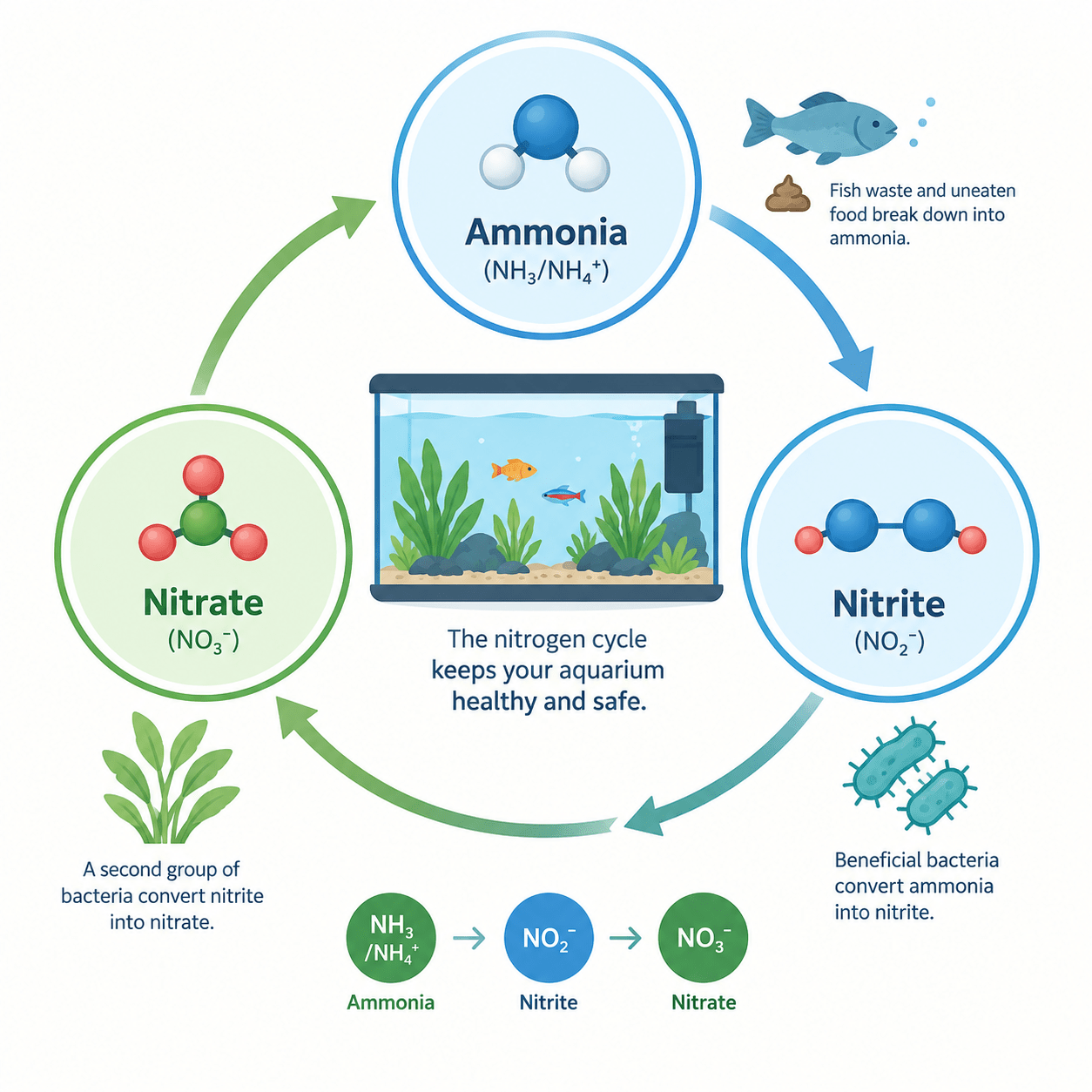
In an established aquarium, that ammonia doesn’t just accumulate — a chain of naturally occurring bacteria processes it: fish waste → ammonia → nitrite (via one group of bacteria) → nitrate (via a second group) → removed through routine water changes or uptake by live plants. This is the nitrogen cycle, and it’s the actual reason “beneficial bacteria” matters.
Here’s the detail most cleaning guides get wrong: those bacteria colonize surfaces — filter media and substrate especially — they aren’t suspended in the water column itself. That distinction matters because it means the water you remove during a routine change isn’t where most of the bacterial colony lives.
What actually threatens that colony is disturbing or damaging the surfaces they live on: rinsing filter media under hot tap water, replacing all your filter media at once, or using antimicrobial chemicals near the filter. The Merck Veterinary Manual notes that a biofilter takes roughly six to eight weeks to become fully established, and that a damaged filter’s bacterial population needs a similar span to recover — which is why aggressive media cleaning, not water changes on their own, is the more direct route to an ammonia or nitrite spike.
A very large or complete water change carries its own, different risks — mainly losing the water’s existing chemical stability and buffering capacity, and a bigger jump in temperature or pH if the replacement water isn’t closely matched. Those are real concerns worth avoiding, but they’re a distinct issue from “wiping out the bacteria,” which is mostly a filter-media and substrate-disturbance problem.
Routine Maintenance vs. an Ammonia/Nitrite Emergency
These are two different situations, and treating them the same way is where a lot of cleaning advice goes wrong.
Routine maintenance is what you do on a regular schedule when your tank is stable: a partial water change sized to your specific tank (more on the variables below), gentle substrate vacuuming, and occasional gentle rinsing of filter media in removed tank water.
An ammonia or nitrite emergency is a different situation with a different response. If a test shows a detectable ammonia or nitrite reading, that’s a signal to investigate immediately and take corrective action based on what the reading actually shows — not necessarily a fixed percentage, and not something to leave for your next scheduled cleaning day.
Per the Merck Veterinary Manual, a substantial water change (50% or more) is a reasonable emergency response once high ammonia is confirmed, provided the replacement water itself doesn’t introduce more ammonia or chloramine. The right size of an emergency response depends on how high the reading is and how your tank is set up, which is a good reason to have a plan (and, ideally, a vet or experienced aquatics source to consult) rather than a fixed number memorized in advance.
Use a Routine, But Let Testing Tell You When to Adjust It
A fixed cleaning calendar — weekly, biweekly, whatever a guide recommends — is a reasonable starting baseline. The mistake is treating that calendar as fixed regardless of what’s actually happening in the tank. The more reliable framing: use a regular maintenance routine as your baseline, and let water-test results tell you when that routine needs to change. Stable, low ammonia and nitrite readings mean your current routine is working.
A detectable ammonia or nitrite reading means it’s time to investigate and respond, regardless of where you are in the calendar. Rising nitrate between changes, with ammonia and nitrite both at zero, is what your next scheduled routine change is for.
How Much Water Should I Change? The Real Variables
There’s no single universal percentage that’s correct for every tank, which is why care guides disagree so much. What actually determines the right amount for routine maintenance includes: how mature and established the tank is, stocking level, how much you’re feeding, how heavily planted the tank is, filtration capacity, and your current ammonia, nitrite, and nitrate readings, along with the chemistry of your source water.
A lightly stocked, mature, well-planted tank with stable readings can typically get by with smaller, less frequent changes than a heavily stocked or newly established one.
This is separate from the emergency response covered above, where the size of the change is driven by how high a confirmed ammonia or nitrite reading actually is, not by these routine-maintenance variables.
Chlorine vs. Chloramine: Check What Your Water Utility Actually Uses
Every care guide agrees you need a water conditioner before adding tap water, but not every water utility disinfects the same way, and that affects which conditioner is appropriate. According to the EPA, chloramines are formed when ammonia is added to chlorine during water treatment, specifically because the combination provides longer-lasting disinfection as water travels through pipes to consumers, compared to chlorine alone, which dissipates more quickly.
This is a difference in how the two are formed and how long they persist — it’s worth finding out which one your local utility uses and choosing a conditioner labeled for that specific disinfectant, rather than assuming any dechlorinator handles both equally.
Copper and Other Heavy Metals: A Risk Without One Guaranteed Fix
Standard dechlorinators are formulated to neutralize chlorine and chloramine — they aren’t designed to remove dissolved metals. The Merck Veterinary Manual lists copper concentrations above roughly 0.2 mg/L, particularly combined with low water alkalinity, as capable of causing sudden fish mortality, and copper is generally more dangerous to invertebrates like shrimp and snails than to many fish at comparable levels.
Old household plumbing with copper pipes or solder is a common source, but there isn’t one guaranteed fix that eliminates the risk. Running the tap briefly before filling a bucket may reduce copper picked up from standing water in the pipes, but it isn’t a verified or complete solution on its own. If you keep shrimp, snails, or other copper-sensitive invertebrates and have older plumbing, testing your tap water for copper and using a conditioner or additive specifically formulated to bind heavy metals is a more reliable approach than tap-flushing alone.
What Your Water Test Results Actually Mean
- Ammonia — should not be detectable in a properly cycled, stable aquarium; any reading above zero is worth investigating.
- Nitrite — same standard as ammonia: should not be detectable once a tank is established, and any reading calls for a look at what’s changed.
- Nitrate — useful mainly as a trend indicator of accumulating nitrogen waste over time between water changes, rather than a single number with one universal “safe” threshold across every tank and species.
- pH and temperature — sudden shifts in either can matter for fish even when ammonia and nitrite both read as acceptable, which is part of why matching temperature during water changes (covered in the checklist below) is worth doing carefully rather than approximately.
The Ultimate Safe-Cleaning Checklist
- Test the water before you start.
- Prepare and treat replacement water with an appropriate conditioner.
- Match the new water’s temperature to the tank’s.
- Unplug any equipment that shouldn’t run dry (heater, filter).
- Remove only the intended amount of water for today’s routine.
- Vacuum the substrate gradually, section by section.
- Clean glass and decorations without soap, detergent, or household chemicals.
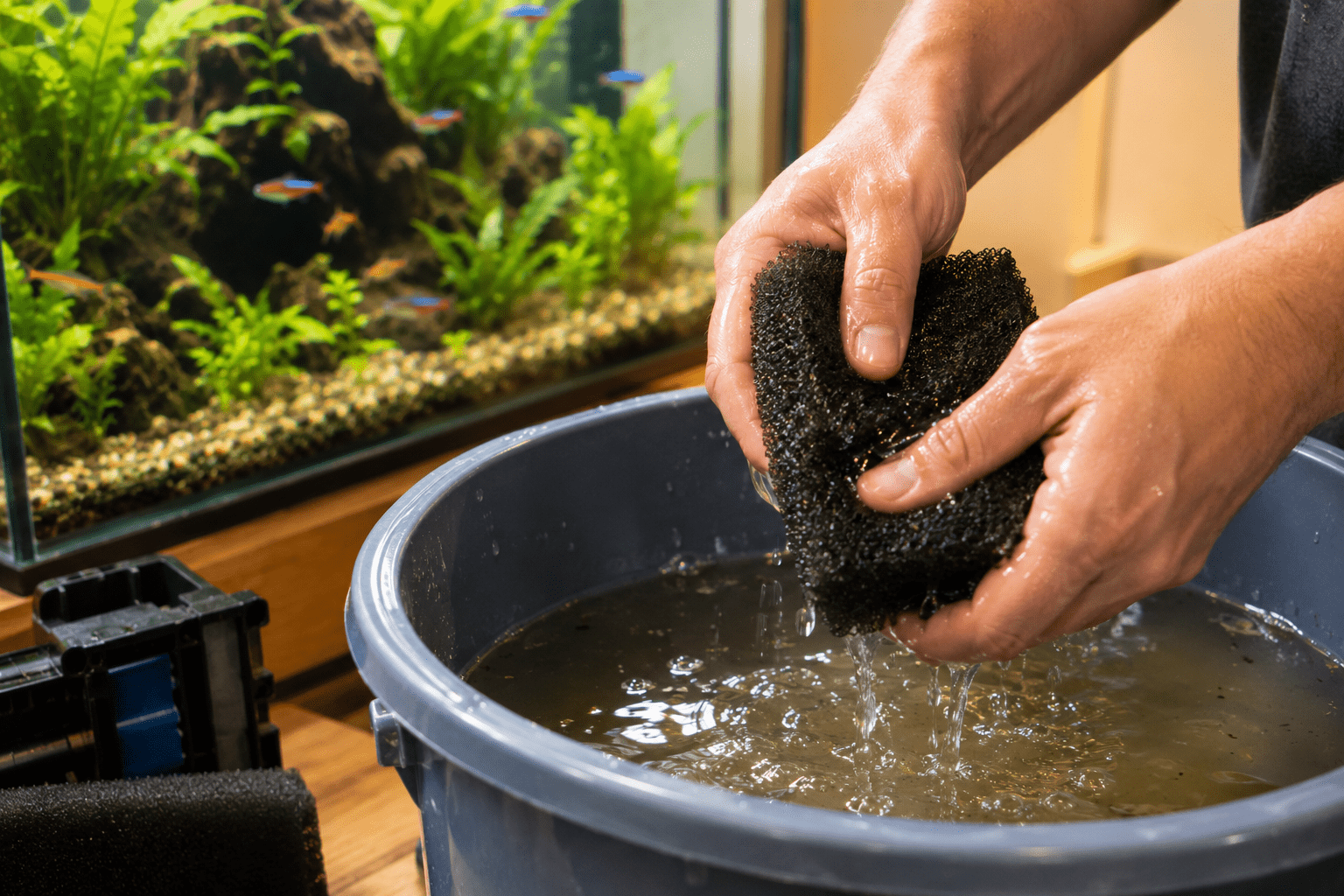
- Rinse reusable filter media gently in the removed aquarium water, not tap water.
- Refill slowly with the prepared, treated, temperature-matched water.
- Restart equipment and verify normal flow and heating.
- Observe your fish for a few minutes after restarting.
- Retest later if readings or fish behavior indicate a problem.
Emergency Troubleshooting
|
Problem |
What to Do |
|
Forgot conditioner |
Treat the water according to your conditioner’s instructions as soon as you notice |
|
Fish gasping at the surface |
Increase aeration/surface agitation and test water immediately |
|
Ammonia detected |
Investigate the cause and respond with a corrective water-quality action sized to the reading |
|
Nitrite detected |
Same as above — investigate and respond based on the reading, not a fixed percentage |
|
Temperature shock suspected |
Stabilize temperature gradually rather than making another sudden change |
|
Filter media rinsed under tap water |
Monitor ammonia and nitrite closely over the following days |
|
Full or near-full water change done |
Monitor water chemistry closely and avoid heavy feeding for a few days |
Not All Fish Tolerate Cleaning the Same Way
Community fish — most hardy, commonly kept species generally tolerate standard partial water changes reasonably well.
Sensitive or scaleless species — some fish are more prone to stress from abrupt chemistry or temperature shifts and benefit from more gradual changes than a generic routine assumes.
Shrimp and snails — invertebrates warrant particular attention to copper exposure and rapid parameter swings, given the sensitivity covered above; this doesn’t mean a single fixed percentage applies to all shrimp or snail species, since sensitivity varies, but it does mean applying a fish-tank routine unmodified to an invertebrate tank is worth reconsidering.
Never Do These During Routine Cleaning
❌ Use soap or detergent on glass, decorations, or equipment ❌ Replace all filter media at once ❌ Rinse biological filter media under untreated tap water ❌ Add untreated tap water directly to the tank ❌ Make a large, sudden temperature change during a water change ❌ Deep-clean every surface (substrate, decor, filter media, glass) in a single session ❌ Assume one fixed percentage applies to every aquarium ❌ Ignore a detectable ammonia or nitrite reading because it’s not your scheduled cleaning day
When You Should Not Clean More
If the tank looks visually clean and your water test results are stable, there’s no benefit to deep-cleaning simply because the calendar says it’s time. Over-cleaning — disturbing filter media and substrate more than necessary — is itself a route to the ammonia/nitrite risk covered earlier. A tank that’s testing well doesn’t need a more aggressive routine; it needs the same routine, at the same pace, until the readings say otherwise.
If You Already Made a Mistake
You did a full or near-full water change: Monitor ammonia and nitrite closely over the following days, since the tank’s chemical stability has been disrupted. Avoid heavy feeding during this window, and be ready to respond with a corrective water-quality action if readings climb.
You forgot the dechlorinator: Treat the water according to your conditioner’s instructions as soon as you notice, and test water quality once it’s had time to circulate.
Your fish are gasping or clearly distressed right after cleaning: Increase surface agitation or aeration right away, test ammonia and nitrite immediately, and respond with an appropriately sized corrective water change using properly treated, temperature-matched water if a problem is confirmed.
After You Clean: A Timeline for What to Watch
First few hours: Watch for gasping at the surface, erratic or darting swimming, hiding, or loss of color — per the Merck Veterinary Manual’s reference signs of illness in fish, these (along with lethargy and rapid or labored breathing) are worth taking seriously if they appear shortly after a cleaning.
Next 24-48 hours: Monitor ammonia and nitrite if you did a larger-than-routine change or suspect any disturbance to the filter, feed conservatively rather than heavily, and keep an eye on general behavior.
Following days: Return to your normal monitoring routine, and adjust your maintenance schedule only if test results actually indicate a change is needed — not simply because time has passed.
Common Mistakes Owners Make
Doing a full or near-full water change to “really” clean the tank, which disrupts chemical stability more than a partial change would. Rinsing filter media or decorations under a tap instead of in removed tank water. Adding new water without checking that its temperature is close to the tank’s. Cleaning more aggressively than test results call for, simply because of the calendar. And using soap, detergent, or general household cleaning products anywhere near the tank, its equipment, or decorations.
Practical Examples
A lightly stocked, well-planted, established tank with consistently stable test readings: a modest routine partial change on a regular schedule is likely sufficient, and there’s no benefit to cleaning more aggressively than the readings call for.
A newly set up tank showing detectable ammonia between scheduled changes: this points to an incompletely established biofilter rather than a cleaning-frequency problem, and calls for the emergency-response approach above rather than simply waiting for the next scheduled cleaning.
A tank with shrimp that previously held only fish: the owner’s old fish-only routine, including any copper-containing products used in the past, is worth re-evaluating against the more cautious approach the species-sensitivity section above describes.
FAQ
Why did my fish die after I cleaned the tank?
The most common causes are a disturbance to the bacteria that process ammonia (often from aggressive filter-media cleaning), or a chemical or temperature shock from untreated or mismatched-temperature replacement water — investigate both if this happens.
How much water should I change at once?
For routine maintenance, it depends on your tank’s maturity, stocking, feeding level, and current test readings rather than one universal number; a confirmed ammonia or nitrite emergency calls for a separate, larger corrective response as covered above.
Can I clean the filter and do a water change on the same day?
Yes, but avoid rinsing all your filter media aggressively and doing a large water change at the same time — space out how much you disturb the biological colony and the water chemistry in a single session.
Do I need a water conditioner every time I add tap water?
Yes, and the specific conditioner should match what your water utility actually treats with — chlorine or chloramine.
How do I know if my fish are stressed after cleaning?
Watch for gasping at the surface, erratic or darting swimming, hiding, or loss of color in the hours following a cleaning, and test your water right away if you see any of these.
Is it safe to remove all the water and start over?
Generally not recommended for routine maintenance — a full water change disrupts the tank’s chemical stability and risks a bigger temperature or pH swing than a partial change, on top of losing whatever buffering the established water was providing.
How often should I really clean my fish tank?
Use a regular routine as your baseline, and let water test results tell you when that routine needs to change — a detectable ammonia or nitrite reading calls for investigation regardless of the calendar.
Can a 100% water change kill fish?
It can contribute to fish loss, mainly through temperature/chemistry shock and the loss of the tank’s existing chemical stability, rather than through “losing the bacteria” specifically, since most of the bacterial colony lives on filter media and substrate rather than in the water itself.
Should I remove my fish while cleaning the tank?
For most routine maintenance, no — removing fish adds its own handling stress, and standard cleaning steps (partial water change, gentle vacuuming, gentle media rinsing) are designed to be done with fish in the tank.
Can I clean the filter and change water together?
Yes, but do it gently rather than aggressively on both fronts at once — a full media replacement combined with a large water change compounds disturbance to both the bacterial colony and the water chemistry in a single session.
Why are my fish gasping after a water change?
This can indicate low dissolved oxygen, a temperature or chemistry mismatch in the new water, or an ammonia/nitrite issue — increase aeration and test the water immediately rather than waiting to see if it passes.
Written by the Pets Store Home Team — pet care writers and researchers who cross-check every medical or water-chemistry claim against the veterinary and regulatory sources cited inline and above, rather than other blogs. Fact-checked/reviewed by: Not yet reviewed by a named, credentialed aquatic professional — add one here before publishing if genuinely available. No credential is listed in the meantime, since we don’t fabricate reviewer names. Last reviewed: September 2026
Conclusion
The bacteria that keep a tank safe live mostly on filter media and substrate, not in the water itself — which is why aggressive media cleaning and abrupt temperature or chemistry changes are the real risks, more than “not cleaning enough.”
Use a steady routine as your baseline, let test results tell you when to deviate from it, match your dechlorinator to your actual water supply, and treat copper as a real but not fully solved risk if you keep invertebrates or have older plumbing. Get those pieces right, and “without killing your fish” stops being a worry and starts being the default outcome.
[…] Which foreign pets are legal in Washington State? […]