
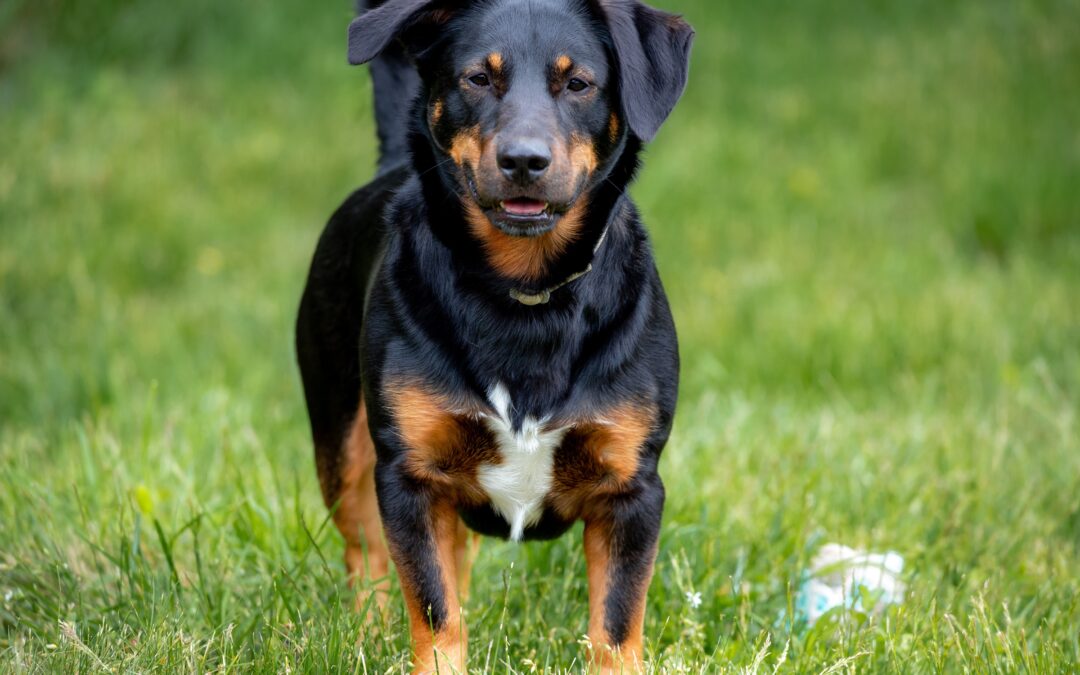
Rottweiler with German Shepherd Mix: Size, Temperament, Health and Care (2026)
What is a Rottweiler with German Shepherd mix? It is a Rottweiler and German Shepherd cross, often called a Shepweiler. Expect a large, loyal dog of roughly 75 to 115 pounds that needs one to two hours of exercise daily, early socialization and checks for hip, bloat and spinal risks from both parents.
Both parent breeds are intelligent working dogs, so as general advice, this cross is often smart, devoted and protective. A Rottweiler with German Shepherd mix can be a wonderful family guardian in the right home, but it is a big commitment. This guide covers size, temperament, training, exercise, health, puppy care and who this mix suits best.
Key takeaways
- A Rottweiler with German Shepherd mix is a large crossbreed, often called a Shepweiler.
- Rottweilers weigh 80 to 135 pounds and German Shepherds 50 to 90 pounds, per PetMD.
- Plan for at least 60 minutes to two hours of exercise a day.
- Early, ongoing socialization is essential for a guardian-type dog.
- Both parents carry joint risks, and German Shepherds can carry a gene linked to degenerative myelopathy.
In this guide
What Is a Rottweiler with German Shepherd Mix?
A Rottweiler with German Shepherd mix has one Rottweiler parent and one German Shepherd parent, or a mix of both lines. As a crossbreed, it has no official breed standard. Each puppy can lean toward either parent in looks and personality, which is why it helps to know both breeds well.
PetMD, in an article by Heather Newett, MPH, DVM, describes Rottweilers as intelligent, eager-to-please working and guardian dogs that may bark at unfamiliar people. PetMD, in an article by Barri J. Morrison, DVM, describes German Shepherds as loyal, alert and gentle with family but often wary of strangers, with a strong prey drive.
| Trait | Rottweiler | German Shepherd |
|---|---|---|
| Height | 22 to 27 inches | 22 to 26 inches |
| Weight | 80 to 135 pounds | 50 to 90 pounds |
| Lifespan | About 9 to 10 years | About 7 to 10 years |
| Daily exercise | At least 60 minutes | One to two hours |
| Coat | Short; sheds year-round | Double coat; sheds heavily year-round |
| With strangers | May bark or be reserved | Often wary |
Source: PetMD breed profiles for the Rottweiler (Heather Newett, DVM) and German Shepherd (Barri J. Morrison, DVM).
Shepweiler, German Rottie or Rottweiler Shepherd Mix?
As general advice, these names all describe the same cross. “Shepweiler” is the most common nickname, but you may also see “German Rottie,” “Rottie Shepherd” or “German Shepherd Rottweiler mix” in listings and shelter records. None of them is an official breed name.

How Big Does a Shepweiler Get? Size and Appearance
There is no official size range for a Rottweiler with German Shepherd mix, so the parents are the best guide. PetMD lists Rottweilers at 22 to 27 inches and 80 to 135 pounds, and German Shepherds at 22 to 26 inches and 50 to 90 pounds. K9 of Mine estimates that Shepweilers will likely weigh 75 to 115 pounds and stand 22 to 28 inches tall, noting that some dogs fall outside that range.
As general advice, a male Rottweiler with German Shepherd mix is usually larger than a female, and a puppy from a big Rottweiler parent may end up at the heavier end. If you love large dogs, see our guide to the biggest dog in the world.
| Size measure | Estimated range | Source |
|---|---|---|
| Height | About 22 to 28 inches | K9 of Mine estimate |
| Weight | About 75 to 115 pounds | K9 of Mine estimate |
| Rottweiler parent | 22 to 27 in, 80 to 135 lb | PetMD |
| German Shepherd parent | 22 to 26 in, 50 to 90 lb | PetMD |
Mix estimates are not a breed standard. Individual dogs vary.
Coat, Colors and Shedding
Both parents can be black and tan, so as general advice, many Shepweilers have similar coloring, and the coat can be short like a Rottweiler’s or a thicker double coat like a German Shepherd’s. PetMD says Rottweilers shed heavily year-round and need brushing weekly or more, while German Shepherds shed heavily all year, more in spring and fall, and benefit from daily brushing.
PetMD also notes that German Shepherds are not hypoallergenic. As general advice, expect plenty of hair with this mix whichever coat it inherits, and plan on regular brushing, nail trims and ear checks.

Rottweiler with German Shepherd Mix Temperament, Training and Exercise
As general advice, expect a loyal, intelligent and often protective dog. PetMD quotes the American Rottweiler Club, which says Rottweiler temperament ranges “from natural clowns, affectionate to almost everyone, to the very reserved one-person dog.” PetMD adds that German Shepherds suit experienced owners best and that breed accounts for “about 9% of a dog’s behavior,” so each dog is an individual.
Socialization matters most. The American Veterinary Society of Animal Behavior (AVSAB) says puppy classes can start at 7 to 8 weeks once a puppy has had a first set of vaccines, and that the key window for meeting new people, dogs and places runs until about 3 to 4 months. PetMD advises continuing socialization throughout a Rottweiler’s life.
Training a Rottweiler with German Shepherd Mix
Both PetMD profiles recommend positive reinforcement. Rottweilers learn quickly and are eager to please, while German Shepherds do well with consistency and obedience classes. As general advice, start training the day your puppy comes home, keep sessions short and fun, and focus on calm greetings, a reliable recall and loose-leash walking before the dog gets big and strong.
| Daily need | Guidance | Source |
|---|---|---|
| Exercise | At least 60 minutes (Rottweiler); one to two hours (German Shepherd) | PetMD |
| Mental work | Training games, puzzle toys, scent work | PetMD, general advice |
| Socialization | Start early and continue for life | AVSAB, PetMD |
| Kids | Often good with training; supervise and teach kids to be gentle | PetMD |
| Small pets | Use care; German Shepherds have a strong prey drive | PetMD |
Pet Care Tip: Our suggestion is to enroll in a positive-reinforcement puppy class as soon as your vet says it is safe. Meeting many friendly people and dogs early helps a guardian-type mix stay confident instead of reactive.
As general advice, a strong working-type dog also needs the right food to build and keep muscle. Read our guide on how to build muscle on a dog with food.
Rottweiler with German Shepherd Mix Health, Lifespan and Care
A mix can inherit health risks from both sides. PetMD lists obesity, hip and elbow dysplasia, cranial cruciate ligament rupture, osteosarcoma (bone cancer), bloat (GDV), entropion and subaortic stenosis (a heart condition) for Rottweilers. For German Shepherds, PetMD lists degenerative myelopathy, hip and elbow dysplasia, cancer, bloat, heart disease, exocrine pancreatic insufficiency (EPI), allergies and pannus.
The UC Davis Veterinary Genetics Laboratory explains that degenerative myelopathy is an inherited spinal cord disease, similar to ALS in people, that usually appears at 8 years or older. A DNA test for the SOD1 variant shows risk, though “not all DM/DM dogs will develop the disease.” German Shepherds are among the breeds with a reported link, and crossbred dogs have also been affected.
| Health issue | Parent breed risk | Source |
|---|---|---|
| Hip and elbow dysplasia | Both | PetMD |
| Bloat (GDV) | Both | PetMD; Cornell notes large, deep-chested dogs are most at risk |
| Degenerative myelopathy | German Shepherd | PetMD, UC Davis |
| Osteosarcoma (bone cancer) | Rottweiler | PetMD |
| Subaortic stenosis | Rottweiler | PetMD |
| Cruciate ligament rupture | Rottweiler | PetMD |
| Exocrine pancreatic insufficiency | German Shepherd | PetMD |
A mix may inherit some, all or none of these risks.
Bloat: A Large-Dog Emergency
Cornell University College of Veterinary Medicine says gastric dilatation-volvulus is a life-threatening emergency in which the stomach fills with gas and twists, and that large, deep-chested dogs are most at risk. It suggests two or more smaller meals a day, limiting activity after eating and avoiding raised food bowls. A preventive surgery called gastropexy greatly lowers the risk of twisting.
Lifespan and Puppy Feeding
PetMD puts Rottweiler lifespan at about 9 to 10 years and German Shepherds at about 7 to 10 years, while K9 of Mine says Shepweilers usually live 9 to 13 years. Because these sources differ, a realistic plan for a Rottweiler with German Shepherd mix is roughly 9 to 12 years. As general advice, keep your dog lean, since extra weight strains the joints. PetMD explains why large-breed puppies need food made for large breeds.
If your dog is carrying extra pounds, see our guide on how to help your dog lose weight.
When to call a vet right away: Go to your vet or a 24/7 emergency animal hospital at once if your dog retches without bringing anything up, has a swollen belly, drools, paces or collapses, since Cornell lists these as bloat signs. As general advice, also call promptly for sudden limping, dragging back paws or fainting.
One more practical point: as general advice, some landlords and insurers restrict large guardian breeds, so check your lease and policy first. The ASPCA opposes breed-specific laws and supports judging dogs on behavior. Curious about other mixes? Read our guides to the German Shepherd husky mix and the Siberian pitbull mix.
7 questions to ask a breeder or rescue
- Can I meet both parents, or at least the mother?
- Do the parents have hip and elbow screening results?
- Was the German Shepherd parent DNA tested for degenerative myelopathy?
- Has either parent had heart checks?
- How does the dog react to strangers and other dogs?
- What socialization has the puppy had so far?
- Will you take the dog back if it does not work out?
Example Scenario (illustrative)
Danielle in San Antonio adopted a 10-month-old, 70-pound Shepweiler who barked at every visitor. She started a positive-reinforcement class, asked friends to toss treats on arrival, and added two long walks and a sniff session each day. Within three months, he greeted guests calmly on cue, and her vet helped her set a feeding plan to keep him lean.
| Myth | Fact |
|---|---|
| “A Shepweiler is a ready-made guard dog.” | Both breeds need early, lifelong socialization (PetMD, AVSAB). |
| “Mixed breeds don’t get inherited diseases.” | Crossbred dogs have been affected by degenerative myelopathy (UC Davis). |
| “A big yard replaces walks.” | Plan for 60 minutes to two hours of exercise a day (PetMD). |
| “One big meal a day is fine.” | Cornell suggests two or more smaller meals to lower bloat risk. |
What most owners get wrong
In our experience, many owners stop socializing once the puppy is past the cute stage. A large, protective dog that rarely meets new people can become wary as an adult. Keep introducing calm, positive experiences for life, and get help from a qualified trainer early if guarding behavior worries you.
Rottweiler with German Shepherd Mix: FAQs
What is a Rottweiler German Shepherd mix called?
It is most often called a Shepweiler. You may also see German Rottie or Rottie Shepherd.
How big does a Shepweiler get?
K9 of Mine estimates about 75 to 115 pounds and 22 to 28 inches tall, but individual dogs vary.
Are Shepweilers good family dogs?
They can be, with training and socialization. PetMD says both parent breeds are often good with children when well trained, with supervision.
How long does a Rottweiler German Shepherd mix live?
Sources differ: PetMD gives the parents 7 to 10 years, while K9 of Mine says Shepweilers usually live 9 to 13 years.
How much exercise does a Shepweiler need?
PetMD recommends at least 60 minutes a day for Rottweilers and one to two hours for German Shepherds.
Do Shepweilers shed a lot?
Yes. PetMD says both parent breeds shed heavily year-round, and German Shepherds are not hypoallergenic.
Is a Shepweiler good for first-time owners?
As general advice, it is better suited to experienced owners. PetMD says German Shepherds suit experienced owners best.
Final Verdict: Is a Rottweiler with German Shepherd Mix Right for You?
A Rottweiler with German Shepherd mix can be a loyal, smart and devoted family dog, but it is large, strong and naturally watchful. It needs an experienced owner, an hour or more of exercise a day, lifelong socialization and careful health planning for joints, bloat and spinal disease. If that fits your life, a Shepweiler can be an outstanding companion.
Your next steps
- Meet adult dogs of both parent breeds.
- Ask for hip, elbow and DM test results.
- Book a puppy class and check your lease and insurance.
Share your Shepweiler on the Pets Store Home Facebook page, and find more breed guides in our Dogs section.
About the author: Written and reviewed by the Pets Store Home Editorial Team, pet owners who check every guide against trusted sources.
How we checked this guide: Parent breed traits and health come from PetMD profiles written by Heather Newett, DVM, and Barri J. Morrison, DVM. Spinal disease genetics come from UC Davis, bloat guidance from Cornell, and socialization timing from AVSAB. Mix size and lifespan estimates come from K9 of Mine.
Where sources differ, such as lifespan, we show each figure and its source. This guide was written in November 2026 and is reviewed every 12 months.
Last reviewed: November 2026.
Sources (accessed November 5, 2026)
- PetMD: Rottweiler
- PetMD: German Shepherd
- K9 of Mine: The Shepweiler
- UC Davis Veterinary Genetics Laboratory: Degenerative Myelopathy
- Cornell University: Gastric Dilatation-Volvulus (Bloat)
- AVMA News: Behavior society supports early puppy socialization
- PetMD: Best Puppy Food for Large Breeds
- ASPCA: Position Statement on Breed-Specific Legislation
[…] Which foreign pets are legal in Washington State? […]