
Thinking about American Staffordshire Terrier puppies? AmStaffs are muscular, athletic, people-oriented dogs that the American Kennel Club describes as smart, confident, good-natured companions. The AKC breed standard prefers a height of about 18–19 inches for males and 17–18 inches for females. Like any dog, each puppy is an individual, shaped by genetics, early experiences, training, and lifelong care.
This guide covers what to expect as an AmStaff puppy grows, how to socialize and train one, which health tests to ask breeders about, and what responsible ownership involves in the US.
Key takeaways
- The AKC standard prefers about 18–19 inches for males and 17–18 inches for females; weight should be in proportion to height.
- The Staffordshire Terrier Club of America (STCA) recommends health screening for hips, heart, thyroid, NCL-A, and ALPP.
- Ask to meet the puppy and its mother, and review vet and health-test records.
- Early, positive, controlled socialization and reward-based training matter, but no training guarantees behavior.
- Never leave any dog unsupervised with children or other animals.
- Check local rules, your lease, and your insurance before you bring a puppy home.
In this guide
- AmStaff breed overview
- How big do AmStaff puppies get?
- Puppy development and vet care
- Feeding your AmStaff puppy
- Socialization and training
- Exercise and enrichment
- Grooming
- Health tests to ask breeders about
- Choosing a puppy and a breeder
- Adoption and rescue
- US ownership considerations
- FAQs
- Final verdict
American Staffordshire Terrier Puppies: Breed Overview
The AKC describes AmStaffs as smart, confident, good-natured companions and notes that a responsibly bred, well-socialized AmStaff is a loyal, trustworthy friend. The STCA adds that the breed is not new: the AKC recognized it in 1936.
The STCA describes AmStaffs as strong, athletic, intelligent, and driven to please, but also strong-willed, exuberant, and impulsive while remaining quite sensitive. That mix makes consistent, upbeat training important from day one.
How Big Do American Staffordshire Terrier Puppies Get?
The AKC breed standard says a height of about 18 to 19 inches at the shoulders for males and 17 to 18 inches for females is preferable, and that height and weight should be in proportion. The standard doesn’t set a weight.
| Measure | Typical adult range | Source |
|---|---|---|
| Height (males) | About 18–19 inches | AKC standard (preferred) |
| Height (females) | About 17–18 inches | AKC standard (preferred) |
| Weight | Roughly 40–70 pounds | PetMD; varies by build |
| Lifespan | Roughly 12–16 years | PetMD |
These are typical ranges, not requirements. Your vet can tell you whether your dog is at a healthy weight for its frame.
Puppy Development and Vet Care
Healthy American Staffordshire Terrier puppies need a strong start. The AVMA advises scheduling a vet exam soon after you bring a new dog home, and notes that your veterinarian can advise on vaccines, parasites, nutrition, and training.
- Vaccinations: follow the schedule your vet recommends.
- Parasite prevention: ask about deworming, fleas, ticks, and heartworm.
- Spay or neuter: discuss the right timing for your puppy with your vet.
- Growth checks: regular visits help track weight and body condition.
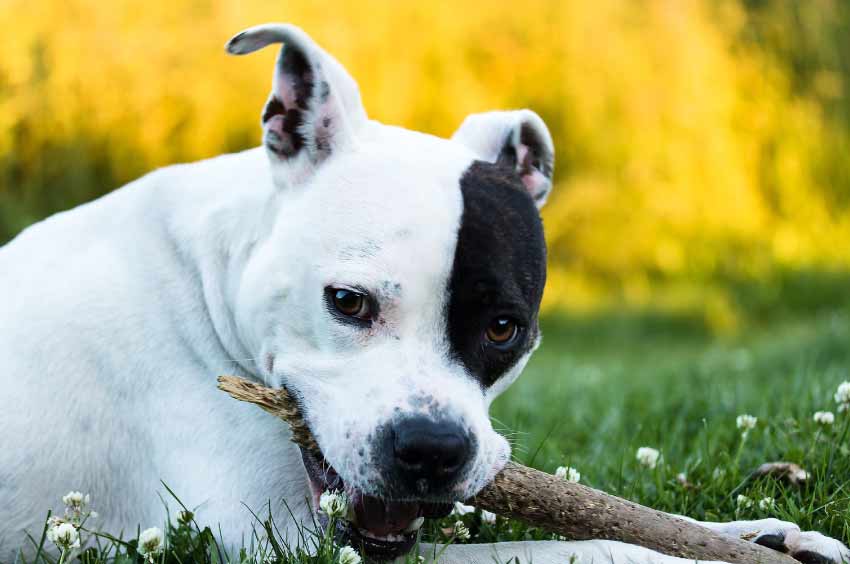
Feeding Your AmStaff Puppy
Feed a complete and balanced puppy food made for your puppy’s life stage. PetMD advises splitting a puppy’s food into at least three meals a day, then moving most adults to two meals a day starting around 1 year old. It also advises avoiding exercise right after meals.
Ask your vet how much to feed and how to check body condition as your puppy grows. Treats count toward daily calories, and keeping your AmStaff at a healthy weight is part of good long-term care.
Socializing and Training American Staffordshire Terrier Puppies
Early, positive experiences help American Staffordshire Terrier puppies grow into confident adults.
- Socialize thoughtfully. The STCA recommends that puppies and young adults meet many other dogs, but only in controlled settings with dogs of known temperament.
- Introduce new people, places, sounds, and surfaces gradually, and keep experiences positive.
- Use reward-based training. The STCA says training works best when it stays fun and varied. PetMD notes AmStaffs can be strong-willed but are eager to please.
- Enroll in puppy classes to practice manners around distractions.
Other dogs and small animals
The STCA advises that AmStaffs should not be left unsupervised with other dogs, and notes that dog aggression can develop even in well-socialized dogs. PetMD mentions a naturally strong prey drive, which can make life with small pets more challenging. Make introductions slowly and on a leash, and supervise. Our guide to dog-on-dog aggression explains warning signs and how to manage them.
Children
The STCA describes AmStaffs as very good with children, but adds that children and dogs of any breed should never be left alone together. PetMD likewise says interactions between kids and dogs of any breed always need supervision. Teach children to be gentle and to leave a dog alone when it’s eating or resting.
Exercise and Enrichment
AmStaffs are energetic. PetMD suggests adult AmStaffs get at least 60 minutes of exercise daily, which can be split into shorter sessions. Puppies need age-appropriate activity instead:
- Short walks and gentle play sessions
- Free play on safe, soft surfaces rather than forced long runs
- Short training sessions throughout the day
- Puzzle toys, chew toys, and sniff games for mental work
Build up exercise gradually as your puppy matures, and ask your vet when longer runs or more strenuous activities are appropriate.
Grooming Basics
The AmStaff’s short, stiff coat is easy to care for. PetMD suggests brushing about once every few weeks and bathing every 4–6 weeks. Routine care also includes:
- Regular nail trims
- Ear checks and cleaning as needed
- Tooth brushing and dental checkups
Handle your puppy’s paws, ears, and mouth gently from an early age so grooming becomes routine.
Health Tests to Ask Breeders About
Before choosing between American Staffordshire Terrier puppies, ask for verifiable health-testing records for both parents. The STCA’s health committee recommends these tests (check the STCA health page for current guidance):
| Test | What it checks | STCA notes |
|---|---|---|
| Hip evaluation | Hip dysplasia | OFA (final at 2 years) or PennHIP (from 16 weeks) |
| Congenital cardiac exam | Heart disease | Exam by a cardiologist; dog must be 1 year old for the OFA database |
| Thyroid evaluation | Autoimmune thyroiditis | Annual testing recommended |
| NCL-A DNA test | Cerebellar ataxia | Two carriers should never be bred together |
| ALPP test | Juvenile laryngeal paralysis and polyneuropathy | A linked-marker test, less reliable than a direct mutation test |
| Eye exam and elbows | Inherited eye conditions; elbow dysplasia | Optional |
Results for these tests can be registered with the Orthopedic Foundation for Animals (OFA), so you can often look them up. No single test guarantees a puppy will never develop disease, but screened parents reduce the risk of some inherited problems. PetMD also lists elbow dysplasia, progressive retinal atrophy, hypothyroidism, cerebellar ataxia, and allergies among breed health concerns.
Choosing a Puppy and a Responsible Breeder
The AVMA notes that, when possible, you should meet the puppy’s parents, since their temperaments are often good indicators of what the puppy’s temperament will be.
- Meet the puppy and, where possible, its mother in the place where the litter is raised.
- Review veterinary, vaccination, and deworming records.
- Ask for the parents’ health-test results, and check them on OFA where possible.
- Ask about the parents’ temperaments and the puppies’ early socialization.
- Ask about the breeder’s contract, return policy, and support after you take the puppy home.
Red flags
- Pressure to pay immediately
- Refusal to show records or let you visit
- Promises that a puppy will “never” have health problems or will be guaranteed perfect with all dogs
Adoption and Rescue
Not every family needs to start with American Staffordshire Terrier puppies from a breeder. The AVMA notes that both purebred and mixed-breed dogs can be found at shelters and rescue organizations, and that some rescues focus on specific breeds. An adult AmStaff can be a great choice: the AVMA says adult dogs are often already housetrained, know some commands, and usually adapt well to a new home.
Example Scenario (illustrative)
Marcus in North Carolina is comparing two litters. One breeder shares OFA hip, cardiac, thyroid, NCL-A, and ALPP results for both parents and invites him to meet the mother. The other says the parents are “healthy” but has no paperwork and wants a deposit today. Marcus chooses the first breeder, then books a vet exam for the week his puppy comes home. This is an illustration, not a real case.
US Ownership Considerations
- Local rules: requirements for dogs vary by city, county, and state. The AVMA suggests checking for restrictions on the number or types of pets where you live, including building, town, or state ordinances.
- Housing: read your lease or HOA rules before you commit.
- Insurance: check your homeowners or renters insurance terms, since policies differ.
- Long-term commitment: raising a strong, active dog takes daily time for exercise and training, plus ongoing costs for food, vet care, and supplies. The AVMA notes that the purchase price is only the initial expense.
Planning ahead protects both you and your dog. If you’re also considering bully breeds, our guide to the tri color American Bully explains how that breed differs.
American Staffordshire Terrier Puppies: FAQs
How big do American Staffordshire Terrier puppies get?
The AKC standard prefers about 18–19 inches at the shoulder for males and 17–18 inches for females, with weight in proportion. PetMD gives a typical weight of roughly 40–70 pounds, depending on build.
What should I look for when choosing an AmStaff puppy?
Meet the puppy and its mother if possible, review vet and deworming records, check the parents’ health tests, and ask about temperament, socialization, and the breeder’s contract.
What health tests should an American Staffordshire Terrier breeder provide?
The STCA recommends hip, congenital cardiac, and thyroid evaluations, plus NCL-A and ALPP testing. Eye and elbow exams are optional. Check the STCA health page for current guidance.
Are American Staffordshire Terriers good family dogs?
Many can be. The STCA and PetMD describe AmStaffs as good with children, but both stress that kids and dogs of any breed need supervision. Each dog’s temperament, training, and socialization matter.
How should I socialize and train an AmStaff puppy?
Use reward-based training and short, fun sessions. Introduce new people and places gradually, and meet other dogs only in controlled settings with dogs of known temperament.
How much exercise does an American Staffordshire Terrier puppy need?
Puppies need short, age-appropriate play and walks rather than forced long runs. PetMD suggests at least 60 minutes daily for adults, split into sessions. Ask your vet as your puppy grows.
Can I adopt an American Staffordshire Terrier instead of buying from a breeder?
Yes. The AVMA notes purebred dogs can be found at shelters and rescues, including breed-specific rescues. Adult dogs often adapt well to new homes.
Final Verdict: American Staffordshire Terrier Puppies
American Staffordshire Terrier puppies can grow into loyal, athletic, people-loving companions, but they need time, training, and responsible care. Choose a breeder who shares STCA-recommended health tests, socialize your puppy carefully, supervise around children and other animals, and work with your vet from day one.
Your next steps
- Ask breeders for the parents’ OFA health results before you visit.
- Plan your puppy’s routine with our guide to crate training.
- Browse more breed guides in our dogs section.
Share your AmStaff puppy photos with our community on Facebook.
About the author
Written and reviewed by the Pets Store Home Editorial Team: pet owners and animal lovers who check every guide against trusted US veterinary and animal-welfare sources. This article is general information, not a substitute for professional veterinary advice. Always talk to your veterinarian about your own pet’s health.
How we checked this guide: We used the AKC breed page and standard, the Staffordshire Terrier Club of America’s breed and health pages, AVMA guidance on selecting a dog, and PetMD’s breed guide written by Georgina Ushi, DVM. We review this article every 12 months, or sooner if guidance changes.
Last reviewed: October 2026
Sources
- American Kennel Club – American Staffordshire Terrier (accessed Oct 2026)
- AKC – Official Standard of the American Staffordshire Terrier (1936) (accessed Oct 2026)
- Staffordshire Terrier Club of America – Health (accessed Oct 2026)
- Staffordshire Terrier Club of America – Breed Info (accessed Oct 2026)
- AVMA – Selecting a Pet Dog (accessed Oct 2026)
- PetMD – American Staffordshire Terrier (Georgina Ushi, DVM; accessed Oct 2026)
[…] Which foreign pets are legal in Washington State? […]