The Most Popular Pets in the UK (Top 10, With Data)

Quick Answer

Dogs are the UK’s most popular pet, with around 11.1 million kept in UK households, closely followed by cats at roughly 10.5 million. Together, more than half (54%) of UK households own at least one pet, with indoor birds, fish, guinea pigs and rabbits rounding out the country’s most commonly kept animals.

Key Takeaways

  • Dogs (11.1 million) and cats (10.5 million) are by far the UK’s most popular pets, together found in the majority of pet-owning homes.
  • 54% of UK households own a pet of some kind.
  • Rabbit ownership has been gradually declining as awareness grows of their complex welfare needs.
  • Costs vary hugely by pet type, from under £20 a month for small rodents to several thousand pounds a year for horses.
  • Population figures come from large-scale surveys, such as PDSA’s PAW Report, rather than a national registry, so numbers are estimates.
  • “Petflation” is a growing pressure, with 22% of UK owners saying pet costs have turned out higher than expected.

Why Trust This Guide?

This guide is researched and written by the Pets Store Home editorial team, drawing primarily on PDSA’s Animal Wellbeing (PAW) Report, Kennel Club registration data, and published UK pet-cost surveys. We cross-check figures across sources where possible and review this content regularly as new survey data becomes available. Because most pet population figures in the UK are survey-based estimates rather than a full census, we note where numbers carry a wider margin of error.

More than half of UK households (54%) own a pet, according to PDSA’s Animal Wellbeing (PAW) Report, one of the largest annual surveys of pet ownership in the country. Here’s how the most commonly kept pets in the UK stack up, based on PDSA’s population estimates.

1. Dogs — around 11.1 million

Dogs are the UK’s most popular pet by population, with numbers at a record high of around 11.1 million. Dog ownership has grown steadily in recent years, partly driven by more people working from home.

Most dogs live somewhere between 10 and 13 years depending on breed and size, with smaller breeds typically living longer than large ones. Annual costs vary hugely too: a small dog can cost owners around £1,500–£2,000 a year in food, insurance and routine vet care, while a large or giant breed can push £2,500–£3,500 or more once you factor in bigger food bills and a higher chance of joint or breed-specific health issues. The French Bulldog, Labrador Retriever and Cocker Spaniel remain among the UK’s most registered breeds with the Kennel Club, though brachycephalic breeds like the Frenchie carry well-documented health risks that vets and welfare charities increasingly urge prospective owners to research before buying.

2. Cats — around 10.5 million

Cats come a close second, with a fairly steady population of around 10.5 million. Cats remain popular with owners who want companionship without the same level of daily walking commitment as a dog.

Cats are considerably cheaper to keep than dogs, with a modest but realistic budget working out at around £480–£700 a year, and they can live well into their mid-to-late teens with good care. Whether to keep a cat strictly indoors or allow outdoor access is a genuinely debated question among UK owners: outdoor cats face risks from traffic and disease, while indoor-only cats need more deliberate enrichment to stay mentally stimulated. Neutering remains a major welfare focus for UK cat charities, since an unneutered cat population contributes heavily to the number of strays and rescue admissions each year.

3. Indoor birds — around 1.4 million

Around 2.7% of UK households keep an indoor bird as a pet, putting the estimated population at roughly 1.4 million — making birds the most popular pet after cats and dogs.

The indoor bird category spans everything from budgerigars and canaries, which are relatively low-maintenance and cost little to keep, through to larger parrots that can live 20 to 80 years and have complex social and enrichment needs that many owners underestimate. Noise, mess and the sheer time commitment of a long-lived, intelligent parrot are common reasons rescue centres cite for birds being rehomed. Finding a vet with genuine avian expertise can also be harder outside major UK cities, which is worth checking before taking one on.

4. Ornamental fish — kept by around a fifth of households

Fish are harder to count individually, but ownership is widespread: around 21% of UK households have an indoor fish tank and 13% have an outdoor pond, making fish-keeping one of the most common pet hobbies even though exact population figures vary by source.

Fish are often seen as the cheapest pet to start with, and the fish themselves usually are inexpensive, but the ongoing running costs of a tank — filtration, heating for tropical species, lighting and electricity — add up over time and are frequently underestimated by first-time owners. A coldwater goldfish setup is generally more forgiving and affordable than a tropical tank, but both need the tank properly cycled before fish are introduced, and overstocking a new tank remains one of the most common beginner mistakes in the hobby.

5. Guinea pigs — around 700,000

Guinea pigs are kept in around 1.2% of UK households, putting their estimated population at roughly 700,000. They’re popular as a first small pet, especially for families with children.

Guinea pigs are social animals that do best kept in same-sex pairs or small groups rather than alone, and UK welfare guidance is increasingly clear on this point. They need a constant supply of hay, a diet supplemented with vitamin C since they can’t produce it themselves, and enough space to move around properly rather than a small hutch. Keeping a pair typically costs somewhere between £20 and £40 a month for food, bedding and routine care, and they tend to live four to eight years, making them a popular first “own pet” for children under adult supervision.

6. Tortoises and turtles — around 700,000

An estimated 1.6% of households keep a tortoise or turtle, giving a population of around 700,000. Tortoises in particular are known for very long lifespans, sometimes outliving their owners.

Tortoises are one of the biggest long-term commitments on this list: many species can live 50 years or more with good care, meaning a tortoise bought for a child could realistically outlive its original owner’s time at home. In the UK’s climate, keeping one well means investing in proper indoor housing with UV lighting and heating for most of the year, alongside outdoor access when weather allows. Interest in reptile-keeping has grown steadily over the past decade, and species-specific care advice matters a great deal here, since needs vary widely between a small Mediterranean tortoise and a large aquatic turtle.

7. Horses and ponies — around 600,000

Horses and ponies remain a significant part of UK pet ownership, with an estimated 600,000 kept across the country, from smallholdings to riding livery yards.

Horses and ponies sit in a different cost bracket entirely to every other pet on this list. Between livery fees, feed, farriery, vaccinations, insurance and equipment, owning a horse in the UK commonly runs into several thousand pounds a year, before accounting for land or stabling if you’re not using a livery yard. The UK’s equestrian culture remains strong, supported by riding schools, Pony Club branches and a well-established competition and leisure riding scene, but prospective owners are generally advised to gain riding and handling experience through lessons or loan arrangements before committing to ownership.

8. Snakes — around 600,000

Pet snakes are kept in around 1.3% of households, putting the population at roughly 600,000 — reptile keeping has grown steadily as a hobby over the past decade.

Snake-keeping has grown steadily in the UK as part of a broader rise in reptile ownership, with corn snakes and royal (ball) pythons among the most popular starter species thanks to their manageable size and generally calm temperament. Most commonly kept pet snakes aren’t subject to special licensing in the UK, though a small number of larger or venomous species fall under the Dangerous Wild Animals Act and require a specific licence. As with tortoises, correct heating, humidity and enclosure size are essential to welfare, and finding a vet experienced with reptiles is worth doing before, not after, a health problem comes up.

9. Hamsters — around 600,000

Hamsters are kept in around 1.5% of households, an estimated population of 600,000. They remain a popular starter pet thanks to their small size and low space requirements.

Hamsters are inexpensive to keep and popular as a child’s first pet, but they’re short-lived, typically only two to three years, and nocturnal, which can make them a frustrating choice for children who want to interact during the day. Syrian hamsters must be housed alone as adults, since they’re solitary and will fight if kept together, while some dwarf species can sometimes be kept in compatible pairs. UK welfare guidance has shifted in recent years toward recommending much larger cage sizes than were traditionally sold as “hamster cages,” reflecting a better understanding of how much space they need to exhibit natural behaviours.

10. Rabbits — around 500,000–700,000 (declining)

Rabbits are kept in roughly 1.1% of UK households. PDSA’s data has shown a gradual decline in rabbit ownership over recent years, even though rabbits remain a well-known pet choice for families.

Rabbit ownership has been gradually declining in the UK, and welfare charities including the RSPCA and PDSA point to growing awareness that rabbits have far more complex needs than the traditional image of a child’s hutch pet in the garden. Rabbits are highly social and, ideally, should be kept in neutered pairs rather than alone, need much more space than a standard hutch provides, and require vaccination against myxomatosis and rabbit viral haemorrhagic disease (RVHD), both of which are serious and common in the UK. Properly kept, a rabbit typically costs in the region of £420 a year and can live 8 to 12 years, considerably longer than many owners expect going in.

Population estimates are drawn from the PDSA Animal Wellbeing (PAW) Report, an annual survey of UK pet owners. Figures are estimates based on survey sampling, not a full census, so exact numbers vary slightly between sources and years.

The Rising Cost of Pet Ownership Is Reshaping the UK Market

“Petflation” has become a real pressure point for UK households: PDSA’s first Pet Health Inequality Report, published in 2026, found that over one in five UK pet owners (22%) say keeping a pet has turned out more expensive than they expected, driven by rising vet fees, food costs and insurance premiums. At the same time, spending on pet technology — smart feeders, GPS trackers and pet cameras — has grown around 34% year-on-year, with the UK pet tech market now estimated at roughly £420 million. Together, these trends point to a market that’s simultaneously getting more expensive at the essentials end and more sophisticated at the discretionary end, which can leave lower-income pet-owning households squeezed from both directions.

Choosing the Right Pet for Your Lifestyle and Budget

The most popular pets in the UK aren’t necessarily the right fit for every household, and matching a pet to your actual living situation matters more than picking whatever’s trending. Dogs need daily exercise, companionship and a realistic ten-plus year commitment; cats suit people who want affectionate company without the same exercise demands; small mammals like guinea pigs and hamsters can work well as a lower-cost introduction to pet care, provided their specific social and space needs are respected rather than assumed; and long-lived animals like tortoises and parrots deserve serious thought about who will care for them decades from now. Before bringing any animal home, it’s worth checking the RSPCA, PDSA or Blue Cross websites for species-specific welfare guidance, and being honest about the time, space and ongoing budget you can commit for the animal’s full lifespan, not just the first year.

How These Population Figures Are Actually Counted

Unlike some countries, the UK doesn’t require national registration for most pets, so there’s no single official headcount the way there is for, say, registered vehicles. Instead, figures like the ones used in this article are built from large-scale household surveys — most notably PDSA’s annual Animal Wellbeing (PAW) Report, which surveys thousands of UK pet owners and vet professionals each year and is widely treated as the most reliable ongoing source for pet population estimates. Because these are survey-based estimates rather than a full census, figures for smaller pet categories in particular (birds, reptiles, small mammals) carry a wider margin of error than the headline dog and cat numbers, and different organisations occasionally publish slightly different totals depending on their methodology and survey year.

Popular Dog and Cat Breeds in the UK Right Now

Within the UK’s 11.1 million dogs, Kennel Club registration data consistently places the French Bulldog, Labrador Retriever, Cocker Spaniel and Cockapoo among the most popular breeds and crossbreeds, alongside a continued rise in “designer” crossbreeds bred for low-shedding coats and family-friendly temperaments. On the cat side, moggies (non-pedigree cats) make up the large majority of the UK’s pet cat population, with pedigree breeds such as the British Shorthair, Ragdoll and Maine Coon accounting for a much smaller but growing share, often commanding higher purchase prices and, in some cases, breed-specific health insurance premiums. Prospective owners researching a specific breed are generally encouraged to look past appearance and check known breed health issues, ideally with a vet or breed club, before committing.

Regional Differences in Pet Ownership Across the UK

Pet ownership isn’t evenly spread across the country. Rural and semi-rural areas tend to have higher rates of dog ownership, partly reflecting more outdoor space and, in some regions, a stronger working-dog tradition, while ownership of space-efficient pets like cats, small mammals and fish tends to be more evenly distributed across urban and suburban areas. London and other major cities generally show lower overall pet ownership rates than the national average, likely linked to smaller homes, rental restrictions on pets, and higher living costs, though cat ownership in flats and houses without gardens remains common throughout urban Britain.

Insurance and Vet Costs Vary a Lot by Pet Type

How much you’ll spend on veterinary care and insurance depends heavily on which animal you choose. Dogs and cats are the only pets for which a large, competitive pet insurance market exists in the UK, with dozens of insurers offering everything from basic accident-only cover to comprehensive lifetime policies. Insurance for smaller pets like rabbits, guinea pigs and birds is available from a smaller number of specialist providers and tends to be far less common, partly because individual vet bills for these animals are usually lower, and partly because fewer owners actively shop for it. Exotic pets such as reptiles often have the most limited insurance options of all, and owners of tortoises, snakes and lizards are more likely to self-fund vet costs, which is worth budgeting for given that specialist exotic vet consultations can be more expensive than a standard cat or dog appointment.

FAQ: Popular Pets in the UK

What is the most popular pet in the UK?
Dogs are the most popular pet by population, at an estimated 11.1 million, just ahead of cats at around 10.5 million.

What percentage of UK households own a pet?
Around 54% of UK households own at least one pet, according to PDSA’s PAW Report.

Is rabbit ownership declining in the UK?
Yes. PDSA’s survey data has shown a gradual decline in rabbit ownership over recent years, even though rabbits remain a well-known family pet.

Where do these population figures come from?
Mainly from PDSA’s Animal Wellbeing (PAW) Report, which surveys thousands of UK pet owners each year and is one of the most widely cited sources for UK pet ownership data.

Which pet is cheapest to keep in the UK?
Small rodents such as hamsters and guinea pigs are generally the cheapest pets to keep month to month, though guinea pigs need to be kept in pairs, which roughly doubles their running costs compared with a single animal. Coldwater fish are also low-cost once a tank is set up, though initial equipment costs can be higher than people expect.

Why is rabbit ownership declining in the UK?
Growing awareness of rabbits’ complex welfare needs — particularly their need for companionship, space and vaccination — appears to be a major factor, as does a better understanding among prospective owners that rabbits are a bigger commitment than the traditional hutch-in-the-garden image suggests.

Are exotic pets like snakes and tortoises legal to keep in the UK without a licence?
Most commonly kept pet reptiles, including corn snakes, royal pythons and Mediterranean tortoises, don’t require any special licence in England, Scotland or Wales. A small number of species considered dangerous or venomous fall under the Dangerous Wild Animals Act 1976 and do require a local authority licence, so it’s worth checking a species’ legal status before buying, particularly for anything unusual.

Matching the Right Pet to the Right Benefits

For a research-backed look at what pet ownership actually does for your health, routine, and social life (and what it honestly costs), see our guide to 8 real benefits of owning a pet, backed by research.

Best Pet Insurance UK (2026): Complete Cost Guide

Best Pet Insurance UK (2026): Complete Cost Guide

Quick Answer

The pet insurance UK depends on your budget and your pet’s age and breed, but lifetime cover is generally considered the strongest option because it renews your claim allowance each year for ongoing conditions, rather than capping or excluding them. Average UK premiums in 2026 run around £436 a year for dogs and £179 a year for cats, though costs vary widely by breed, age and location — compare at least three quotes and check the level of cover, not just the headline price, before choosing.

Key Takeaways

  • Lifetime cover offers the most reliable ongoing protection for chronic conditions; time-limited and maximum benefit policies are cheaper but cap what they’ll pay.
  • Average 2026 UK premiums are around £436/year for dogs and £179/year for cats, but breed, age and postcode all move the price significantly.
  • Pre-existing conditions are the number one reason claims get rejected — be upfront about your pet’s health history.
  • Insuring young and healthy locks in a cleaner claims history and avoids losing cover for conditions that develop later.
  • Multi-pet discounts (typically 5–15%) are common if you insure more than one animal.
  • Always compare the excess, co-payment percentage, and annual or lifetime benefit limit, not just the monthly premium.

Why Trust This Guide?

This guide is researched and written by the Pets Store Home editorial team, drawing on published data from the Association of British Insurers (ABI), current UK insurer policy structures, and Financial Ombudsman Service guidance on claims disputes. We focus on UK-specific pricing and regulation, and review and update this content regularly to reflect current premium trends. This article is provided for general information and isn’t personalised financial advice; always compare full policy documents before buying.

Why Pet Insurance Matters in the UK

Vet treatment in the UK isn’t covered by the NHS, and costs for surgery, diagnostics, and ongoing treatment can run into thousands of pounds. Pet insurance is designed to help cover those costs so a health emergency doesn’t become a financial one. This guide walks through the main types of cover, what affects the price, and what to check before you buy — it’s general information, not financial advice, so always compare current quotes and full policy terms directly with insurers. If you’re weighing up whether a specific breed of dog or cat is right for you, it’s worth understanding their typical health needs before you insure them.

The Main Types of Pet Insurance Cover

UK pet insurance policies generally fall into four categories, and the difference between them matters more than the headline price:

Accident-only covers injuries from accidents but not illnesses, and is usually the cheapest option.
Time-limited covers both accidents and illnesses, but only for a set period (commonly 12 months) after a condition is first diagnosed — after that, the condition is excluded.
Maximum benefit covers a condition until a set monetary limit is reached, with no time limit, but once you hit that limit the condition is excluded going forward.
Lifetime cover renews your claim limit each year for ongoing conditions, as long as you keep renewing the policy without a break. It’s the most comprehensive type and typically the most expensive.

Cover Types at a Glance

Cover Type Covers Best For
Accident-only Injuries only, not illness Budget cover, older declined pets
Time-limited Accident + illness, ~12 months per condition Short-term budget cover
Maximum benefit Accident + illness, up to a set £ limit Mid-range, no time cap
Lifetime Renews yearly for ongoing conditions Most comprehensive, chronic conditions
best pet insurance in the uk a complete guide

What Affects the Cost of Pet Insurance

Premiums vary a lot between pets and providers. Common factors insurers use to price a policy include your pet’s breed and size (some breeds are prone to costlier hereditary conditions), age (premiums typically rise as pets get older), your location, and whether your pet has any pre-existing conditions, which are usually excluded from cover. Keep in mind that pet insurance premiums in the UK are also subject to Insurance Premium Tax, currently charged at the standard rate of 12%, which is added on top of the base premium.

What to Check Before You Buy

The cheapest policy on paper isn’t always the best value. Before choosing a policy, check the per-condition and per-year claim limits, the excess (the amount you pay per claim) and whether there’s a co-payment percentage on top of it, whether dental illness and complementary therapies are included, and what specifically is excluded. It’s also worth checking how the insurer handles conditions related to a breed’s known predispositions, since these are sometimes excluded or capped differently.

How to Compare Quotes

Because cover types and exclusions vary so much, comparing pet insurance mainly on price can be misleading. A policy that looks cheaper may have a lower claim limit, a higher excess, or a co-payment that increases with your pet’s age. When comparing quotes, get like-for-like cover types (for example, compare lifetime policies against other lifetime policies), read the policy document rather than just the summary, and check reviews of how straightforward each insurer is to actually claim with.

How Much Pet Insurance Actually Costs in the UK Right Now

According to the Association of British Insurers, the average UK pet insurance premium in 2026 works out to around £436 a year for a dog and £179 a year for a cat — roughly £13.67 and £7.94 a month respectively. That’s up from an average of £389 in 2024, and the trend has been climbing steadily for several years, even though the pace of increase slowed somewhat through 2025. These are averages across all breeds, ages and cover levels, so your own quote could sit well above or below that depending on the pet in question, where you live, and how much cover you choose.

Why Premiums Keep Rising

Two forces are doing most of the work behind these increases. The first is veterinary cost inflation, which has been running in double digits in some years as practices invest in more advanced diagnostic equipment, out-of-hours emergency care, and referral specialists — all of which push up the average cost of a claim. The second is Insurance Premium Tax, a government tax currently charged at 12% on most general insurance policies sold in the UK, including pet insurance. It’s added on top of the underlying premium, so as the cost of cover itself rises, the tax bill attached to it rises too. Neither of these pressures is within an individual pet owner’s control, but understanding them helps explain why renewal quotes rarely go down.

Lifetime Cover vs Time-Limited vs Maximum Benefit, With Real Examples

The three main types of policy work very differently once a pet develops an ongoing condition. With lifetime cover, a set amount of benefit renews each year for as long as the condition lasts and the policy stays active — so a dog with a lifelong skin allergy would keep getting help with vet bills year after year, provided you renew on time. Time-limited cover only pays out for a condition for a fixed period, typically 12 months from the first claim, after which any further treatment for that same condition is excluded, even if you’re still insured. Maximum benefit cover pays up to a set total amount for a condition and then stops covering it once that pot is used up, however long that takes. In practice, lifetime cover is the only one of the three that behaves like most people assume pet insurance works, which is also why it tends to be the most expensive option.

How Your Pet’s Age Changes the Price

Age is one of the biggest single drivers of premium cost. Industry pricing data shows premiums roughly doubling between age four and age ten for the same dog on the same level of cover, and costs then tend to climb even more sharply each year after that as the statistical likelihood of illness or injury increases. This is worth planning for early: insuring a pet while they’re young and healthy locks in a cleaner claims history and avoids the situation where a condition that develops at, say, age six becomes a pre-existing condition that a new insurer won’t touch if you try to switch later.

Breed and Location Also Move the Price

Certain breeds cost noticeably more to insure because they’re statistically more likely to need treatment. Brachycephalic (flat-faced) breeds such as French Bulldogs, Pugs and English Bulldogs typically cost around twice the all-breed average to insure, reflecting higher rates of breathing difficulties, skin fold infections and birthing complications. Large and giant breeds often carry higher premiums too, linked to conditions like hip dysplasia and bloat. Where you live matters as well: owners in London and other major UK cities can pay 20% to 40% more than those in rural postcodes, largely because veterinary overheads and the cost of emergency and specialist care are higher in urban areas.

Excess, Co-Payments and Benefit Limits Explained

Most UK policies combine a fixed excess (an amount you pay first on any claim, commonly £80–£250) with a percentage co-payment on top, particularly for older pets — it’s common to see co-payments of 10–20% kick in once a dog passes seven or eight years old. On top of that, every policy has a benefit limit, which might apply per condition, per year, or as a lifetime cap depending on the type of cover. When you’re comparing quotes, a cheaper headline premium often hides a higher excess, a steeper co-payment, or a lower benefit limit, so it’s worth working through a realistic claim scenario — not just the monthly price — before deciding.

Pre-Existing Conditions and How Insurers Assess Them

A pre-existing condition is any illness or injury your pet showed signs of, was diagnosed with, or was treated for before your policy started (or before it was upgraded). Insurers assess this by requesting your pet’s full veterinary history when you make a claim, not just when you take out the policy, so an old note in a vet’s records about a minor limp or a skin flare-up can resurface months or years later during a claims investigation. This is the single most common reason claims are refused in the UK, so it’s worth being upfront about your pet’s history from the start and keeping your own copy of their clinical notes if you ever plan to switch insurer.

Multi-Pet Discounts and Family Cover

If you insure more than one cat or dog, most UK insurers offer a multi-pet discount, typically somewhere between 5% and 15% off each policy, applied automatically once you add a second or third animal under the same account. It’s a genuine saving rather than a marketing gimmick, but it’s still worth checking that the level of cover on each individual pet’s policy is right for them — a discount isn’t worth much if it comes attached to a lower benefit limit than you’d have chosen for that specific animal on its own.

Insuring an Older or Senior Pet

Many insurers cap the age at which a pet can first be insured, often somewhere around eight to ten years old for accident-and-illness cover, after which some switch to accident-only policies or refuse new applications altogether. If your pet is already insured, most providers will keep renewing them into old age without a new upper limit, which is another reason starting cover early and keeping it continuous matters more than people often realise. If you’re looking for cover for a senior pet for the first time, expect a smaller pool of insurers to choose from, higher premiums, and a closer look at existing health records.

Switching Insurers: What You Lose and What You Keep

You can switch pet insurance provider at any time, usually at renewal to avoid losing any unused no-claims history, but doing so resets your relationship with a new insurer from scratch in one important way: any condition your pet has already been treated for becomes a pre-existing condition on the new policy, even if the old insurer was covering it under lifetime cover. This is why people often stay with an expensive lifetime policy rather than switching once a pet develops a chronic condition — moving providers would mean losing cover for that condition altogether. If your pet is still healthy, switching is far less risky and can be a straightforward way to bring costs down.

How to Make a Claim: Step by Step

Most UK insurers follow a broadly similar claims process. You’ll usually need to pay the vet directly at the time of treatment (some insurers offer direct vet-to-insurer payment for larger claims), then submit a claim form along with the itemised invoice and, if requested, a clinical history report from your vet. Claims are typically processed within one to two weeks once all the paperwork is in, though anything involving a pre-existing condition query or a request for further vet records can take longer. Keeping digital copies of every invoice and vaccination record as you go, rather than searching for them after the fact, makes the whole process considerably faster.

Why Claims Get Rejected, and How to Avoid It

The most common reason UK claims are turned down is a dispute over pre-existing conditions, but several other avoidable issues come up regularly. Nearly every policy has an initial exclusion period, commonly 10 to 14 days from the start date, during which no new illness is covered — a claim made in that window is almost always refused. Missed annual vaccinations can also invalidate cover for related illnesses, since most policies require pets to be kept up to date as a condition of the contract. Administrative problems cause a surprising number of rejections too: missing invoices, incomplete claim forms, or a lapsed direct debit that quietly cancelled the policy without the owner noticing. If a claim is rejected, insurers are required to explain why in writing, and you can challenge the decision through the insurer’s complaints process or, if unresolved, escalate it to the Financial Ombudsman Service.

Common Mistakes Owners Make

  • Choosing purely on the cheapest monthly premium. Why it happens: price is the easiest thing to compare. Consequence: ending up with a low benefit limit or high excess that costs more at claim time. Fix: compare like-for-like cover types and read the full policy wording.
  • Not disclosing full vet history. Why it happens: forgetting a minor past issue, or assuming it won’t matter. Consequence: the number one reason claims are rejected in the UK. Fix: be fully upfront about your pet’s medical history from day one.
  • Waiting until a pet is older to insure. Why it happens: insurance feels unnecessary for a healthy young pet. Consequence: any condition that develops before you insure becomes permanently excluded. Fix: insure while your pet is young and healthy to lock in a clean history.
  • Switching insurers without checking pre-existing condition rules. Why it happens: chasing a cheaper quote. Consequence: losing cover for an already-diagnosed condition. Fix: only switch while your pet is fully healthy, or stay put once a chronic condition is covered.
  • Letting a direct debit lapse accidentally. Why it happens: a card expiry or bank change goes unnoticed. Consequence: the policy silently cancels, and a claim made afterward is refused. Fix: check your policy is active at least once a year at renewal.

Is Pet Insurance Worth It? Doing the Maths

There’s no single right answer, but the numbers are worth running for your own situation. At an average of roughly £436 a year for a dog, a lifetime policy costs somewhere in the region of £4,000–£7,000 over a typical 10–12 year lifespan once you factor in rising premiums as your pet ages. Against that, a single serious illness or accident — a torn cruciate ligament, a foreign body removal, a course of cancer treatment — can easily cost £2,000 to £6,000 or more in a single event. For owners who could comfortably self-insure by setting the equivalent monthly premium aside in a savings account and never touching it, that can work out cheaper over a healthy pet’s lifetime. For most people, though, the value of insurance isn’t really about the average cost, it’s about not having to make a treatment decision based on what you can afford in an emergency.

Accident-Only Cover: When It Makes Sense

Accident-only policies are the most basic and cheapest form of cover, paying out for injuries from accidents — road traffic collisions, cuts, broken bones, swallowed objects — but excluding illness entirely, so nothing is paid for cancer, diabetes, skin conditions or infections. This can suit owners of older pets who’ve been declined for accident-and-illness cover elsewhere, or anyone who wants a safety net for sudden trauma without paying for full cover. It’s worth going in with realistic expectations: for a young, healthy pet, the majority of lifetime claims tend to be for illness rather than accidents, so accident-only cover leaves a significant gap.

Vet Fee Cover vs Third-Party Liability and Death Cover

Most UK pet insurance quotes bundle in more than just vet fees. Third-party liability cover, which is a legal requirement for some dog breeds and strongly recommended for all dog owners, pays out if your dog injures someone or damages property. Some policies also include cover for the cost of the pet itself if they die or are stolen, and for advertising and reward costs if a cat or dog goes missing. These add-ons rarely cost much extra, but it’s worth checking exactly what’s included as standard rather than assuming, since the balance varies a lot between insurers.

Before You Buy: Checklist

  • ☐ Compared at least 3 quotes with the same cover type (e.g. lifetime vs lifetime)
  • ☐ Checked the excess, co-payment %, and benefit limit — not just the price
  • ☐ Confirmed the exclusion period and what it covers from day one
  • ☐ Disclosed full vet history honestly
  • ☐ Checked if multi-pet discount applies and whether cover level still fits

Sources & References

About the Author & Editorial Process

This guide was researched and written by the Pets Store Home editorial team — pet owners and researchers who verify every claim against trusted sources before publishing.

This content is for general information only and isn’t personalised financial advice; always compare full policy documents directly with insurers before buying.

Last reviewed: September 2026  |  Read our Editorial Standards

FAQ: Pet Insurance in the UK

Is pet insurance worth it in the UK?
For most owners, yes — a single emergency surgery or ongoing illness can cost far more than years of premiums combined. Whether it’s worth it for you depends on your pet’s breed, age, and your own ability to cover a large unexpected vet bill.

What isn’t covered by pet insurance?
Pre-existing conditions are almost never covered. Routine care like vaccinations, flea and worm treatment, and neutering is also typically excluded unless you have an add-on wellness plan.

Does pet insurance cost more as my pet gets older?
Usually, yes. Premiums for most policies increase with age, and some insurers add a co-payment percentage for older pets, so it’s worth reviewing your policy each year at renewal.

Can I switch pet insurance providers?
You can, but be aware that any condition your pet has already been treated for may become a pre-existing exclusion with a new insurer, even if it was covered under lifetime cover with your old one.

Does pet insurance cover dental treatment?
Most standard policies only cover dental treatment resulting from an accident, such as a broken tooth from trauma, not routine dental disease or cleaning. A small number of insurers offer optional dental add-ons that cover illness-related dental work — check the policy wording carefully if this matters to you.

Can I insure a pet with a pre-existing condition?
Some specialist insurers will offer cover that excludes the known condition but covers everything else, though this is less common and usually more expensive. A handful of providers offer limited cover for “cured” pre-existing conditions after a symptom-free period, typically two years, but policy wording varies significantly, so read the fine print before assuming you’re covered.

Final Thoughts

Pet insurance isn’t about predicting exactly what will go wrong — it’s about making sure a health scare never turns into a financial one too. Lifetime cover offers the strongest ongoing protection, but the right choice ultimately depends on your pet’s age, breed, and your own budget and risk tolerance. Whatever you choose, the details matter more than the headline price: check the excess, the benefit limits, and exactly what’s excluded before you commit. If you’re still deciding, start by getting a handful of like-for-like quotes and reading the policy documents in full — a little time spent comparing now can save a lot of stress later, when it actually counts. Explore more pet care guides  and whatever cover you land on, keeping your pet’s vaccinations current and your vet records handy will make any future claim far smoother.

Why Pet Insurance Pairs With the Bigger Ownership Picture

For a research-backed look at what pet ownership actually does for your health, routine, and social life (and what it honestly costs), see our guide to 8 real benefits of owning a pet, backed by research.

Wondering Whether Your Dog Could Qualify as a Service Animal?

Pet insurance for a working or service dog covers the same veterinary realities as any other dog, but the legal side is a separate question entirely. Our guide on what actually makes a dog a legally recognized service animal breaks down the ADA’s task-trained standard, the difference from emotional support animals, and what businesses can and can’t ask.

Insuring a Cancer-Prone Breed Like the Golden Retriever

Some breeds carry a meaningfully higher lifetime cancer risk than others, and that risk should factor into both your insurance decision and your puppy-buying budget. Our guide on what actually drives Golden Retriever puppy prices explains why this particular breed’s roughly 60% lifetime cancer incidence makes early insurance enrollment especially worthwhile.

When Is a Mini Goldendoodle Full Grown? Size & Growth Guide

When Is a Mini Goldendoodle Full Grown? Size & Growth Guide

When Is a Mini Goldendoodle Full Grown? Essential 2026 Growth Timeline

When is a mini Goldendoodle full grown? Most mini Goldendoodles reach close to their adult height somewhere between about 8 and 12 months, then keep filling out with muscle and weight until roughly 12 to 15 months. Larger minis can take a little longer. Because this is a mixed breed, your own puppy’s timeline depends on its parents.

Owners usually ask this question for practical reasons: when to stop buying bigger harnesses, when to switch to adult food, and when to talk to the vet about spaying or neutering. This guide answers each of those, stage by stage, using veterinary growth guidance for small and medium dogs.

Key takeaways

  • Mini Goldendoodles usually stop growing taller before they stop gaining weight.
  • By weight, most minis fall into the small or medium groups vets use, which typically finish growing at 9 to 15 months.
  • There is no official breed standard, so the parents’ size is the best size guide.
  • Puppy food is usually switched to adult food around the time growth slows.
  • Spay and neuter timing depends on projected adult weight, so ask your vet.

When Is a Mini Goldendoodle Full Grown? The Short Answer

The honest answer to “when is a mini Goldendoodle full grown?” is that it depends on how big your mini will be. Veterinarian Sandra Mitchell, DVM, writing for PetMD, gives typical ages by adult weight. Here is how those ranges line up with mini Goldendoodle sizes:

Expected adult weight PetMD size group Typical age fully grown
Under 12 lbs (5 kg) Toy 8–12 months
12–24 lbs (5–11 kg) Small 9–12 months
24–59 lbs (11–27 kg) Medium 12–15 months

Source: PetMD, “When Do Dogs Stop Growing?” Individual dogs vary.

Many minis land in the small or lower medium group, which is why the answer often falls between about 9 and 15 months. A 20-pound mini is likely to finish earlier than a 35-pound one.

Pet Care Tip: Buy an adjustable harness and a crate with a divider panel. Both can grow with your puppy, so you avoid replacing gear every few weeks.

When is a mini Goldendoodle full grown: a small brown Goldendoodle puppy sitting in the grass
When is a mini Goldendoodle full grown? Many reach adult height by around their first birthday, then fill out. Photo: Cameron Peters / Unsplash.

Mini Goldendoodle Growth Stages by Age

If you are wondering “when is a mini Goldendoodle full grown?”, start by working out which stage your puppy is in. Growth is fastest in the first few months and then slows. AKC Chief Veterinarian Dr. Jerry Klein says small breeds typically stop growing by 6 to 8 months, and the AKC adds that medium breeds reach adult size at around 12 months. The stages below are a general guide for a typical mini:

Age What usually happens What to do
8–16 weeks Rapid growth; weight can change week to week Weigh weekly, start vaccines and socialization
4–6 months Still growing quickly Use adult-size estimates and plan spay or neuter timing
6–9 months Height gain slows for smaller minis Ask your vet about switching to adult food
9–12 months Many minis are near adult height Check body condition and adjust portions
12–15 months Chest and muscle fill out; larger minis finish growing Record adult weight and height for future vet visits

General guide based on AKC and PetMD small and medium breed timelines. Your puppy may be ahead or behind.

Height first, then filling out

The AKC explains that puppies may stop getting taller but keep developing muscle and body fat. That is why a mini may look lanky at 8 months and noticeably sturdier a few months later. Growth plates near the ends of the bones drive height. Dr. Klein notes they are soft and flexible during puppyhood and harden once the bone reaches its final size.

What Decides Your Mini Goldendoodle’s Adult Size

The parents shape the answer to “when is a mini Goldendoodle full grown?” because they shape adult size. The mini Goldendoodle is a cross, not an AKC-recognized breed, so there is no official height or weight standard.

A mini is usually bred from a Golden Retriever or Goldendoodle and a Miniature Poodle. The Poodle Club of America’s AKC standard defines a Miniature Poodle as over 10 inches and no more than 15 inches at the shoulder, while Golden Retrievers are much larger dogs.

  • Parents: The size of both parents, and of earlier generations, is usually the best guide you have.
  • Generation: Terms like F1, F1B and multigen describe how many generations of crossing are behind the litter. Breeders often say litters with more Poodle in the background run more consistent in size, but results still vary.
  • Sex: Males may end up a little larger than females from the same litter.
  • Nutrition: Good food supports healthy growth, but overfeeding adds fat, not height.

For typical size ranges, see our guide to the full grown mini Goldendoodle. If you are comparing costs with the Golden Retriever side of the family, our Golden Retriever puppy price guide may also help.

How to Estimate Your Puppy’s Adult Size

The question “when is a mini Goldendoodle full grown?” is easier to answer once you have a rough idea of its adult weight. PetMD offers simple rules of thumb that vets sometimes use. They are estimates, not promises.

Adult size estimator (rough guide)

  • Toy and small dogs: weight at 6 weeks × 4, or weight at 8 weeks × 3.
  • Medium and large dogs: weight at 4 months × 2.
  • Example: a puppy weighing 7 lbs at 8 weeks may land near 21 lbs as an adult; a puppy weighing 14 lbs at 4 months may land near 28 lbs.

Formulas from PetMD. Mixed breeds can vary more than purebreds, so treat results as a range.

Mixed breeds are harder to predict. PetMD notes vets may also consider DNA results, the parents’ size, paw size, leg length, body build and sex. Our guide to dog DNA test kits explains what those tests can and cannot tell you.

Is my mini Goldendoodle done growing?

These 5 clues can help you judge whether your mini Goldendoodle is full grown:

  • Its height at the shoulder has not changed for two or three months.
  • Its weight gain has slowed to small, steady changes.
  • Its legs, paws and body tend to look more in proportion and less gangly.
  • The AKC’s Dr. Klein suggests feeling along the ribs: if you can still feel the “knobs” of the ribs, the dog will probably keep growing in height.
  • For a definite answer, PetMD notes that X-rays can show whether the growth plates have closed.

Milestones Tied to Being Full Grown

Owners asking “when is a mini Goldendoodle full grown?” are often really asking about three decisions: food, surgery timing and exercise.

Switching to adult food

VCA Animal Hospitals suggests switching small breeds at about 6 to 8 months and medium breeds at about 9 to 12 months, judged by your vet. VCA warns that puppy food may be too rich for adults and can lead to weight gain. Make the change over 7 to 14 days, mixing in more adult food each day.

Spay and neuter timing

The AAHA canine life stage guidelines base timing on projected adult weight. For dogs expected to weigh under 45 lbs, they suggest neutering males at about 6 months and spaying females before the first heat, at about 5 to 6 months. Many minis are expected to weigh under 45 lbs, but your vet will make the final call.

Exercise and joints

The AKC advises that puppies avoid jumping and extended balancing until their bones finish developing. Short walks, gentle play and training games suit growing minis. Dr. Klein also notes that a lean puppy is better than a chubby one, because puppy obesity can set dogs up for joint problems such as hip dysplasia.

When to call a vet: Limping, a puppy that stops gaining weight, sudden weight loss, or vomiting and diarrhea during a food change that lasts more than a day needs a vet check. For severe pain, collapse or repeated vomiting, go to a 24/7 emergency animal hospital.

Example Scenario (illustrative)

Priya in Charlotte brings home a mini Goldendoodle puppy weighing 7 lbs at 8 weeks. Using the small-dog rule of thumb, she expects an adult of around 21 lbs. At 10 months, Ziggy’s height has not changed in three months, and her vet agrees it is time for adult food. He keeps filling out until about 13 months, when Priya finally buys the larger, non-adjustable bed she had been waiting on.

Common mistake Why it matters Better approach
Trusting the “mini” label alone There is no official mini standard Ask for the parents’ adult weights
Keeping puppy food too long It may be too rich and add weight Plan the switch with your vet
Feeding for a “bigger” dog Extra food adds fat, not height Keep your puppy lean
Long runs and jumping too early Growing bones are still soft Short walks and gentle play until growth ends

What most owners get wrong

Many owners treat the first birthday as the finish line. A mini Goldendoodle is often full grown in height before then but can keep filling out for several more months, since the AKC notes puppies keep developing muscle and body fat after they stop getting taller. Watch the body, not the calendar, and keep your puppy lean. If your adult dog has gained too much, our guide to helping your dog lose weight can help.

When Is a Mini Goldendoodle Full Grown? FAQs

At what age do mini Goldendoodles stop growing?

Most stop growing taller between about 8 and 12 months and finish filling out by about 12 to 15 months. Larger minis may take a little longer.

How big will my mini Goldendoodle get?

It depends mostly on the parents. Ask the breeder for both parents’ adult weights, and use your puppy’s weight at 8 weeks or 4 months for a rough estimate.

Is a mini Goldendoodle full grown at 6 months?

Usually not. Most minis are still growing at 6 months, though very small minis may be close to adult height.

When should a mini Goldendoodle switch to adult food?

VCA suggests about 6 to 8 months for small breeds and 9 to 12 months for medium breeds. Your vet can confirm the right time.

Do F1B mini Goldendoodles grow differently?

Generation may affect size and coat, but no single rule applies. The parents’ sizes are a better guide than the generation label.

How can I tell if my mini Goldendoodle is done growing?

Look for no change in height for two or three months and slower weight gain. Your vet can confirm with an exam or X-rays.

When is a mini Goldendoodle full grown compared with a standard Goldendoodle?

Usually sooner. Standard Goldendoodles are much bigger, and PetMD says large dogs of 59 to 99 lbs typically finish growing at 15 to 18 months.

Final Verdict: When Is a Mini Goldendoodle Full Grown?

So, when is a mini Goldendoodle full grown? Most reach adult height by about 8 to 12 months and finish filling out by about 12 to 15 months, with larger minis taking longer. Use the parents’ size and simple weight estimates, switch to adult food with your vet, and keep your puppy lean throughout.

Your next steps

  1. Weigh your puppy now and use the estimator above for a rough adult size.
  2. Read our full grown mini Goldendoodle size guide for typical ranges.
  3. Explore more breed guides in our Dogs section.

Share your doodle’s growth photos with other pet parents on our Pets Store Home Facebook page.

About the author: Written and reviewed by the Pets Store Home Editorial Team, a group of pet owners and animal lovers who check every guide against trusted US veterinary and animal-welfare sources. This article is general information, not a substitute for professional veterinary advice. Always talk to your veterinarian about your own pet’s health.

How we checked this guide: Growth timelines and size estimates come from a veterinarian-written PetMD article and the AKC’s Chief Veterinarian. Food-switch timing comes from VCA Animal Hospitals, spay and neuter timing from the AAHA canine life stage guidelines, and Miniature Poodle size from the Poodle Club of America’s AKC standard. We review this article every 12 months, or sooner if guidance changes.

Last reviewed: October 2026. Sources: PetMD, AKC, VCA, AAHA, Poodle Club of America.

How Long Should A Dog Leash Be?

How Long Should A Dog Leash Be?

How long should a dog leash be? For most everyday walks, a 6-foot leash is the right length. It gives your dog room to sniff while keeping them close enough to steer around traffic, people and other dogs. Shorter, longer and retractable leashes all have a place, though, and picking the wrong one is behind many tangled, tugging walks.

This guide gives you a length chart for every situation, explains why 6 feet became the US standard, covers sizing for small dogs, large dogs and puppies, and shows when a long line or retractable leash makes sense.

Safety first: leash accidents injure owners as well as dogs. If your dog has neck, back or breathing problems, ask your veterinarian whether a harness is safer than a collar before you change leashes.

Key takeaways

  • A 6-foot flat leash suits most dogs and most walks. The AKC says standard leashes are typically 4–6 feet long.
  • Many US rules cap leash length at 6 feet, including National Park Service regulations and the New York City Health Code.
  • Use a 4-foot leash for busy sidewalks and a 15–30-foot long line for recall practice in open, legal spaces.
  • Retractable leashes can extend up to about 30 feet. Skip them for dogs that aren’t leash trained.
  • Match the width to your dog: narrow and light for small dogs, wider with a padded handle for large dogs.

How Long Should a Dog Leash Be? The Short Answer

Six feet is the best all-round length. The American Kennel Club notes that standard flat leashes are typically 4–6 feet long, and trainers suggest a 4–6-foot nylon leash as the starting point for leash training. The right length, though, depends on where you walk and what your dog already knows.

Situation Best length Why
Everyday neighborhood walks 6 ft (1.8 m) Room to sniff, still easy to control
Busy sidewalks, vet visits, crowds 4 ft (1.2 m) Keeps your dog close and out of the way
Puppy and loose-leash training 4–6 ft (1.2–1.8 m) Clear, consistent feedback
Recall practice, sniff walks in open fields 15–30 ft (4.5–9 m) long line Freedom without going off-leash
National parks and many city streets 6 ft maximum Common legal limit
Pet Care Tip: Can’t decide? Buy one 6-foot flat leash first. It covers most everyday walks, and you can add a long line later for training.
How long should a dog leash be - small dog on a short leash at a city crosswalk
How long should a dog leash be on city streets? A shorter leash keeps a small dog close at busy crossings. Photo: Mathias Reding / Pexels.

Why 6 Feet Is the US Standard

Six feet balances freedom and control, which is why so many rules settle on it. Federal regulations for National Park Service areas require pets to be restrained on a leash that “shall not exceed six feet in length” (36 CFR 2.15). New York City’s Health Code also requires a leash or chain no more than six feet long in public places.

Leash laws vary by state, county and city, and some parks set their own limits. Check your local rules before switching to a longer leash, especially on shared trails and in city parks.

So how long should a dog leash be if you never walk in parks or cities? Six feet still makes sense. It’s long enough for a relaxed sniff and short enough to pull your dog back from a dropped chicken bone or a startled cyclist.

Parts and Types of Dog Leashes

The answer to “how long should a dog leash be?” also depends on the leash type. What is a dog leash, exactly? It’s a strap or line with a handle at one end and a clip at the other. The main parts of a dog leash are the snap or clip that attaches to the collar or harness, the line or webbing, the handle loop, and sometimes a second “traffic handle” near the clip for close control.

Leash type Typical length Best for Watch out for
Flat dog leash 4–6 ft Daily walks, training Thin nylon can burn hands if a big dog lunges
Adjustable / multi-length About 3–8 ft Switching between city and park, hands-free use Extra hardware adds weight
Slip lead 4–6 ft Quick on/off with well-trained dogs Tightens on the neck; not for pullers
Long line 15–30 ft or more Recall training, open spaces Tangles, rope burn, legal limits
Retractable Up to about 30 ft Calm, trained dogs in quiet areas Teaches pulling; thin cord hard to see
Hands-free (waist) 4–6 ft with bungee Jogging with a dog that already walks nicely A strong lunge can pull you off balance

Typical US prices vary by brand: flat leashes about $10–$30, long lines about $15–$40, retractables about $15–$50.

The AKC points out that a slip lead should only be used with well-trained dogs that aren’t likely to back out of it. For most dogs, a flat leash clipped to a well-fitted harness or flat collar is the safest everyday choice.

Pet Care Tip: Check the metal clip every few weeks. A worn spring or bent snap can let a good leash fail without warning.

Leash Length and Width by Dog Size and Age

Asking “how long should a dog leash be for a big dog?” is common, but length matters less with size than width and weight do. A 6-foot leash works for a Chihuahua and a Great Dane alike. What changes is how thick and strong it needs to be.

  • Best leash for small dogs: a narrow, lightweight 4–6-foot leash (about 3/8 inch wide). The AKC notes that narrow leashes are strong enough for small and toy breeds. A lighter clip also avoids dragging on a tiny neck.
  • Dog leash for large dogs: a wider leash (about 3/4–1 inch) with a padded handle. The AKC recommends thicker, heavier leashes for big or untrained dogs to cut the risk of leash burn.
  • Chewers: a chain leash with a nylon or leather handle survives teeth that shred webbing.

How long should a dog leash be for a puppy?

A light 4–6-foot leash is ideal for puppies. It’s long enough for exploring and short enough to keep a curious pup from grabbing things off the ground. Avoid retractables during the puppy months. Every time the cord extends, your puppy learns that pulling earns more space.

What is the best leash for dog training?

For loose-leash walking, use a 4–6-foot flat training leash for dogs, so slack and tension are easy to feel. For recall, switch to a long line. If your dog pulls hard, read our guide on how to stop a dog from pulling on the leash before buying special gear.

When a Long Line Dog Leash Makes Sense

For recall work, the answer to “how long should a dog leash be?” jumps well past 6 feet. A long line is a 15–30-foot lead used for recall training, sniff walks and tracking in open spaces. Unlike a retractable, the AKC notes, its length doesn’t grow when your dog pulls. You let line out and gather slack back in by hand, so you stay in control.

  • Clip it to a harness, never a collar, to protect the neck if your dog hits the end at speed.
  • Wear gloves and never wrap the line around your hand or fingers.
  • Use it only where longer leashes are allowed, such as empty fields, private land or dog-friendly beaches.
  • Pick biothane or coated webbing, which stays lighter and cleaner than cotton when wet.

Long lines also suit nose work. Our guide to tracking dog training shows how to use one.

Are Retractable Leashes Safe?

They can be for calm, trained dogs in quiet places, but they carry real risks. The AKC warns that dogs that aren’t leash trained quickly learn pulling earns more room. It also says the cord can cause rope burn if you grab it, and thin cords are hard to see in the dark.

Leash injuries in general are common. A study in the American Journal of Emergency Medicine (Forrester, 2020) estimated 356,746 dog leash-related injuries treated in US emergency departments from 2001 to 2018. The yearly rate rose from 25.4 to 105.5 per million people. Fractures made up 26.8% of injuries, and half of patients were 50 or older. The study covered all leash types, not just retractables.

Dog leash for hiking - border collie on a leash during a snowy trail walk
On shared trails, a 6-foot leash keeps an active dog close. Save longer lines for open areas where rules allow. Photo: Brixiv / Pexels.

The J-Shape Test: Is Your Leash the Right Length?

Still unsure how long should a dog leash be for your daily route? Here’s a quick way to check. With your dog standing calmly at your side and your hand relaxed at your waist, the leash should hang in a soft “J” below the clip. If it’s tight, it’s too short. If it drags on the ground, you’re holding too much slack, or the leash is too long for that spot.

Checklist: Choosing your next leash

  • ☐ Where will I walk most: city, suburb, trail or open field?
  • ☐ Does my area limit leash length? (Many cap it at 6 feet.)
  • ☐ Is the width right for my dog’s weight?
  • ☐ Is the clip solid metal and easy to open with one hand?
  • ☐ Is the handle comfortable, or padded for a big dog?
  • ☐ Do I need reflective stitching for early or late walks?

Common Leash Mistakes

1. Using a long leash on busy streets. Why it happens: owners want to give the dog freedom. Effect: a dog can reach traffic or other dogs before you react. Fix: shorten to 4–6 feet in town.

2. Wrapping the leash around your hand. Why it happens: it feels more secure. Effect: a sudden lunge can injure fingers or wrists. Fix: hold the handle loop and fold extra slack in your palm.

3. Starting a puppy on a retractable. Why it happens: it seems convenient. Effect: the puppy learns that pulling works. Fix: train with a 4–6-foot flat leash first.

4. Clipping a long line to a collar. Why it happens: the collar is already on. Effect: a hard stop at full speed jolts the neck. Fix: attach long lines to a back-clip harness.

Example Scenario (illustrative): Priya in Portland, Oregon, has Milo, a young 55 lb Lab mix who zigzags on walks. She asks: how long should a dog leash be for a dog like Milo?

She swaps her 16-foot retractable for a 6-foot, 1-inch-wide flat leash with a traffic handle for downtown walks. On weekends she uses a 20-foot long line on a harness in an empty ballfield to practice recall. Within a few weeks, Milo pulls less and comes back more reliably.

How Long Should a Dog Leash Be? FAQs

Is a 4 ft or 6 ft leash better?

A 6-foot leash is better for most walks because it allows sniffing while staying under control. A 4-foot leash is handy in crowds, at the vet, or for dogs that need to stay very close.

Is a 10 ft leash too long?

For city walks, usually yes, and it may break local 6-foot rules. A 10-foot leash can work in quiet, open areas or as a short long line for recall practice.

How long should a dog leash be for hiking?

Six feet is a sensible choice on most trails, and it’s the maximum in National Park Service areas. Use a long line only where rules allow and other hikers are few.

What length is a long line for dog training?

Many trainers use 15–30 feet. Start shorter, around 15 feet, until you’re comfortable handling the extra line, and always clip it to a harness.

Do leash laws limit leash length in the US?

Many do. National Park Service rules and New York City’s Health Code both cap leashes at six feet. Rules vary by state and city, so check your local ordinance.

What is the best dog leash for everyday use?

For most dogs, the best dog leash for daily walks is a sturdy 6-foot flat leash with a solid metal clip. Choose the width to suit your dog’s size, and add a padded handle if your dog is large.

Final Verdict: How Long Should a Dog Leash Be?

How long should a dog leash be? For most dogs, 6 feet is the answer: it’s comfortable, controllable and within the 6-foot limit that many US parks and cities set. Keep a 4-foot leash for crowds, add a 15–30-foot long line for training in open spaces, and save retractables for calm, trained dogs in quiet areas.

Your next steps

  1. Browse more walking gear guides in our pet accessories section.
  2. Struggling with tugging? Follow our steps to stop leash pulling.
  3. Find breed care tips and training ideas in our dog care section.

Share your favorite walking setup with other pet parents in our Pets Store Home Facebook community.

About the author — Written and reviewed by the Pets Store Home Editorial Team: pet owners and animal lovers who check every guide against trusted US veterinary and animal-welfare sources. This article is general information, not a substitute for professional veterinary advice. Always talk to your veterinarian about your own pet’s health.

How we checked this guide: leash lengths and types from the AKC, legal limits from 36 CFR 2.15 and the New York City Health Code, and injury data from the American Journal of Emergency Medicine. We review it every 12 months.

Last reviewed: October 2026

What Does a Loggerhead Sea Turtle Eat? Essential Diet Facts

What Does a Loggerhead Sea Turtle Eat? Essential Diet Facts

What does a loggerhead sea turtle eat? Mostly hard-shelled animals. Adult and juvenile loggerheads in coastal waters eat mainly bottom-dwelling invertebrates such as crabs, whelks, conchs, clams, and horseshoe crabs, according to NOAA Fisheries. Young loggerheads in the open ocean eat a wide variety of floating food. They only occasionally eat plant material.

This guide explains how a loggerhead’s diet changes as it grows, why it has such powerful jaws, where it finds food, and how ocean trash puts it at risk. Loggerheads are protected wild animals, not pets, so the best way to enjoy them is to watch from a respectful distance.

Key takeaways

  • Loggerheads mainly eat crabs, whelks, conchs, clams, horseshoe crabs, and other hard-shelled invertebrates.
  • Young turtles in the open ocean feed on floating prey; older turtles move to coastal waters and feed on the bottom.
  • Their large heads support powerful jaw muscles for crushing shells.
  • Jellyfish and plants are eaten sometimes, but they aren’t the main diet.
  • Plastic and fishing gear can be swallowed or cause entanglement.
  • Loggerheads are protected under the Endangered Species Act. Never feed or touch a wild sea turtle.

What Does a Loggerhead Sea Turtle Eat?

NOAA Fisheries says juveniles and adults in coastal waters eat mostly bottom-dwelling invertebrates, including mollusks, crustaceans, and horseshoe crabs, and only occasionally eat plant material. The U.S. Fish & Wildlife Service adds that loggerheads feed on mollusks, crustaceans, fish, and other marine animals.

Food group Examples How important?
Crustaceans Crabs, including blue crabs A main food
Mollusks Whelks, conchs, clams A main food
Horseshoe crabs Atlantic horseshoe crab Common in some US coastal areas
Fish Various small fish Eaten depending on location and availability
Soft-bodied prey Jellyfish, marine worms, squid Eaten sometimes; not the main diet
Plants Algae, seagrass Occasional

How a Loggerhead’s Diet Changes as It Grows

The answer to “what does a loggerhead sea turtle eat?” depends a lot on the turtle’s age and where it lives.

Hatchlings and young juveniles: open ocean

After hatching, young loggerheads head out to sea. NOAA Fisheries says they spend their first 7 to 15 years in the open ocean, where they feed on a wide variety of floating items. The National Park Service notes that hatchlings and juveniles seek shelter and food in floating mats of Sargassum, a type of seaweed.

Older juveniles and adults: coastal waters

As they grow, loggerheads move into nearshore coastal areas, where they keep growing for a decade or more. Here they become bottom feeders. USFWS describes them feeding in lagoons, estuaries, bays, river mouths, and shallow coastal waters, where crabs and shellfish are plentiful.

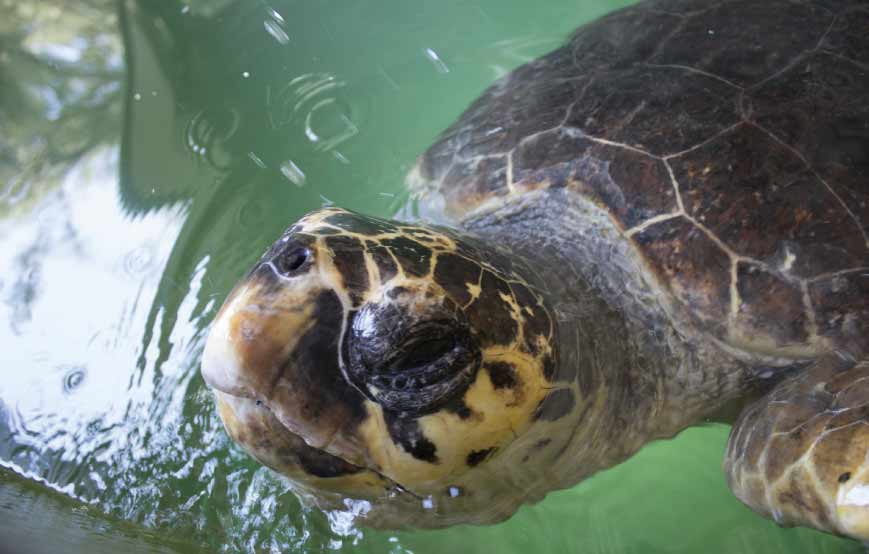
What does a loggerhead sea turtle eat: loggerhead sea turtle swimming in the ocean
What does a loggerhead sea turtle eat? Mostly crabs, whelks, and other hard-shelled prey.


Why Loggerhead Sea Turtles Have Powerful Jaws

The loggerhead gets its name from its big head. NOAA Fisheries explains that this large head supports powerful jaw muscles, which let the turtle crush hard-shelled prey such as whelks and conchs. Instead of teeth, loggerheads have the hard, crushing beak that NOAA describes as typical of most sea turtles.

Those jaws open up food that many other animals can’t reach. A whelk or conch shell is no match for an adult loggerhead.

Do Loggerhead Sea Turtles Eat Jellyfish or Plants?

Jellyfish

Yes, sometimes. The National Park Service lists jellyfish among loggerhead foods. A NOAA-hosted study of loggerheads in the southeastern US also tested cannonball jellyfish as one of the common local prey items, alongside blue crab, horseshoe crab, and whelk. But jellyfish aren’t the main food for most loggerheads. If you’re asking what does a loggerhead sea turtle eat most of the time, the answer is shellfish and crabs.

Plants

Loggerheads are mainly carnivores. NOAA Fisheries says they only occasionally eat plant material, and the National Park Service lists algae and seagrass among the foods they may eat. Plants are a small extra, not a staple.

Where Loggerheads Find Food

Loggerheads use a huge range of habitats. USFWS says they may be found hundreds of miles out to sea, and also in bays, lagoons, salt marshes, and estuaries.

  • Open ocean: young turtles feed among floating mats of Sargassum and other drifting material.
  • Coastal waters: older turtles feed on the bottom in bays, estuaries, river mouths, and shallow waters.
  • Structure: USFWS notes that coral reefs, rocky places, and shipwrecks are often used as feeding areas.

What a US study found in their stomachs

Researchers examined the stomach contents of 153 loggerheads that stranded in coastal Georgia. Crustaceans were the most common prey, followed by bony fish, gastropods such as whelks, bivalves such as clams, and horseshoe crabs. Adults ate proportionately more gastropods, while subadults ate more fish. The authors note that diets shift with life stage and location, depending on what prey is available locally.

How big loggerheads get

All that shellfish fuels a big animal. NOAA Fisheries gives adult loggerheads a weight of about 200 to 350 pounds and a shell length of about 2.5 to 3.5 feet. USFWS reports that adults in the southeastern US average a straight shell length of about 36 inches (92 cm) and about 250 pounds (113 kg). Older versions of this article listed weights up to 440 pounds without a source, so we’ve replaced them with these figures.

Did you know? Loggerheads nest mainly along the Atlantic coast of Florida, South Carolina, Georgia, and North Carolina, and along the Gulf coast of Florida and Alabama, according to USFWS. Nesting season runs from April through September.

Loggerheads vs. Green and Leatherback Sea Turtles

It’s easy to mix up sea turtle diets. Here’s how the answer to “what does a loggerhead sea turtle eat?” compares with two other species found in US waters.

Species Main adult diet Key feature
Loggerhead Crabs, whelks, conchs, clams, horseshoe crabs Large head with powerful jaw muscles
Green turtle Mainly algae and seagrasses Only herbivorous sea turtle as an adult
Leatherback Jellyfish and salps Backward-pointing spines in mouth and throat

NOAA Fisheries calls adult green turtles the only herbivorous sea turtles. Leatherbacks lack the crushing beak of other sea turtles and instead have backward-pointing spines in the mouth and throat to hold gelatinous prey. Loggerheads sit in between: carnivores built for hard shells.

Plastic, Fishing Gear, and Other Feeding Hazards

Sadly, part of the answer to “what does a loggerhead sea turtle eat?” includes things that were never food at all. Human trash can end up looking like prey. NOAA Fisheries warns that young loggerheads in the open ocean often mistake small fragments of plastic for food, and that released balloons can be mistaken for prey like jellyfish.

  • Swallowing debris: NOAA says ingesting marine debris is a threat to all sea turtle species.
  • Entanglement: turtles can become tangled in debris, including discarded fishing line and nets.
  • Bycatch: NOAA calls accidental capture in fishing gear a primary threat to sea turtles.
  • Other threats: USFWS lists pollution, boat strikes, disease, and loss of nesting beaches.

Common myths about loggerhead diets

  • Myth: Loggerheads mainly eat jellyfish. Jellyfish are eaten sometimes, but crabs and shellfish are the core of the diet. Leatherbacks are the jellyfish specialists.
  • Myth: All sea turtles eat seagrass. That describes adult green turtles. Loggerheads only occasionally eat plants.
  • Myth: Sea turtles need people to feed them. Wild loggerheads find their own food, and NOAA says never to feed them.

How to Help Loggerheads (and Why Not to Feed Them)

Loggerheads are protected under the Endangered Species Act. NOAA Fisheries lists nine distinct population segments: five endangered and four threatened, including the threatened Northwest Atlantic population that nests in the Southeast US.

  • Never feed or touch sea turtles. NOAA Fisheries says never to feed, attempt to feed, or touch them.
  • Don’t keep one as a pet. Sea turtles are wild, protected animals.
  • Report problems. If you see a stranded, injured, or entangled sea turtle, contact trained responders through NOAA’s reporting page.
  • Cut the trash. Skip balloon releases, pack out plastic, and dispose of fishing line properly.
  • Boat carefully. NOAA advises boaters to watch for turtles, slow down, and steer around them.

Example Scenario (illustrative)

On a morning walk in South Carolina, Marisol spots a loggerhead in the shallows with fishing line wrapped around one flipper. She keeps her distance, doesn’t try to free it or offer food, and contacts trained responders through NOAA’s reporting page. She stays nearby to describe the location when they arrive. This is an illustration, not a real case.

Love turtles and want one at home? Freshwater species are a different story. See our turtles section for pet turtle care guides.

What Does a Loggerhead Sea Turtle Eat? FAQs

What does a loggerhead sea turtle eat?

Mostly hard-shelled animals. Loggerheads eat crabs, whelks, conchs, clams, horseshoe crabs, and other invertebrates, plus fish and other prey depending on where they live.

Do loggerhead sea turtles eat jellyfish?

Sometimes. Jellyfish are part of the diet in some places and life stages, but crabs and shellfish make up most of what loggerheads eat. Leatherbacks are the sea turtles that specialize in jellyfish.

Do loggerhead sea turtles eat plants?

Only occasionally. NOAA Fisheries describes loggerheads as only occasionally eating plant material, such as algae or seagrass. They are mainly carnivores.

How does a loggerhead’s diet change as it grows?

Young loggerheads live in the open ocean for years and feed on a wide variety of floating items. As they grow, they move to coastal waters and feed mainly on bottom-dwelling prey like crabs and mollusks.

Why do loggerhead sea turtles have powerful jaws?

Their large heads support strong jaw muscles that let them crush the hard shells of prey such as whelks and conchs.

Can plastic harm loggerhead sea turtles?

Yes. Young loggerheads often mistake small plastic pieces for food, and turtles can become entangled in debris and fishing gear. Swallowed or tangled debris can injure them.

Final Verdict: What Does a Loggerhead Sea Turtle Eat?

So, what does a loggerhead sea turtle eat? Mainly crabs, whelks, conchs, clams, and other hard-shelled prey, crushed with powerful jaws. Young turtles feed on floating food in the open ocean before moving to coastal feeding grounds. Help them by keeping plastic and fishing line out of the water and enjoying them only from a distance.

Your next steps

  1. Learn more about the species in our loggerhead sea turtle facts guide.
  2. Read about another protected reptile in our guide to alligator snapping turtle conservation.
  3. Save NOAA’s stranding report page before your next beach trip.

Share your sea turtle sightings (from a safe distance) with our community on Facebook.

About the author

Written and reviewed by the Pets Store Home Editorial Team: pet owners and animal lovers who check every guide against trusted US wildlife and animal-welfare sources. This article is general information about a protected wild species.

How we checked this guide: We compared diet, habitat, and conservation information from NOAA Fisheries, the U.S. Fish & Wildlife Service, the National Park Service, and a NOAA-hosted 2021 study of loggerhead health and nutrition in the southeastern United States. We review this article every 12 months, or sooner if guidance changes.

Last reviewed: October 2026