
How often should you feed a ball python
Last updated: September 2026
Short answer: a ball python (Python regius) generally needs feeding every 5 days as a hatchling (45–80g), every 7–10 days as a growing juvenile (roughly 120–360g, about 3–6 months), every 10–14 days as a sub-adult or young adult (roughly 500–1,800g, about 1–2 years), and every 14–50 days (about 2–7 weeks) as a larger, more mature adult (900g and up) — with your snake’s actual weight and body condition mattering more than its age.
See the full chart below for exact brackets, including where adjacent ranges overlap. If you’ve searched this question, you’ve probably already found a few charts that don’t quite agree with each other, and you’re either setting up a new ball python’s feeding routine for the first time, or your snake just skipped a meal and you’re wondering if that’s normal.
This guide gives you a weight-and-age-based starting point sourced from a ball-python-specific feeding chart, then spends real time on something that’s often the actual reason for the search: what’s actually normal when a ball python doesn’t eat on schedule, and when it’s worth a call to the vet.
A note on scope: this guide is written for readers in the United States, and it’s a companion piece to our Best Beginner Pet Snake for First-Time Owners guide — that article covers the full cost and setup picture; this one goes deeper on ball python feeding specifically. Weights below are given in grams (the standard unit in reptile-keeping sources) with an approximate ounce or pound conversion alongside.
Quick Answer
Hatchling ball pythons (45–80g, roughly 1.5–3 oz) typically eat every 5 days; growing juveniles (120–360g, roughly 4–13 oz) every 7–10 days; sub-adults and young adults (roughly 500–1,800g, about 1–2 years old) every 10–14 days; and larger, more mature adults (900g and up) every 14–50 days. These figures come from a ball-python-specific feeding chart (full table below), which is organized by age with a weight range for each age bracket — those weight ranges overlap between some adjacent rows, which reflects normal variation in individual growth rather than a mistake. Use your snake’s actual weight, not just its age, and treat body condition as the final tiebreaker.
Key Takeaways
- Feeding frequency tracks weight and body condition more closely than age — typical ranges run from every 5 days for hatchlings, to every 7–10 days for growing juveniles, to every 10–14 days for sub-adults and young adults, to every 14–50 days for larger, mature adults. Use the chart below as a starting point for your specific snake, not a fixed rule.
- A healthy ball python can often go several weeks without eating, especially around a shed or during cooler months — on its own, this is usually not a cause for concern, though prolonged or unexplained refusal is still worth keeping an eye on.
- Frozen-thawed prey, sized to roughly 1 to 1.25 times the diameter of the snake’s midsection, is the standard, safer approach — not a sign you’re doing something wrong.
- Weight loss, lethargy, other illness signs, or repeated regurgitation are reasons to contact an exotic-animal vet promptly — a single skipped meal on its own generally isn’t.
In this article: Why Age-Based Charts Fall Short · Feeding Frequency by Weight and Age · Prey Sizing · Live vs. Frozen-Thawed · What’s Normal When They Skip a Meal · When to Contact a Vet · Regurgitation · Overfeeding & Body Condition · FAQ
Why Age-Based Charts Don’t Tell the Whole Story
Many feeding charts organize by age because it’s a convenient shorthand — but age is really a stand-in for the thing that matters directly: a snake’s weight, metabolism, and body condition, which can vary between two snakes of the same age. Ball pythons, like all snakes, are ectotherms — their metabolism and digestion speed depend heavily on enclosure temperature, which is one more reason a fixed calendar doesn’t fit every snake equally.
That’s part of why feeding guidance across different sources doesn’t always match exactly — each chart reflects a slightly different set of assumptions about a “typical” snake at a given age. Even a single detailed, weight-based chart, like the one below, still has to generalize: the weight range attached to a given age bracket is naturally a range, and it can genuinely overlap with the range for the adjacent age bracket, because two ball pythons of a similar age can be meaningfully different weights. That’s why your snake’s own body condition (covered later in this article) is the final word, not any chart.
Feeding Frequency by Weight and Age
Short answer: the chart below is organized the way TerrariumQuest’s original source chart is — by age, with a weight range attached to each age bracket. If your snake’s weight falls within more than one row’s range, use the row that’s the closer match to its actual weight, and let body condition (see “Overfeeding and Body Condition” below) break the tie.
These are source-based starting points, not a prescription for every snake.
|
Age |
Weight |
Feeding Interval |
Typical Prey |
|
Hatchling |
45–80g (1.5–3 oz) |
Every 5 days |
Hopper mouse (7–12g) |
|
~3 months |
120–220g (4–8 oz) |
Every 7 days |
Fuzzy rat or small mouse (13–19g) |
|
~6 months |
270–360g (9.5–13 oz) |
Every 7–10 days |
Rat pup or adult mouse (20–30g) |
|
~1 year |
500–900g (1–2 lb) |
Every 10–14 days |
1 small rat, or 1–3 adult mice (45–80g) |
|
~1.5 years |
600–1,400g (1.3–3 lb) |
Every 10–14 days |
1 medium rat, 3–5 adult mice, or 2 small rats (80–150g) |
|
~2 years |
800–1,800g (1.8–4 lb) |
Every 10–14 days |
4–6 adult mice, or 3 small rats (85–150g) |
|
~3 years |
900–2,000g (2–4.4 lb) |
Every 14–21 days |
1 medium rat, 4–5 adult mice, or 2 small rats (90–150g) |
|
5+ years |
1,000–3,000g (2.2–6.6 lb) |
Every 21–50 days |
1 medium rat, 4–5 adult mice, or 2 small rats (90–150g) |
Source: TerrariumQuest’s ball python feeding chart, reproduced here with its own age-primary structure intact. Notice that the weight ranges for adjacent age rows overlap — for example, “~1 year” runs 500–900g and “~1.5 years” runs 600–1,400g, overlapping between 600–900g. That’s how the source itself presents the data, not an error introduced here, and it reflects normal variation in individual growth rates rather than a strict cutoff.
If your snake’s weight falls in an overlap, pick the row that’s the closer match, then use body condition to decide whether to lean toward the shorter or longer interval. ExoticReptileCare’s age-based brackets describe a broadly similar overall shape (hatchling roughly 5–7 days, adult roughly 10–21 days) — but because that source is organized by age only, without its own weight figures, it confirms the general shape of this chart, not the specific weight cutoffs.
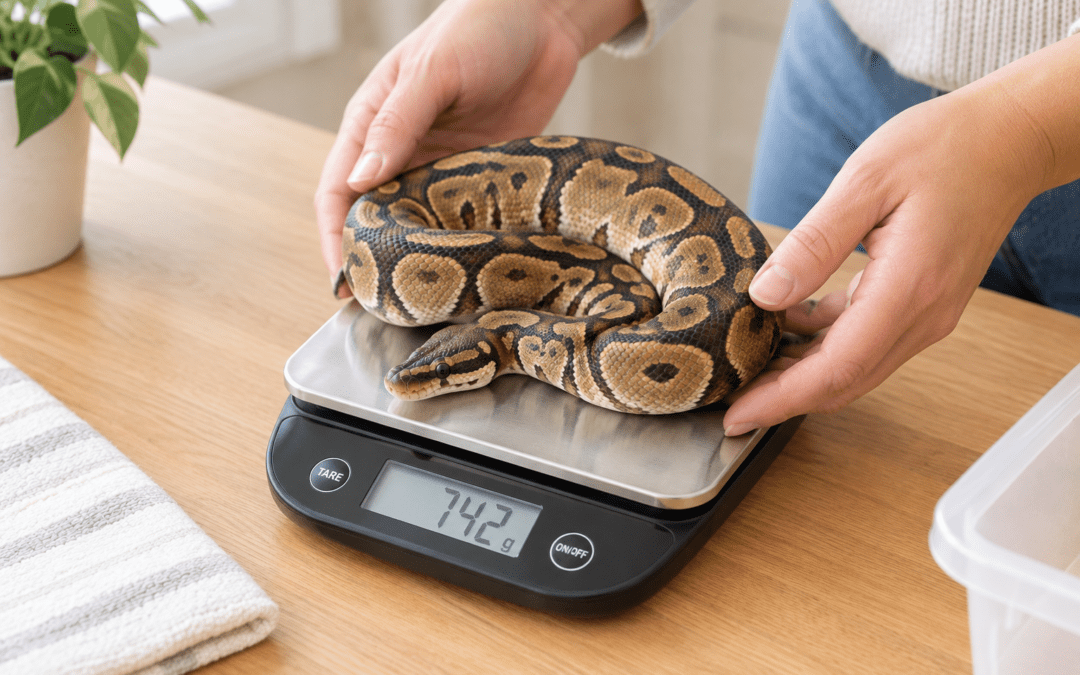
Pet Care Tip: Weigh your snake periodically with a kitchen scale rather than estimating by eye. A weight trend over weeks and months is a far more reliable feeding guide than any chart on its own.
Prey Sizing, Explained Plainly
Per TerrariumQuest, prey should be roughly 1 to 1.25 times the diameter of the snake’s midsection. This is about the prey’s diameter relative to the snake’s body, not its length — a prey item noticeably wider than the snake at its thickest point is the thing to avoid, since oversized prey is a commonly cited cause of regurgitation (see below).
As your snake grows, prey size should scale up gradually following the chart above: hopper mice for hatchlings, moving through fuzzy rats and small-to-medium mice, up to medium rats for larger adults. When in doubt, size down slightly rather than up — underfeeding a single meal is a minor, easily corrected issue, while oversized prey carries real regurgitation risk.
Live vs. Frozen-Thawed, and Feeding Method
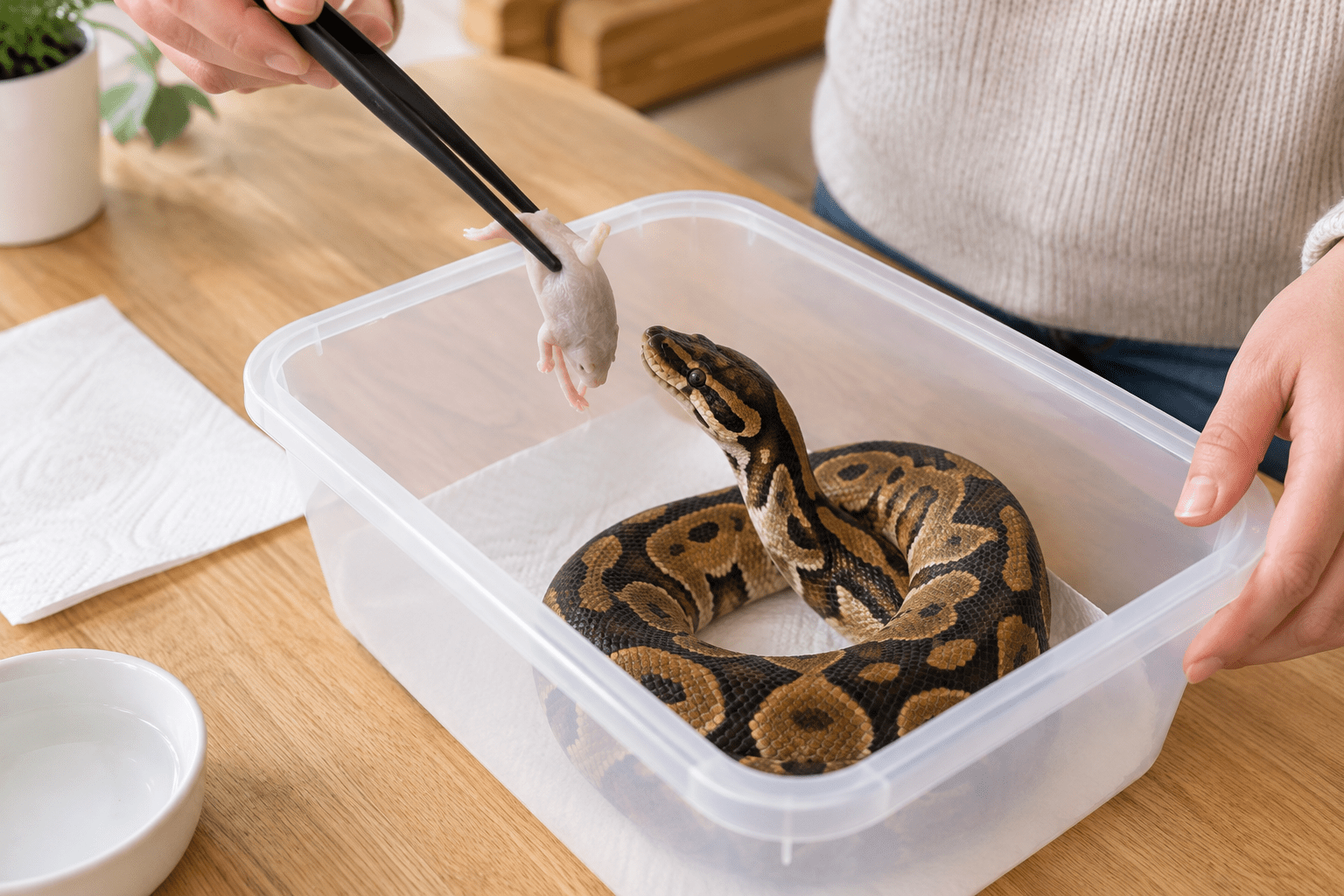
Frozen-thawed prey is the standard, safer approach for ball pythons, as it is for other beginner-friendly snake species — an unsupervised live rodent can injure a snake that isn’t hungry enough to strike immediately. Per TerrariumQuest’s feeding guide, the recommended method is: thaw the prey item in the refrigerator — about 5 hours for a rat-sized item, or 2 hours for a mouse-sized item — then warm it by soaking the sealed bag in warm water until it reaches approximately 110°F, and offer it with feeding tongs rather than bare hands.
Actual thaw time will vary somewhat with prey size and your refrigerator, so check that the prey is fully thawed through rather than treating these as exact clock times. Avoid thawing at room temperature for an extended period — TerrariumQuest doesn’t address this specifically, but it’s consistent with general food-handling guidance against holding raw meat at room temperature for long stretches.
On feeding location specifically, there’s a genuine nuance worth knowing: some care sheets recommend a separate feeding container so the snake doesn’t associate your hand or the enclosure opening with food, while others note that ball pythons in particular can become more feeding-shy after being moved for a meal, and may do better fed inside their home enclosure. Our beginner-snake guide covers this same nuance — if your ball python repeatedly refuses food after being transferred to a separate container, that’s a reasonable sign to try feeding in-enclosure instead, rather than a rule you’re breaking.
Pet Care Tip: Avoid handling your snake for at least 24–48 hours after a meal. Digestion is metabolically demanding, and early handling is one of the more commonly cited, avoidable causes of regurgitation.
What’s Actually Normal When a Ball Python Skips a Meal
This is often the real reason someone searches “how often should you feed a ball python” in the first place. A few things are reported consistently across the sources reviewed for this guide (see Sources & References) as ordinary and not cause for concern on their own:
- Refusing the first meal after a shed. Multiple sources note this as a common pattern — a snake in or just finishing a shed cycle will often refuse food, with normal appetite typically returning within a few days to about a week.
- Seasonal or cooler-weather fasting. Some adult ball pythons — reported more often in males — go through a natural fasting period during cooler months that can last several weeks. This is a recognized pattern in the species, though it’s still worth confirming your snake otherwise looks and behaves normally during it.
- General individual variation. Ball python sources describe this species as unusually tolerant of extended fasting compared to many other pets — but “tolerant of fasting” isn’t the same as “fasting never needs a second look,” especially outside the shed/season explanations above.
If your snake is otherwise alert, maintaining a healthy body shape, and behaving normally, a skipped meal or two on its own is not usually a reason for alarm — but see the next section for the signs that do warrant reaching out sooner rather than later.
When to Contact a Vet
Short answer: don’t wait on a calendar if any of these show up — contact an exotic-animal vet promptly regardless of how recently your snake last ate:
- Noticeable weight loss, or a body shape that’s visibly thinning rather than just “not growing”
- Lethargy, or any other sign the snake seems unwell rather than simply uninterested in food
- Repeated regurgitation (more than once or twice)
- Any other symptom that doesn’t fit the ordinary shed/season/individual-variation explanations above
Separately, if your snake looks and behaves completely normally, is maintaining weight, and none of the above apply, but it still hasn’t eaten in roughly two to three months with no identifiable cause — we’d treat that as a reasonable, conservative check-in point, not a strict medical threshold; a vet may reasonably advise differently for your specific snake. This article can’t diagnose your snake; it can only describe what’s commonly reported as normal and what commonly isn’t. When in doubt, a vet visit is a reasonable, low-risk step compared to guessing.
Regurgitation: Causes and What to Do
Regurgitation is more alarming to witness than a simple skipped meal, but it’s usually explainable. Commonly cited causes include prey that was too large for the snake, handling too soon after a meal, incorrect enclosure temperature (too cold to digest properly, or a temperature spike), stress from an unstable or overly exposed setup, and — less commonly — illness or parasites.
If your snake regurgitates, hobbyist and breeder sources (Ball Python Breeder UK, Lizards101 — see Sources & References) commonly recommend waiting roughly 14 days before offering food again, giving the digestive system time to recover, while making sure temperature, humidity, and hides are all correctly set up in the meantime.
This figure comes from reptile-keeping sources, not a veterinary one — treat it as a reasonable starting point rather than settled medical guidance, and follow a vet’s specific recommendation if you get one. Regurgitation happening more than once or twice, or without an obvious cause (oversized prey, early handling), is a clear reason to involve an exotic-animal vet — it can also indicate parasites or another underlying issue worth ruling out with a fecal check.
Pet Care Tip: After any regurgitation event, double-check your prey size for the next attempt — sizing down slightly is a simple, low-risk adjustment worth trying if oversized prey seems like the likely cause.
Overfeeding and Body Condition
It’s possible to overfeed a ball python, and sticking to a fixed schedule regardless of how the snake actually looks isn’t automatically the safer choice — obesity is a real risk in captivity, where snakes get consistent access to food without the energy expenditure of hunting. A healthy ball python’s body should read as a smooth, even taper rather than showing pronounced rolls or a noticeably thickened midsection. If your snake’s body condition looks heavier than that, or it’s consistently accepting every offered meal without ever appearing hungry, it’s reasonable to lengthen the interval between feedings rather than sticking rigidly to the chart above.
Practical Examples
The following are illustrative scenarios based on patterns reptile keepers commonly describe, not documented case studies.
The shed-cycle scare. A new owner was concerned when their ball python refused three offered meals in a row. After checking, they realized the snake had gone through a full shed during that window — appetite returned normally the following week, consistent with the shed-related pattern described above.
The live-to-frozen switch. An owner who’d been feeding live prey out of habit switched to frozen-thawed after reading about the safety risks. Their snake initially seemed uninterested, but accepted a meal normally within two feeding cycles.
The handling mistake. An owner handled their ball python for a photo about an hour after it finished eating; the snake regurgitated later that day. After waiting roughly two weeks and being more careful about post-feeding handling going forward, there were no further issues.
Common Mistakes to Avoid
- Treating a chart as an exact rule for your individual snake, regardless of its actual weight or body condition.
- Assuming a skipped meal is automatically fine without checking for the specific normal causes — shedding, season, recent move — described above, or dismissing genuine warning signs because “ball pythons fast a lot.”
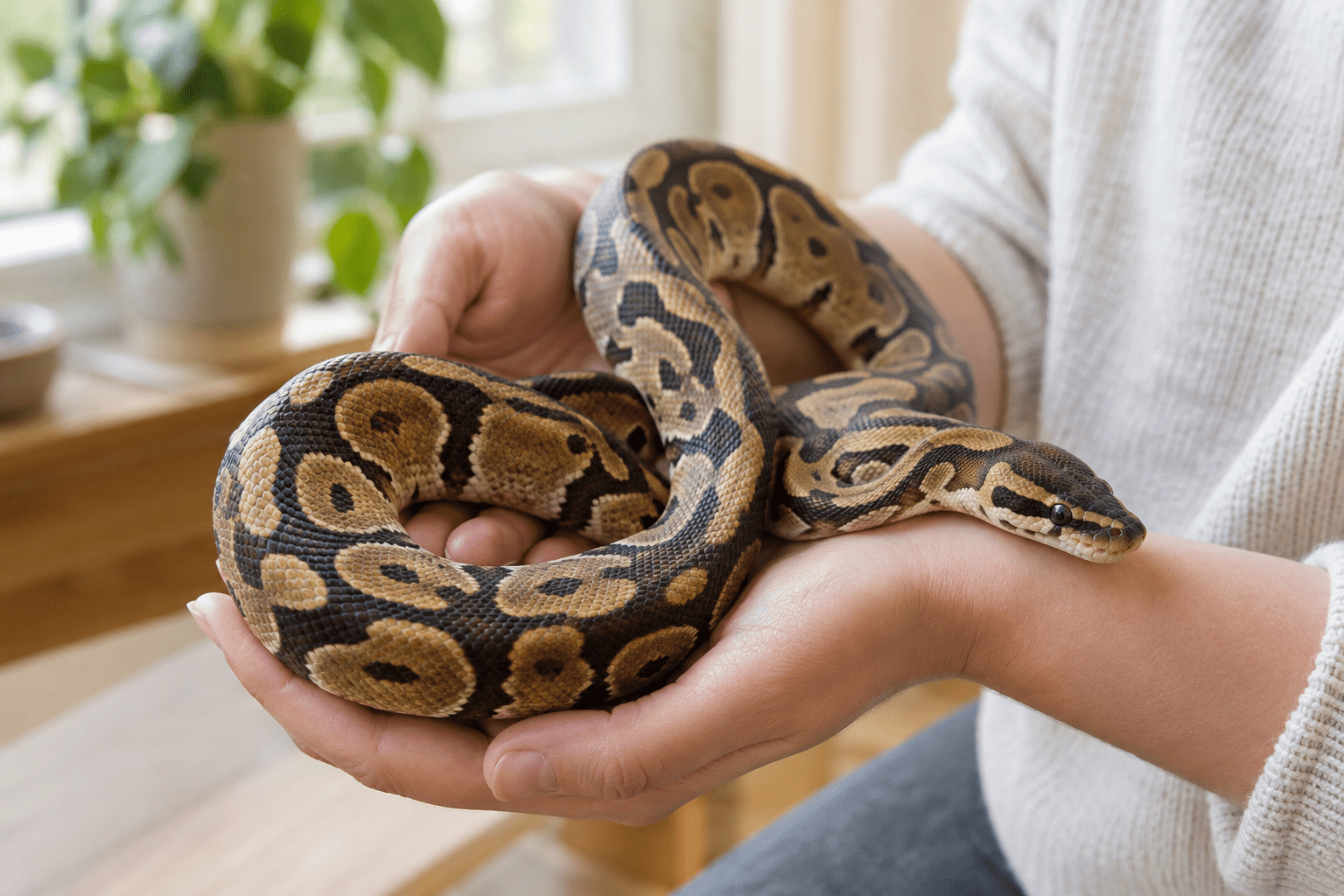
- Handling or disturbing the snake too soon after a meal, one of the most commonly cited, avoidable causes of regurgitation.
- Feeding live prey out of habit despite the safety case for frozen-thawed.
- Sticking to a fixed feeding schedule even as body condition suggests the snake could use a longer interval between meals.
Editor’s Insights
- Body-condition scoring (how your snake actually looks and feels) should override any chart when the two disagree — a snake that’s visibly heavier than a smooth taper needs a longer interval, regardless of what a weight bracket suggests.
- If a meal is refused, resist the urge to immediately offer a replacement or a different prey item — repeatedly disturbing a snake that isn’t hungry tends to prolong the stress rather than solve anything.
- The two commercial sources cross-checked for the broader research behind this topic (a breeder site and a habitat-product company blog) had feeding-frequency figures broadly consistent with the independent sources — useful as a rough cross-check, but not confirmation of the exact numbers, and not the place to look for unbiased urgency-free advice.
- Prey sourcing quality matters as much as size — a rancid or poor-quality frozen rodent can also cause refusal or regurgitation, and it’s worth ruling out if your usual supplier or batch has changed.
Which Situation Applies to You?
A quick pointer to the right section above — not a substitute for reading it:
- Snake maintaining weight and body shape, skipped meal explained by shed, season, or individual variation? → See “What’s Actually Normal” above — monitor, no action needed yet.
- Weight loss, lethargy, repeated regurgitation, or another symptom that doesn’t fit those explanations? → See “When to Contact a Vet” above — contact a vet promptly.
- Roughly two to three months with no meals, no other symptoms, no clear cause? → See “When to Contact a Vet” above — worth a check-in.
- Snake just regurgitated? → See “Regurgitation” above — hold off roughly 14 days, involve a vet if it recurs.
Checklists
Before You Worry Checklist
- Check recent shed history — refusal right around a shed is a commonly reported pattern
- Consider the season — cooler-weather fasting is reported more often, especially in males
- Weigh the snake if you can, rather than relying on memory or a guess
- Assess body condition against the smooth-taper description above before assuming a feeding problem exists
Feeding Routine Checklist
- Use frozen-thawed prey sized to roughly 1–1.25x the diameter of the snake’s midsection
- Thaw in the refrigerator (about 5 hours for a rat, 2 hours for a mouse), then warm in a ~110°F water bath — never microwave whole prey
- Use feeding tongs, not bare hands
- Feed in a separate container, or in-enclosure if your snake is feeding-shy after transfers
- Avoid handling for 24–48 hours after a meal
- Log the date, prey size, and outcome every time
Frequently Asked Questions
How often should you feed a ball python?
It depends mainly on weight and age together, per a ball-python-specific feeding chart: every 5 days for a hatchling, every 7–10 days for a growing juvenile, every 10–14 days for a sub-adult or young adult, and every 14–50 days for a larger, mature adult — see the full table above for the exact age-and-weight brackets, including where ranges overlap.
How much should a ball python weigh at different ages?
Roughly 45–80g as a hatchling, 270–360g around 6 months, 500–900g around 1 year, and 900g or more by 3 years and beyond — individual growth rates vary and adjacent brackets can overlap, so treat these as typical ranges rather than a strict growth schedule.
How long can a ball python safely go without eating?
Sources describe this species as unusually tolerant of extended fasting — some adults can go a month or more, especially seasonally — but that describes the species’ general tolerance, not a green light to ignore other warning signs if they appear.
Why did my ball python stop eating?
Most often it’s an upcoming or recent shed, seasonal fasting, or individual variation — see “What’s Actually Normal” above for details. Weight loss, lethargy, or other illness signs are the reasons to contact a vet rather than wait.
Is it normal for a ball python to refuse food after shedding?
Yes — it’s a commonly reported pattern, with appetite typically returning within days to about a week.
How do I know if I’m feeding my ball python the right size prey?
Per TerrariumQuest, prey should be roughly 1 to 1.25 times the diameter of your snake’s midsection. Oversized prey is a commonly cited cause of regurgitation, so when unsure, size down rather than up.
Should I feed my ball python live or frozen-thawed prey?
Frozen-thawed is the standard, safer approach — it avoids the risk of an unsupervised live rodent injuring a snake that isn’t ready to eat.
What should I do if my ball python regurgitates its food?
Hobbyist and breeder sources commonly suggest waiting roughly two weeks before offering food again and double-checking temperature and prey size; this isn’t veterinary guidance, so involve an exotic-animal vet if it happens more than once or twice.
How can I tell if my ball python is overweight?
A healthy ball python’s body should taper smoothly without pronounced rolls or a thickened midsection. If it looks heavier than that, or never seems hungry, consider lengthening the interval between meals.
Do adult ball pythons eat less often than juveniles?
Yes — per the chart above, the interval lengthens as weight increases, from every 5 days for a small hatchling to every few weeks for a large, mature adult.
When should I take my ball python to the vet about feeding issues?
Promptly for weight loss, lethargy, other illness signs, or regurgitation happening more than once or twice — and as a check-in, even without other symptoms, if refusal stretches to roughly two to three months.
Related Reading
- Best Beginner Pet Snake for First-Time Owners
- Signs a Bearded Dragon Is Stressed
- Bearded Dragon Glass Surfing: Causes & How to Stop
- Why Is My Turtle Not Eating?
Sources & References
- TerrariumQuest, “Ball Python Feeding Chart (Guide & Schedule)” — primary source for the age-and-weight feeding chart (reproduced with its own structure, including overlapping weight brackets), the prey-sizing ratio, and the thawing/warming method used throughout this article
- ExoticReptileCare, “Ball Python Feeding Schedule by Age” — age-based feeding brackets; checked for overall shape against the TerrariumQuest chart, not as independent confirmation of its specific weight cutoffs, since this source doesn’t use weight
- Furry Critter Network, “Hatchling Feeding Schedule” — hatchling-specific feeding frequency, checked against PetMD’s differing figure
- Pawshatch, “Ball Python Feeding Chart by Age: Hatchling to Adult” — body condition scoring, overfeeding signs, shed/season refusal patterns
- Ball Python Breeder UK, “Ball Python Regurgitating: Causes and What You Should Do” — regurgitation causes (hobbyist/breeder source, not veterinary)
- Lizards101, “Ball Python Regurgitating Causes and Regurgitation vs. Poop” — 14-day recovery window, vet-consultation thresholds (hobbyist/breeder source, not veterinary)
- Wilbanks Reptiles and Zen Habitats care guides — used only as secondary, broad cross-checks against the independent sources above, not as primary sources, since both are commercial (breeder and habitat-product company respectively)
- PetMD, “Ball Python Care Sheet” — general care baseline; its “every other day” hatchling-feeding figure conflicts with the other sources above and was not used for the frequency figures in this article — see editorial notes for how this conflict is handled
Written by the Pets Store Home editorial team. Sourcing by claim: the age-and-weight feeding chart, prey-sizing ratio, and thawing/warming instructions are drawn from TerrariumQuest specifically; the shed- and season-related “what’s normal” guidance and body-condition/overfeeding signs draw on Pawshatch and ExoticReptileCare; regurgitation-recovery guidance is sourced from hobbyist/breeder publishers (Ball Python Breeder UK, Lizards101), not a veterinary source.
Several figures in this article — including the feeding chart, prey-sizing ratio, and thawing method — trace to that single primary source (TerrariumQuest) rather than independent multi-source confirmation, and are marked as such rather than presented as a broader consensus. Commercial sources (Wilbanks Reptiles, Zen Habitats) were used only as rough cross-checks, not as primary citations.
No licensed veterinarian has reviewed this draft, and it is not a substitute for professional veterinary or exotic-pet-care advice — this is a limitation of this article, not a formality, so if your snake’s feeding behavior concerns you and you can’t identify a normal cause, or any warning sign in this article applies, consult an exotic-animal vet rather than relying on this guide alone.
Last fact-checked: September 2026 — the feeding chart above was checked against a verbatim reproduction of TerrariumQuest’s published chart; a discrepancy with PetMD’s hatchling figure is noted rather than resolved by source count; regurgitation guidance is flagged as hobbyist-sourced rather than veterinary.
Where to Go From Here
The signs covered under “When to Contact a Vet” above are worth acting on promptly, whatever the calendar says. For the full commitment, cost, and species picture, see our Best Beginner Pet Snake for First-Time Owners guide, linked again under Related Reading above.
[…] Which foreign pets are legal in Washington State? […]