
Indoor Pet Fence for Cats and Dogs: Essential Safe Setup Guide (2026)
What is the best indoor pet fence for cats and dogs? For most homes, it is a sturdy gate with a small pet door, so your cat can pass while your dog stays on its own side. Pick a gate at least 30 inches tall for jumping dogs, and mount it with hardware at the top of stairs.
Maybe your new puppy keeps raiding the litter box, or your senior cat needs a dog-free retreat. Perhaps you just want to keep muddy paws out of the living room. This guide explains the main fence types, how to size one safely, and how to use it to introduce a cat and a dog step by step.
Key takeaways
- A gate with a built-in small pet door lets cats move freely while keeping dogs out of the cat’s space.
- The AKC suggests at least 30 inches of height for bigger or jumping dogs, and about 20 inches for puppies and small breeds.
- Use hardware-mounted gates at the top of stairs. Pressure-mounted gates suit doorways and hallways.
- Avoid accordion gates with V- or diamond-shaped openings, which can trap heads and paws.
- Skip shock-based “invisible” indoor barriers. Veterinary behaviorists recommend reward-based training instead.
In this guide
- Indoor Pet Fence for Cats and Dogs: The Short Answer
- Which Type of Indoor Pet Fence Suits Your Home?
- Size and Safety Checklist
- Using a Fence to Introduce a Cat and a Dog
- Why We Don’t Recommend Electronic Indoor Barriers
- How to Teach Your Pets to Respect the Fence
- Indoor Pet Fence for Cats and Dogs: FAQs
- Final Verdict
Indoor Pet Fence for Cats and Dogs: The Short Answer
An indoor pet fence for cats and dogs is any barrier that divides your home into pet zones. It might be a gate across a doorway, a set of freestanding panels, or a playpen. The American Kennel Club’s guide to dog gates notes that barriers help with house training, keep apart pets that don’t get along, and protect pets during meals, medication or grooming.
| Fence type | Best for | Watch out for |
|---|---|---|
| Hardware-mounted gate | Top of stairs, strong or pushy dogs | Needs drilling; harder to move |
| Pressure-mounted gate | Doorways and hallways; renters | Can be pushed out; never at the top of stairs |
| Gate with small pet door | Homes with both cats and dogs | Small dogs may fit through the cat door |
| Freestanding panels or playpen | Open-plan rooms, puppies, temporary use | Less secure; strong dogs can shift them |
| Electronic “invisible” barrier | Not recommended | Relies on aversive correction |
Pet Care Tip: Measure your doorway or opening at the floor and again at gate height. Old houses often have walls that are not perfectly straight, and a gap of an inch at one side is all a determined small dog needs.
Which Type of Indoor Pet Fence Suits Your Home?
The right indoor pet fence for cats and dogs depends on what you are trying to keep apart, and where. The AKC describes the trade-offs clearly. Pressure-mounted gates need no tools and suit renters. Hardware-mounted gates bolt to the wall and are the most secure. Freestanding panels need no installation but are the least secure of the three.
- Keeping a dog out of the cat’s room: a gate with a small pet door across that doorway.
- Blocking stairs: a hardware-mounted gate at the top, fixed into studs.
- Giving a puppy a safe play area: a freestanding playpen on a washable floor.
- Dividing an open-plan space: extra-wide freestanding panels or a wall-mounted extra-wide gate.
- Short-term visitors or holidays: a pressure-mounted gate that moves easily between doorways.
Pet gate with door: the easiest option for mixed homes
A pet gate with door usually has two openings. A full-size walk-through door lets people pass without stepping over. A smaller, often lockable pet door near the floor lets a cat slip through. The Franklin County Dog Shelter in Ohio suggests exactly this kind of gate so a cat can come and go while the dog cannot. Check the size of the small door against your dog. A little terrier may fit through a cat-sized opening.
Indoor dog playpens and freestanding fences
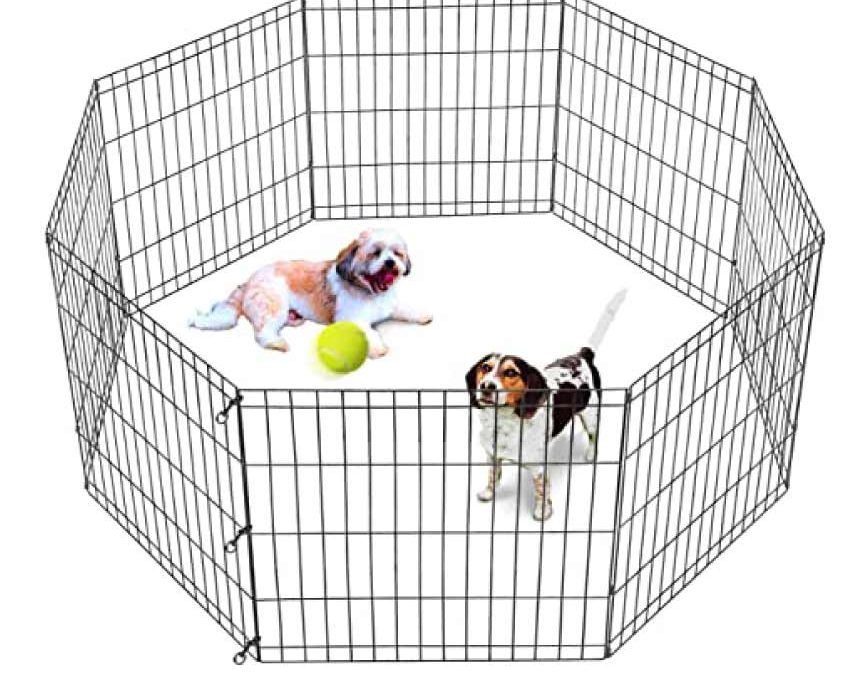
Playpens and freestanding panels create a room within a room, and a lightweight portable fence for dogs can move with you between rooms or on visits. They work well for puppies during house training, for small dogs while you cook, or for blocking a wide archway that no gate can span. Choose panels that lock together firmly and have a wide base or feet. Place the pen away from furniture a dog could use as a launch pad.
Size and Safety Checklist for an Indoor Pet Fence
An indoor pet fence for cats and dogs only helps if it is safe. Run through this checklist before you buy and again after you install it.
| Check | What to look for |
|---|---|
| Height | About 20 inches for puppies and small breeds; at least 30 inches for bigger dogs or jumpers (AKC) |
| Stairs | Hardware-mounted only at the top of stairs |
| Openings | Bars or mesh too narrow for a head or paw to get stuck |
| Climbers | Vertical bars; horizontal bars act as a ladder |
| Shape | Straight top edge; no V- or diamond-shaped gaps |
| Surroundings | No chairs, crates or boxes nearby to climb |
| Recalls | Search the model on CPSC.gov before buying |
The open-diamond warning comes from the US Consumer Product Safety Commission, which linked accordion-style gates with V-shaped openings to child deaths from head entrapment. It found rigid mesh gates with a straight top much safer. The same shape can trap a curious puppy’s head. The CPSC still recalls gates for entrapment gaps, such as a 2024 recall of gates whose side gap could trap a child.
Remember that many cats can jump or climb a 30-inch gate with little effort. A fence keeps the dog in or out; it rarely contains a cat. Plan the cat’s route on purpose rather than hoping the gate stops it.
Using an Indoor Pet Fence for Cats and Dogs During Introductions
One of the best uses of an indoor pet fence for cats and dogs is a slow, safe introduction. The Franklin County Dog Shelter handout recommends planning about a month, sometimes longer. Here is how its staged approach works:
| Stage | What happens | Role of the fence |
|---|---|---|
| Week 1 | Pets only smell and hear each other | Closed doors keep them fully apart |
| Week 2 | They see each other through a gate | Dog leashed; no lunging, barking or jumping at the gate |
| Week 3 | Supervised face-to-face time | Only once gate meetings look calm |
| Week 4 and beyond | Gradually more shared time | Put the gate back if progress stalls |
The same handout stresses three cat comforts behind the fence. Keep the litter box and cat food where the dog cannot reach them. Give the cat high places to jump onto and spots to hide under. And for a large dog, use a taller gate or stack two.
Example Scenario (illustrative)
Danielle in Raleigh, North Carolina, adopts a young beagle mix while her 12-year-old cat, Olive, rules the house. She asks herself what kind of indoor pet fence for cats and dogs will work in her small apartment. She chooses a hardware-mounted gate with a small pet door across the spare room, where Olive’s litter box and food now live. For two weeks the pets only meet through the gate, with treats for the dog whenever he stays calm.
Olive keeps her retreat, and the beagle learns the gate means “not your room.”
If your dog is new to the household too, our step-by-step guide to introducing a new puppy to a resident dog follows a similar slow, step-by-step approach.
Why We Don’t Recommend Electronic Indoor Barriers
Some “indoor pet fences” are not fences at all. They are transmitters that trigger a sound, spray or static correction on a collar when a pet crosses a line. The American Veterinary Society of Animal Behavior states in its 2021 position statement that evidence supports reward-based methods for all dog training. It lists electronic shock collars among tools to avoid because they cause pain.
A physical gate is simpler and kinder. It blocks the dog physically, needs no batteries and teaches nothing frightening. If you already own an electronic system, talk to your vet or a credentialed behavior professional about switching.
How to Teach Your Pets to Respect the Fence
Even the best indoor pet fence for cats and dogs needs a short introduction. The AKC suggests letting your dog explore the gate while it is open, then closing it and rewarding calm behavior nearby.
- Day 1: Install the gate and leave it open. Let your dog sniff it and walk through. Toss a treat on each side.
- Day 2: Close it for a few minutes while you stay close. Reward your dog for lying down or sitting on its side.
- Days 3 to 5: Lengthen the time the gate is closed. Give your dog a chew or puzzle toy on its side.
- For the cat: Put a treat beside the small pet door, then inside it, so the opening feels like the cat’s own shortcut.
- Ongoing: Never use the gate as punishment, and never let the dog bark or lunge at it repeatedly.
| Common mistake | Effect on your pets | How to avoid it |
|---|---|---|
| Pressure gate at the top of stairs | Gate can give way and cause a fall | Use hardware-mounted gates there |
| Litter box on the dog’s side | Dog raids it; cat feels unsafe using it | Keep cat resources behind the gate |
| Gate too low for a jumper | Dog clears it and may land badly | Go to 30 inches or more |
| Rushing introductions | Fear, chasing or fights | Allow about a month of staged meetings |
| Old accordion gate | Head or paw entrapment | Replace with mesh or vertical bars |
What most owners get wrong
Many owners buy a fence to stop the cat, then wonder why the cat hops over it in seconds. Think of the fence as a dog barrier with a cat shortcut. A cat that has to pass the dog to reach its box may start avoiding it, so our guide to why a cat stops using the litter box is worth a read if trouble starts.
Indoor Pet Fence for Cats and Dogs: FAQs
What is the best indoor pet fence for cats and dogs?
For most homes, a sturdy gate with a small pet door works best. Your cat can pass through, while your dog stays on its side. Choose hardware mounting for stairs and at least 30 inches of height for jumpers.
How tall should a dog gate be?
The AKC suggests about 20 inches for puppies and small breeds and at least 30 inches for bigger dogs or jumpers. Remove nearby furniture that a dog could climb.
Can cats jump over pet gates?
Yes, many cats can clear a standard gate. Use the gate to manage the dog, and give the cat its own route through a small pet door or over the top.
Is a pressure-mounted gate safe at the top of stairs?
No. The AKC recommends hardware-mounted gates at the top of stairs because they are fixed securely and less likely to give way under pressure.
Are electronic indoor pet barriers safe?
We don’t recommend them. The American Veterinary Society of Animal Behavior advises reward-based training and lists shock collars among tools to avoid. A physical gate is safer.
How long should I keep a gate up between a new cat and dog?
Plan for about a month of staged introductions, and longer if needed. Keep the gate in place until meetings stay calm, and bring it back if progress slips.
Final Verdict: Choosing an Indoor Pet Fence for Cats and Dogs
The best indoor pet fence for cats and dogs is a sturdy gate with a small pet door, sized for your dog and mounted for its spot. Skip accordion styles and shock-based barriers. Keep the cat’s litter and food behind the gate, introduce pets slowly, and reward calm behavior on both sides.
Your next steps
- Measure your doorway and your dog’s jumping height before you shop.
- Browse more home and gear guides in our Pet Accessories section.
- Planning a crate as well? Read our guide to crate training an adult rescue dog.
Show us your pet-zone setup and swap tips with other pet parents on our Pets Store Home Facebook page.
About the author: Written and reviewed by the Pets Store Home Editorial Team, a group of pet owners and animal lovers who check every guide against trusted US veterinary and animal-welfare sources. This article is general information, not a substitute for professional veterinary advice. Always talk to your veterinarian about your own pet’s health.
How we checked this guide: Gate types, heights and stair advice come from the American Kennel Club. Entrapment warnings come from the US Consumer Product Safety Commission. Introduction stages come from the Franklin County Dog Shelter in Ohio, and training guidance from the American Veterinary Society of Animal Behavior. We review this article every 12 months, or sooner if guidance changes.
Last reviewed: October 2026. Sources: AKC, CPSC, Franklin County Dog Shelter, AVSAB.
Sources (accessed October 16, 2026)
- American Kennel Club: Dog Gates 101
- US Consumer Product Safety Commission: Some Baby Gates Are Dangerous, Others Are Safer
- US Consumer Product Safety Commission: Baby Gate Entrapment Recall
- Franklin County Dog Shelter (Ohio): Dog-to-Cat Introductions
- American Veterinary Society of Animal Behavior: Humane Dog Training Position Statement (2021)
[…] Which foreign pets are legal in Washington State? […]