
Corn Snake vs. Ball Python for Beginners
Last updated: September 2026
Short answer: both are genuinely solid first snakes, and the real differences come down to feeding reliability and handling style rather than one being objectively easier. Corn snakes are consistently described as more reliable eaters; ball pythons are well-documented to fast for extended periods, especially seasonally — commonly reported as normal, though prolonged refusal alongside weight loss or lethargy is still worth a check-in with a reptile-experienced vet rather than something to always assume away. Ball pythons are generally the calmer handle; corn snakes are more active and exploratory.
Adult size is genuinely disputed across the sources reviewed for this guide — expect a wide range, roughly 2 to 6 feet depending on source, sex, and bloodline, rather than one precise figure.
A note on scope: this guide is a focused, two-way comparison for readers who’ve already narrowed their choice to these two species. If you’re still deciding among a wider shortlist — including California kingsnakes and rosy boas — see Best Beginner Pet Snake for First-Time Owners. For ball-python-specific feeding depth, see How Often Should You Feed a Ball Python? and Why Is My Snake Not Eating?; for shedding, see How to Tell If a Snake Is About to Shed.
Quick Answer
- Feeding: corn snakes are more reliably active eaters; ball pythons commonly fast for extended periods, especially seasonally — usually normal, but worth a vet check if paired with weight loss or lethargy.
- Handling: ball pythons are generally the calmer handle; corn snakes are more active and curious while held.
- Size: genuinely disputed across sources — expect roughly 2 to 6 feet depending on source, sex, and bloodline, not one fixed number.
Key Takeaways
- Corn snakes are the more reliable eaters — ball pythons commonly fast for weeks or months, especially seasonally; this is usually normal, but prolonged fasting with weight loss or lethargy is still worth a vet check.
- Sources disagree on which species grows larger as an adult — expect roughly 2 to 6 feet depending on source, sex, and bloodline, rather than trusting any single precise figure.
- Cost of the animal and cost of the full starting setup are two different numbers — corn snakes are usually cheaper to buy, but total setup costs land in a similar range for both.
- Ball pythons are generally the calmer handle; corn snakes are more active and exploratory — neither is more “difficult,” just different.
In this article: Feeding · Size and Growth · Handling · Housing and Humidity · Cost · Shedding and Health · Which One Fits You? · Comparison Table · FAQ
Why This Comparison Comes Up So Often
Corn snakes and ball pythons, alongside California kingsnakes and rosy boas, are the species most consistently recommended for first-time snake owners — and of that shortlist, corn snake versus ball python is by far the most common specific head-to-head question, since the two look and behave quite differently while both having a genuine reputation for being beginner-friendly. Neither species is objectively “harder” to keep than the other; the real substance of this comparison is about which set of behaviors and care patterns suits a given owner’s expectations, not a difficulty ranking.
The rest of this guide works through the specific points where the two genuinely differ, and is upfront about the points where the sources reviewed for it don’t agree with each other.
Feeding: A Consistently Reported Difference
This is one of the most consistently reported differences across the sources reviewed for this guide: corn snakes are described as reliable, consistent eaters, while ball pythons are widely reported to refuse food for extended periods, sometimes weeks to months, especially seasonally. Per Reptination, corn snakes “eat reliably with no drama,” while ball pythons are “infamous for feeding strikes,” with adults commonly fasting two to six months, especially during breeding season.
Pawshatch similarly describes corn snake feeding reliability as “excellent,” while ball pythons are “prone to fasting” in a way that “often surprises inexperienced keepers.” Zen Habitats and reptile.guide both echo the same pattern — though all five sources reviewed here are hobbyist, seller, or reference sites rather than veterinary publishers, so treat this as a well-corroborated hobbyist pattern rather than a clinical finding.
This isn’t a minor detail — it’s arguably the single biggest practical difference between the two species for a first-time owner, and it’s exactly the kind of thing that causes real anxiety if you don’t know it’s coming. If you’re considering a ball python, read our dedicated How Often Should You Feed a Ball Python? guide for the full weight-based feeding picture before you bring one home, and keep Why Is My Snake Not Eating? bookmarked in case your ball python skips several meals in a row.
Pet Care Tip: If the idea of your snake not eating for weeks at a time would seriously worry you, that alone is a reasonable, honest reason to lean toward a corn snake.
Size and Growth: A Genuinely Disputed Point
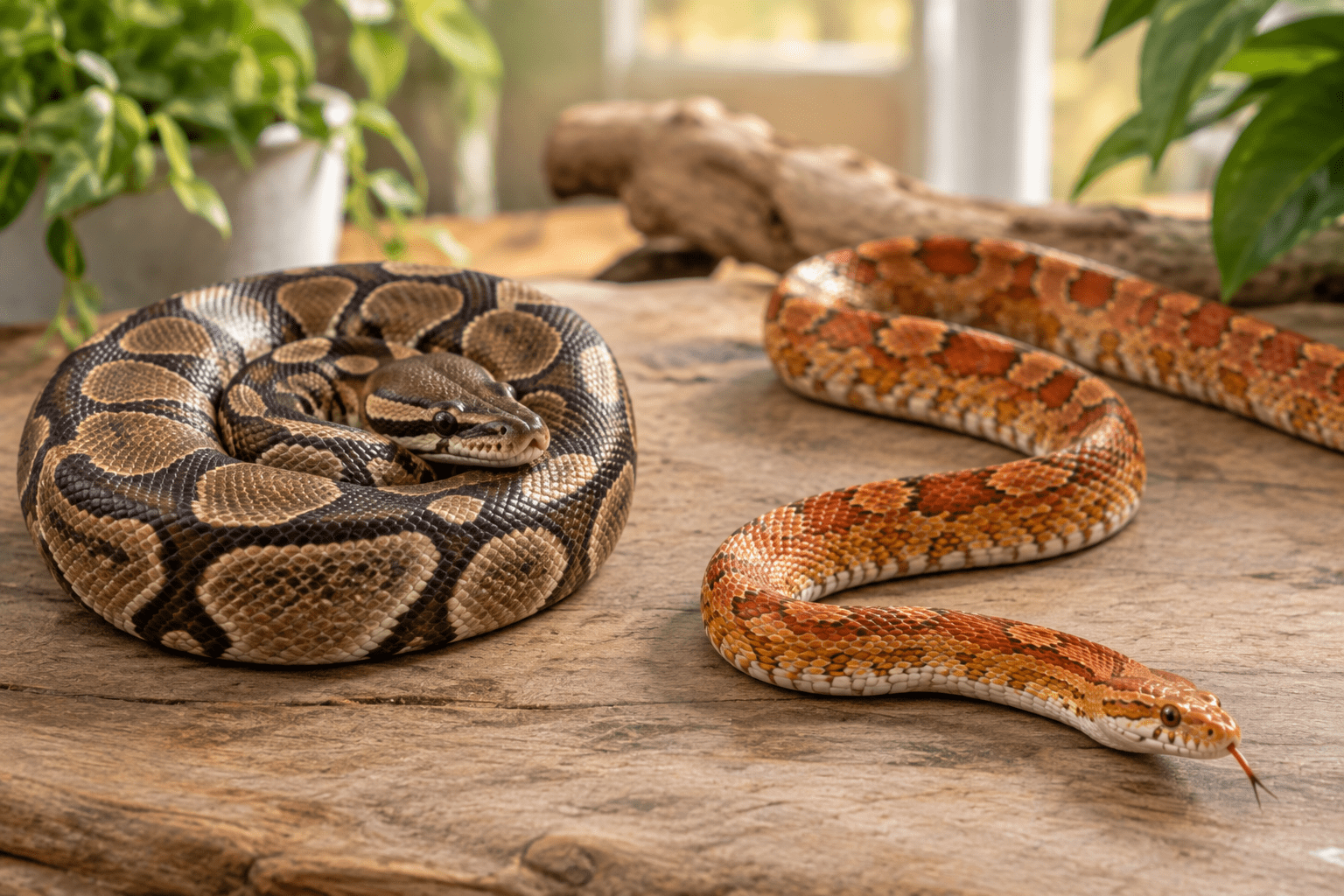
Here’s where the sources reviewed for this guide stop agreeing. reptile.guide states corn snakes reach roughly 5 feet and ball pythons roughly 6 feet. Zen Habitats and Pawshatch both give the opposite pattern — ball pythons at 3–5 feet, corn snakes at 4–6 feet. Reptination gives both species the same 3–5 foot range. XYZReptiles states ball pythons run 3–5 feet against corn snakes at 2–4 feet. None of these five sources acknowledges that the others give different numbers, and taken together, they don’t support a single confident answer to “which one gets bigger.”
The honest takeaway: across the five sources reviewed, adult size for both species falls somewhere in a roughly 2-to-6-foot envelope, and individual size varies meaningfully by sex, bloodline, and individual animal — enough that a specific breeder’s line matters more than a general species figure. Don’t choose between these two species based on a precise size number from any one source, including this one.
Pet Care Tip: If enclosure space is a real constraint, ask a specific breeder about the typical adult size for their line rather than relying on a general species-wide figure.
Handling: Physical Difficulty vs. Behavioral Ease
These two things get blended together across the sources reviewed for this guide, but they’re really separate questions.
Physical handling. Ball pythons are generally the heavier-bodied, more muscular of the two, and per reptile.guide, may need more physical support when held, particularly as adults. Corn snakes are lighter and more slender, and are generally easy to support one-handed even as adults.
Behavioral handling. This is where ball pythons are usually described as the easier of the two: per Reptination, they’re “slow, calm, deliberate” and tend to curl defensively into a ball when startled rather than react unpredictably — a trait that gives the species its name. Corn snakes, by contrast, are consistently described as more active and exploratory while being held — per Zen Habitats, “more active and curious,” moving around more rather than settling. Neither behavior is better on its own: some owners find a corn snake’s activity engaging, others find it harder to keep still for things like photos or nail checks.
A snake can be both heavier to physically support and calmer to hold — the two aren’t contradictory, which is why it’s worth treating them as separate questions rather than one blended “which is easier to handle” verdict.
Pet Care Tip: If you’re nervous about handling in general, a ball python’s tendency to stay still (even if it needs more support) may feel more manageable than a corn snake’s constant exploring.
Housing and Humidity Needs, Side by Side
Adult enclosure footprint is broadly similar between the two species — several sources reviewed for this guide cite comparable adult enclosure sizes for both (commonly a 4×2×2 foot enclosure or equivalent, though sources don’t always specify whether this is a stated minimum or a general recommendation), so check current husbandry guidance against your specific setup rather than treating this as a fixed number.
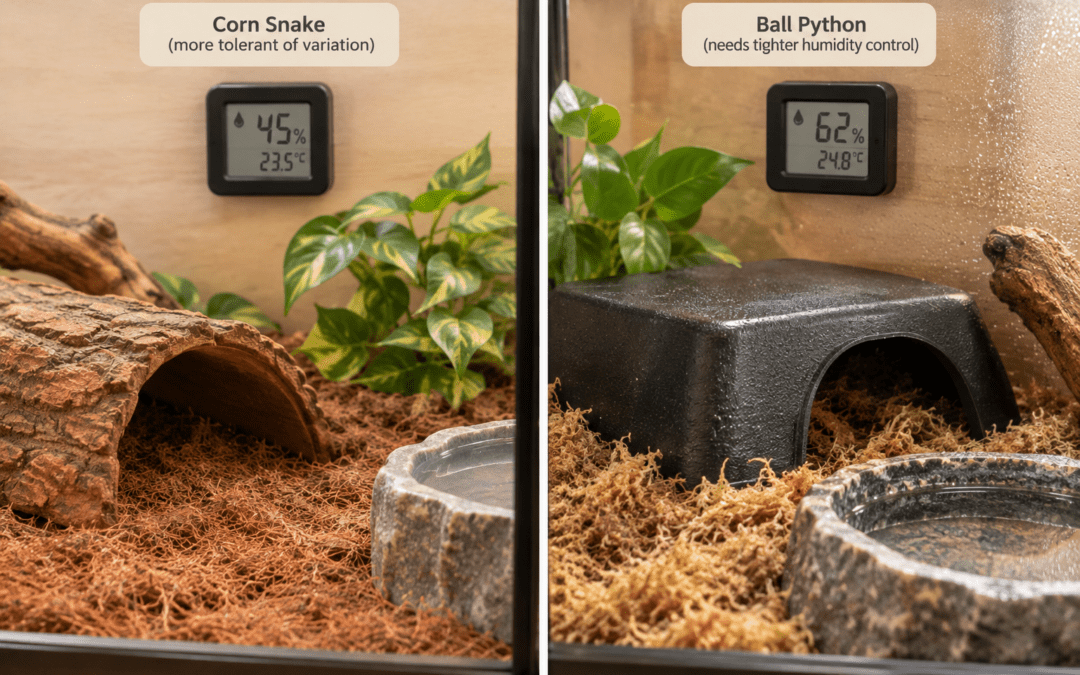
Where the two differ more clearly is humidity consistency. Ball pythons are consistently described as needing more careful, tighter humidity control — Zen Habitats and Reptination both cite humidity ranges in the 50–65% zone with an emphasis on consistency, and Pawshatch describes ball pythons as needing “elevated moisture” with “consistent environmental monitoring.
” Corn snakes, by contrast, are described across sources as tolerating more variation, with several sources citing comfortable ranges as low as 40–50%; a couple of sources go further and describe them as adaptable to typical indoor humidity levels, though that claim wasn’t independently verified for this guide and shouldn’t be read as “no monitoring needed.” For a first-time owner weighing day-to-day maintenance effort, this is a more practically meaningful difference than the disputed size figures above.
Pet Care Tip: A digital hygrometer is worth having for either species, but it matters more for a ball python, where the margin for humidity drift is described as tighter across sources.
Cost: The Animal vs. the Full Setup
This is a genuine gap in how competitors present cost: most give only the purchase price of the animal, which tells an incomplete story. Per reptile.guide, basic corn snake morphs start around $30, against roughly $50–80 for a ball python — a real gap in animal price. Reptination gives a different, arguably more useful figure: a full starting setup (enclosure, heating, substrate, hides) in the range of $300–500 for either species — meaning the total cost of entry may be considerably more comparable than the animal-price gap alone suggests.
That $300–500 figure comes from a single source, though, so treat it as a rough planning estimate rather than a verified number, and check current prices from a supplier before budgeting against it.
The practical takeaway: if you’re comparing sticker price on the animal itself, corn snakes are typically the cheaper purchase. But if you’re budgeting the whole project — enclosure, heating and lighting equipment, substrate, hides, and ongoing feeder costs — the gap between the two species may narrow considerably, since most of that cost comes from the setup, not the snake.
Pet Care Tip: Budget for the full setup before you fall in love with either species specifically — it’s the bigger number either way, and prices for both animals and equipment change, so get a current quote before buying.
Shedding and Health Considerations
Shedding itself works the same way in both species — see our dedicated How to Tell If a Snake Is About to Shed guide for the full picture on signs and timing, since the process doesn’t differ meaningfully by species. Per reptile.guide, ball pythons are sometimes described as somewhat more prone to shedding difficulties tied to humidity than corn snakes, though this wasn’t corroborated in detail by the other sources reviewed for this guide.
On health more broadly, reptile.guide is the only source reviewed for this guide to raise Inclusion Body Disease (IBD) as a ball-python-specific concern. It’s worth knowing the name if you keep researching ball pythons, but since only one of the five sources reviewed mentions it, this guide treats it as a single-source claim, not an established consensus — and it is not a major differentiator between these two species based on what this comparison actually found. Both species, per the sources reviewed, can be affected by more general reptile health issues like mouth rot and respiratory illness if husbandry is off — nothing species-specific stands out there.
Pet Care Tip: A reputable breeder and a post-purchase check-in with a reptile-experienced vet are good practice for either species — this isn’t a ball-python-specific precaution.
Which One Fits You? A Decision Framework
Every source reviewed for this guide ends on some version of “it depends on preference” without actually saying what it depends on. Here’s a more concrete version:
- Want a snake that’s usually visible and active, and eats reliably with little drama? → A corn snake fits better.
- Want the calmer, more predictable handle, and you’re comfortable with extended fasting being a commonly-reported, often-seasonal pattern rather than something to panic over? → A ball python fits better — just read our ball python feeding guide first, so you know what’s typical versus what’s worth a vet check.
- Mainly comparing sticker price on the animal itself? → Corn snakes are typically cheaper to buy, though total setup cost may land in a similar range either way.
- Want humidity control to be less of a daily concern? → A corn snake’s tolerance for more variation is generally the easier day-to-day fit.
- Still weighing a wider set of species, not just these two? → See our broader Best Beginner Pet Snake guide instead of choosing between just these two.
What These Situations Might Suggest
The following are illustrative scenarios based on patterns commonly described across the sources reviewed for this guide, not documented case studies.
Choosing for activity and reliability. A first-time owner picks a corn snake specifically because they want to see their pet exploring the enclosure rather than staying hidden most of the time, and finds the consistent feeding pattern reassuring while they’re still learning the basics.
Choosing for temperament, with eyes open. A first-time owner picks a ball python for its calm handling temperament, and — having read about seasonal fasting patterns beforehand — checks husbandry and body condition rather than assuming something is wrong when it skips several meals over the winter.
Common Mistakes to Avoid
- Treating a single source’s exact size figures as settled fact, when the sources reviewed for this guide genuinely disagree on which species grows larger.
- Assuming a ball python’s extended fasting means something is wrong, without knowing this is a well-documented, often-seasonal pattern for the species.
- Comparing only the purchase price of the animal and concluding one species is dramatically cheaper overall, without accounting for the more comparable full setup cost.
- Conflating “calmer to hold” with “easier to care for overall” — the two aren’t the same axis, and each species has different strengths.
- Choosing based on appearance alone without considering the real behavioral and feeding differences that affect day-to-day ownership.
Comparison Table
|
Factor |
Corn Snake |
Ball Python |
|
Adult size |
Roughly 2–6 ft (disputed across sources) |
Roughly 2–6 ft (disputed across sources) |
|
Feeding reliability |
Generally very reliable |
Prone to extended, often seasonal fasting |
|
Handling (physical) |
Lighter-bodied, easy to support one-handed |
Heavier-bodied; may need more support |
|
Handling (behavioral) |
More active and exploratory while held |
Generally calmer; may curl defensively when startled |
|
Humidity/husbandry |
Tolerates more variation |
Needs tighter, more consistent humidity |
|
Cost (animal) |
Typically cheaper to purchase |
Typically more expensive to purchase |
|
Cost (full setup) |
Roughly comparable to ball python |
Roughly comparable to corn snake |
|
Lifespan |
Often cited around 15–20 years (single-source estimate) |
Often cited around 20–30 years (single-source estimate) |
This table is intentionally cautious on the disputed figures (size, lifespan) rather than presenting false precision — see Size and Growth above for the source-by-source breakdown, and our ball python feeding guide for feeding depth. Exact numbers should be independently verified before making a purchasing decision.
Checklists
Before-You-Decide Checklist
- Honestly assess how you’d feel about a pet that might not eat for weeks at a time (ball python) versus wanting more visible day-to-day activity (corn snake)
- Check your ability to maintain tighter, more consistent humidity control if considering a ball python
- Price out a full starting setup, not just the animal, for whichever species you’re leaning toward
- Confirm local laws don’t restrict either species before buying
First-Week Checklist (Either Species)
- Confirm enclosure temperature and humidity with a digital thermometer/hygrometer before bringing your snake home
- Have hides ready on both the warm and cool sides
- Give a newly acquired snake a genuine settling-in period before expecting normal feeding behavior — see Why Is My Snake Not Eating? if early refusal worries you
Frequently Asked Questions
Which is better for a beginner, a corn snake or a ball python?
Both are genuinely solid choices. Corn snakes are more reliable eaters and more active/visible; ball pythons are calmer to handle but prone to extended, commonly-reported fasting. See “Which One Fits You?” above.
Which grows bigger, a corn snake or a ball python?
The sources reviewed for this guide disagree — expect roughly 2 to 6 feet depending on source, sex, and bloodline. Don’t trust any single precise figure.
Why do ball pythons stop eating?
Extended fasting, especially seasonally, is commonly reported as normal for the species, though prolonged refusal alongside weight loss or lethargy is worth a vet check. See our ball python feeding guide and Why Is My Snake Not Eating? for the full picture.
Which snake is calmer to hold?
Ball pythons are generally described as the calmer handle; corn snakes are more active and exploratory while being held. See “Handling” above.
Is a corn snake or a ball python cheaper to own?
Corn snakes are typically cheaper to purchase, but the cost of a full starting setup may be broadly comparable between the two species — see “Cost” above for the caveats on that estimate.
Do corn snakes or ball pythons need more humidity?
Ball pythons generally need more consistent, tighter humidity control; corn snakes tolerate more variation.
Which snake lives longer?
Ball pythons are more often cited with a longer lifespan (roughly 20–30 years) than corn snakes (roughly 15–20 years), though these figures come from the sources reviewed rather than a large-scale study and vary by source.
Related Reading
- Best Beginner Pet Snake for First-Time Owners
- How Often Should You Feed a Ball Python?
- Why Is My Snake Not Eating?
- How to Tell If a Snake Is About to Shed
Sources & References
- reptile.guide, “Corn Snake vs Ball Python: How to Find Your Perfect Match!” — written by Stacey, published August 2021, updated February 2022; reptile-specialist editorial; source for size, cost, lifespan figures and the single-source IBD mention
- XYZReptiles, “Corn Snake vs Ball Python – Which pet snake is better for beginners?” — reptile seller blog, published July 2022; flagged as commercially-sourced content
- Zen Habitats, “Ball Python VS Corn Snake | Which Should I Get?” — written by Madeline Smith, published February 2025; enclosure seller blog; flagged as commercially-sourced content
- Pawshatch, “Corn Snake vs Ball Python: Which Is the Best First Snake?” — author credited as Mehmood, DVM, published July 2026; general pet blog, not a recognized veterinary publisher — credential noted but treated with limited additional weight
- Reptination, “Ball Python vs Corn Snake — Direct Head-to-Head” — written by Max, a reptile keeper, last reviewed June 2026; reptile comparison/reference site; source for the total-setup-cost figure and the clearest side-by-side comparison structure
- This article’s ball-python-fasting claims are drawn from and consistent with this site’s own How Often Should You Feed a Ball Python? and Why Is My Snake Not Eating? articles, both more detailed on this point than any source in this comparison’s SERP
Written by the Pets Store Home editorial team. Sourcing by claim: the feeding-reliability difference is corroborated across all five sources reviewed and cross-checked against this site’s own ball-python-specific articles; the size and lifespan figures are disclosed as disputed across sources rather than resolved to one invented number; the IBD mention is a single-source claim, flagged as such rather than presented as an established risk.
None of the five comparison sources reviewed is a veterinary publisher, and no licensed veterinarian has reviewed this draft — one comparison source’s author is credited as a DVM, but that doesn’t substitute for independent veterinary review of this article itself, and it is not a substitute for professional veterinary or exotic-pet-care advice. If you’re choosing between these species, consulting a reptile-experienced vet or a reputable breeder about your specific circumstances is a reasonable next step beyond this guide.
Last fact-checked: September 2026 — claims were cross-checked against the five hobbyist, seller, and reference sources reviewed (none of which are veterinary publishers) and against this site’s own ball-python-specific articles; the size, cost, and lifespan figures are presented as disputed ranges or single-source estimates rather than resolved to verified numbers, given how much the sources reviewed disagree or how thin the sourcing is.
Where to Go From Here
- Considering a ball python? Start with our feeding-frequency guide and keep Why Is My Snake Not Eating? bookmarked.
- Either species: How to Tell If a Snake Is About to Shed is worth a read before your snake’s first shed at home.
- Still comparing a wider shortlist? See Best Beginner Pet Snake for First-Time Owners.
[…] Which foreign pets are legal in Washington State? […]