
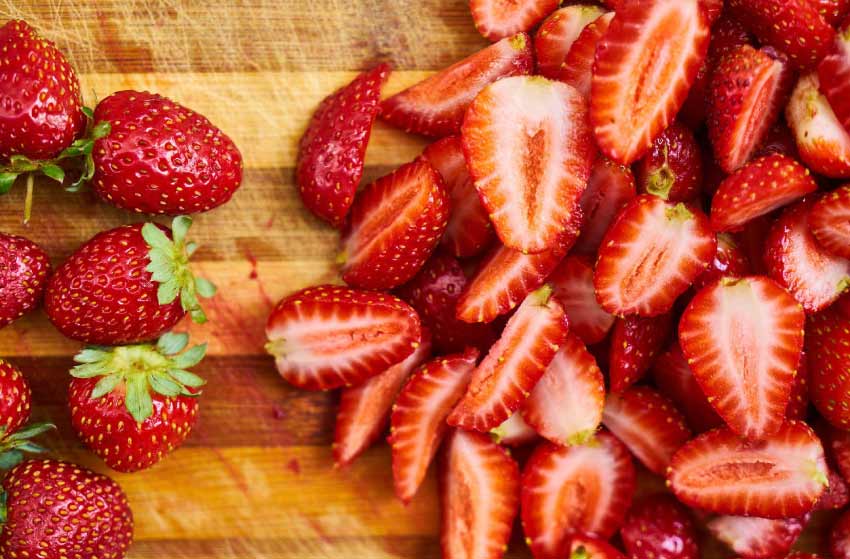
Quick Answer: Yes, gerbils can eat strawberries, but only as an occasional treat. A piece about the size of a fingernail once or twice a week is plenty – strawberries are high in natural sugar relative to a gerbil’s tiny body size, and gerbils are genetically prone to blood-sugar problems in a way most small pets aren’t. Wash the fruit, remove the leafy cap, and cut it small.
Key Takeaways
- Strawberries aren’t toxic to gerbils, but their natural sugar content makes them a treat, not a diet staple.
- Pet gerbils are Mongolian gerbils (Meriones unguiculatus), a species researchers use to study diet-induced diabetes – a good reason to be more careful with sugar than you might be with other small pets.
- A pea-sized piece once or twice a week is a sensible portion; more than that regularly raises real health risks.
- Always wash the fruit, remove the green cap, and cut it small enough to prevent choking.
- A quality gerbil pellet mix should make up roughly 75% or more of the diet, with fruits and vegetables combined staying under 10%.
Why Trust This Guide?
This guide is researched and written by the Pets Store Home editorial team, drawing on veterinary small-animal nutrition resources and published research on gerbil metabolism. It’s intended as general information; consult a veterinarian or exotic-pet specialist for advice specific to your gerbil.
Can Gerbils Eat Strawberries? The Short Answer
Strawberries are not toxic to gerbils, and most gerbils enjoy them. The catch isn’t safety in the poison sense – it’s portion size relative to how sugar affects a gerbil’s body. A gerbil weighs somewhere between 2 and 4.5 ounces (roughly 60 to 130 grams), which is a small fraction of the body mass of a rabbit or guinea pig. A piece of strawberry that would be a rounding error for a guinea pig’s blood sugar is a much bigger relative dose for a gerbil.
That difference matters more with gerbils than with most rodents kept as pets, because of something specific to the species – covered in more detail below. The short version: strawberries are fine as an occasional treat, not as a regular snack, and definitely not as a substitute for a proper pelleted diet.
Why Gerbils Need Extra Caution With Sugar
Pet gerbils are almost always Mongolian gerbils (Meriones unguiculatus), native to the grasslands, shrubland, and semidesert steppe of Mongolia, northern China, and parts of Russia. In the wild, their diet is built around grass seeds, roots, leaves, mugwort and saltwort vegetation, and the occasional insect – a diet that’s fibrous and calorie-sparse, with almost none of the concentrated sugar found in a supermarket strawberry.
That evolutionary background is part of why Mongolian gerbils show up repeatedly in scientific literature as a research model for diet-induced diabetes. Published studies on the species describe a “diabetic syndrome” that can develop in gerbils fed a higher-calorie diet than they evolved for, with researchers measuring elevated blood glucose and altered insulin response under those conditions. A closely related desert species, the sand rat (Psammomys obesus), shows an even more dramatic version of the same pattern – it stays perfectly healthy on the low-calorie desert vegetation it evolved to eat, but develops hyperglycemia and obesity remarkably quickly when switched to standard, calorie-denser laboratory chow.
None of this means a strawberry chunk once a week will give your gerbil diabetes. It does mean gerbils, as a species, are physiologically primed to handle concentrated sugar and extra calories worse than an animal that evolved eating richer vegetation would. That’s the biological reason behind the “small amount, occasionally” advice you’ll see for gerbils specifically, rather than a generic caution copied from guinea pig or rabbit care sheets.
Nutritional Profile of Strawberries
Strawberries aren’t nutritionally empty – they’re just not built for a gerbil’s portion size. A typical serving contains meaningful vitamin C, a modest amount of fiber, and antioxidant compounds like anthocyanins. For a gerbil eating a well-formulated pellet diet, none of that is something they’re lacking; unlike some primates, most small mammals synthesize their own vitamin C internally, so strawberries aren’t filling a nutritional gap so much as adding variety and enrichment.
The tradeoff is sugar content. Strawberries run roughly 4 to 5 grams of sugar per 100 grams of fruit – moderate by human standards, but concentrated compared to the grasses, seeds, and roots a gerbil’s digestive system evolved around. That’s the whole reason portion size matters more here than the nutrient content does.
How Much and How Often
A reasonable serving is a piece of strawberry roughly the size of a pea to a fingernail – offered once or twice a week, not daily. Some gerbil owners and small-animal references suggest scaling this down further, to a small piece once a week, particularly for gerbils that are already on the smaller or older side. There’s no harm in erring toward the smaller, less frequent end of that range.
As a general rule across all treats and fresh produce combined – not just strawberries – fruits and vegetables should make up no more than about 10% of a gerbil’s overall diet. The rest should come from a nutritionally complete, gerbil-specific pelleted food, which is formulated to hit the roughly 14-18% protein, 7-15% fiber, and 4-9% fat that gerbils need. Loose seed-and-grain “muesli” mixes are worth avoiding as a dietary base, since gerbils tend to pick out the high-sugar, high-fat pieces and leave the rest, creating exactly the kind of unbalanced diet that pellets are designed to prevent.
How to Prepare Strawberries Safely
Preparation is simple but worth doing consistently:
Wash thoroughly. Rinse the strawberry under running water to remove dirt, residue, and any pesticide traces, even if it’s labeled organic.
Remove the green cap and any stem. The leafy cap isn’t toxic, but it’s fibrous and harder to digest than the fruit itself, and it offers no benefit worth the risk.
Cut it small. A piece roughly a quarter-inch to half-inch across is manageable for a gerbil to handle and chew without choking risk.
Introduce it gradually the first time. If your gerbil has never had strawberry before, offer a small piece and watch for the next 24 hours before offering more. Loose stools, lethargy, or a gerbil that suddenly won’t touch its normal pellets are signs to stop and consult a vet.
Remove anything uneaten. Gerbils cache food, which is a natural behavior, but a forgotten piece of fresh fruit left in bedding can mold or attract pests. Check food caches periodically and remove spoiled fruit.
Signs of a Problem to Watch For
Most gerbils tolerate an occasional small piece of strawberry without any issue. Still, it’s worth knowing what a negative reaction looks like: soft or watery stools, noticeably reduced appetite for regular food, unusual lethargy, or bloating. If any of these appear after introducing strawberry (or any new food), remove it from the diet and get in touch with a vet experienced with small mammals, particularly if symptoms last more than a few hours.
Other Fruits and Vegetables Gerbils Can Eat
If you’re looking to add variety beyond strawberries, small amounts of apple (seeds removed – they contain trace cyanogenic compounds), pear, blueberry, raspberry, and banana are generally considered safe in similarly small portions. On the vegetable side, carrot is a particularly good option, offering fiber, beta-carotene, and a texture that helps wear down a gerbil’s continuously growing teeth. Small amounts of broccoli and kale are also commonly recommended.
On the avoid list: onions, leeks, garlic, rhubarb, iceberg lettuce (mostly water with little nutritional value), and potato, all of which are either harmful or simply not worth feeding. Citrus fruits are also best skipped, since their acidity can cause digestive upset more readily than other fruits.
Where Strawberries Fit Among Common Gerbil Treats
It helps to think of treats on a spectrum rather than a simple safe-or-unsafe list. Plain cooked pasta, unsalted plain popcorn, and small pieces of whole-grain cracker sit toward the low-sugar end and can be offered a little more often. Fruit – strawberries included – sits in the middle: not dangerous, but concentrated enough in natural sugar that frequency matters. Commercial “yogurt drop” treats sold for small pets sit at the high-sugar, high-fat end and are worth minimizing regardless of how often you offer fresh fruit, since many are closer to candy than to food nutritionally.
Comparing strawberries specifically to another popular gerbil treat, banana, the two are fairly similar in practice: both are safe in small amounts, both are higher in natural sugar than a gerbil’s ancestral diet would have included, and both are best offered once or twice a week rather than daily. Neither should be a rotating daily snack even if you alternate between them, since the sugar load adds up regardless of which fruit it’s coming from.
Gerbils also cache food as an instinctive behavior carried over from their wild ancestry, burying or hoarding extra food for later rather than eating everything immediately. That’s normal and not a sign anything is wrong – but it’s also why leftover strawberry pieces need to be tracked down and removed from bedding rather than left to spoil unnoticed in a cached pile.
Hydration and Fresh Produce
In the wild, Mongolian gerbils get a meaningful portion of their water from the vegetation, roots, and seeds they eat, since standing water is scarce across the grassland and semidesert habitat they evolved in. Pet gerbils should always have clean water available regardless, but this background helps explain why fresh, water-rich foods like strawberries can be genuinely appealing to a gerbil beyond just the sweetness – it taps into a foraging instinct for moisture-bearing plant matter. That’s a reason to offer the occasional piece as enrichment, not a reason to increase the portion size or frequency beyond what’s recommended above.
Dental Health and Treat Texture
A gerbil’s incisors grow continuously throughout its life, and chewing on firm foods helps keep them worn down to a manageable length. Strawberry flesh is soft and doesn’t offer much of that dental benefit compared to a carrot or a hard pellet, so it’s worth thinking of strawberry purely as a flavor-and-enrichment treat rather than a dental aid. If dental wear is a concern, rotating in a small piece of raw carrot alongside (or instead of) fruit gives your gerbil both variety and the firmer texture their teeth benefit from.
Building a Balanced Gerbil Diet
The foundation of a healthy gerbil diet is a specifically formulated gerbil pellet, not a mixed seed blend. Pellets ensure your gerbil can’t selectively eat only the tastiest, highest-sugar or highest-fat components and skip the rest – a real risk with muesli-style mixes, where gerbils reliably cherry-pick and leave a nutritionally unbalanced remainder behind. Fresh water should always be available, and fresh produce – strawberries included – should be treated as an occasional supplement to that foundation, not a replacement for any part of it.
How Gerbils Compare to Other Small Pets on Sugar Sensitivity
It’s worth being specific here, because small-pet care advice often gets copied wholesale between species that don’t actually share the same needs. Guinea pigs, for instance, cannot synthesize their own vitamin C and genuinely need it from their diet – which is part of why fruit is emphasized so heavily in guinea pig care. Gerbils don’t have that requirement; they make their own vitamin C internally, so a strawberry isn’t closing a nutritional gap for them the way it partly does for a guinea pig.
Hamsters, another common comparison, are also prone to diabetes in certain lines (particularly Campbell’s dwarf hamsters), so the “go easy on sugar” advice for hamsters and gerbils actually rests on similar biological reasoning, even though the two species aren’t closely related. Rabbits and chinchillas, by contrast, have digestive systems built around near-constant high-fiber grazing, and sudden diet changes are a bigger acute risk for them than sugar alone. The upshot: “moderation” isn’t a throwaway phrase copied across every small-pet care sheet – for gerbils specifically, it’s grounded in the species’ documented tendency toward diet-related blood sugar issues.
Feeding Strawberries in a Multi-Gerbil Household
Gerbils are social animals typically kept in same-sex pairs or small groups, and treat time is one of the more common flashpoints for squabbling in an otherwise peaceful enclosure. When offering strawberry to more than one gerbil, it helps to give each gerbil its own small piece in a separate spot rather than dropping a single larger piece in and letting them compete over it. This reduces the odds of resource-guarding behavior and gives you a clearer view of whether any individual gerbil is reacting poorly to the treat, since you can watch each one separately rather than trying to track a shared piece.
Age, Health Conditions, and Extra Caution
Very young gerbils that haven’t been weaned onto solid food yet shouldn’t be given fruit at all – stick to their normal diet until a vet or breeder confirms they’re ready for treats. On the other end of the age range, senior gerbils and any gerbil with a known health condition (particularly anything affecting the kidneys, digestive tract, or blood sugar) should get fruit only with a vet’s input first, since the same small piece of strawberry that’s harmless for a healthy adult gerbil can be a bigger relative burden for a gerbil whose body is already working harder to manage its baseline health.
Frequently Asked Questions
Can gerbils eat strawberries every day?
No. Daily feeding is too much sugar for a gerbil’s size and metabolism. Once or twice a week, in a small portion, is the safer approach.
Are strawberry seeds or leaves dangerous to gerbils?
The seeds and leafy cap aren’t toxic, but they’re fibrous and offer no benefit, so it’s simplest to remove them before feeding.
Why are gerbils more sensitive to sugar than some other small pets?
Gerbils evolved eating low-calorie, fibrous desert and grassland vegetation, and the species is used in research specifically because of its tendency toward diet-induced blood sugar problems. That biology is the reason the “small amount, occasionally” rule matters more for gerbils than it might for some other small mammals.
What percentage of a gerbil’s diet should be fruits and vegetables?
No more than about 10% combined, with the rest coming from a complete, gerbil-specific pellet food.
What should I do if my gerbil has diarrhea after eating strawberry?
Remove fresh fruit from the diet immediately and contact a veterinarian experienced with small mammals, especially if symptoms persist beyond a few hours.
Gerbils aren’t the only small pet owners ask fruit questions about – our guide to whether gerbils can eat bananas covers a similarly sugary treat, and if you’re weighing how long you can expect to enjoy your pet, our guide to gerbil lifespan and care rounds out the basics. For a cross-species comparison, our guide to what chinchillas can safely eat looks at the same fruit questions for an even more sugar-sensitive relative.
[…] Which foreign pets are legal in Washington State? […]