
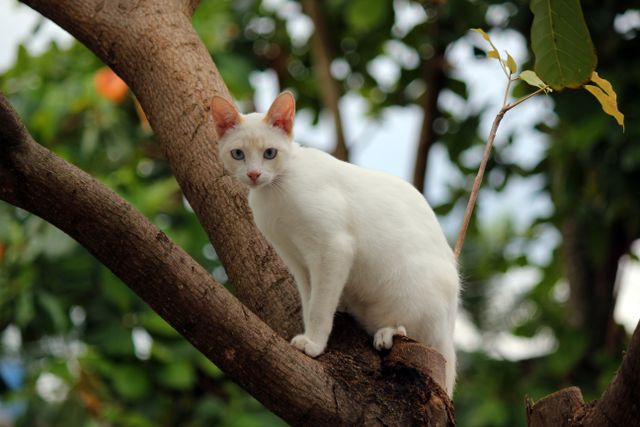
White cat species: all white cats belong to one species, the domestic cat (Felis catus). “White” is a coat color, not a species. Many breeds come in solid white, including the Turkish Angora, Khao Manee, Persian, British Shorthair, Maine Coon, and Cornish Rex. Most white cats get their color from a dominant white gene, which is also linked to blue eyes and a higher risk of deafness.
White cats turn heads, from snowy Persians to sleek Khao Manees with odd-colored eyes. If you’ve searched for white cat species, you’re probably wondering which breeds come in white, why so many white cats have blue eyes, and whether all white cats are deaf. This guide answers those questions in plain words. It also covers sunburn and skin cancer risk on white ears, grooming tips for white fluffy cats, and how to tell an albino cat from a white one.
Key takeaways
- There’s no separate white cat species. White cats are domestic cats with a white coat.
- White cat breeds recognized by the CFA and TICA include the Turkish Angora, Khao Manee, Persian, and many more.
- Most solid white cats carry the dominant white gene, which hides any other coat color.
- White cats with blue eyes are more likely to be deaf, but not all white cats are deaf.
- White ears, noses, and eyelids burn easily and are prone to a skin cancer called squamous cell carcinoma.
- True albino cats are very rare, and a DNA test is the reliable way to tell them apart from dominant white cats.
In this guide
White Cat Species: The Short Answer
Every pet cat, whatever its color, belongs to the same species: Felis catus. So when people search for white cat species, what they usually mean is white cat breeds, or simply cats with a white coat. A white cat can be a purebred, such as a Turkish Angora, or a mixed-breed cat from a shelter.
Pure white cats can get their color in a few different ways:
- Dominant white: a gene that covers up every other color, producing a solid white cat. This is the most common cause.
- White spotting: a related gene that adds white patches. Cats with a lot of white spotting can look almost all white.
- Albinism: a very rare change in a different gene that blocks pigment.
We explain each one below, because the cause affects eye color, hearing, and health.
White Cat Breeds Recognized by the CFA and TICA
When people compare white cat species, they’re really comparing breeds. The Cat Fanciers’ Association (CFA) and The International Cat Association (TICA) are the two largest US cat registries. Many of their breeds accept white as a color. A few are especially known for it:
- Turkish Angora: the CFA notes that only white Angoras were considered authentic in early Turkish preservation breeding, and the first US imports in 1954 were all white. Today the breed comes in many colors, but white with blue, green, amber, or odd eyes remains a classic look.
- Khao Manee: a natural breed from Thailand whose name means “white gem.” A 2020 CFA-linked breed profile on Cat-o-Pedia says it is accepted for championship in TICA and in the CFA’s Miscellaneous class, and that odd eyes are especially prized.
- Persian: the CFA Persian standard lists blue-eyed, copper-eyed, and odd-eyed white classes, and calls for a “pure glistening white” coat.
- Turkish Van: not solid white, but the CFA standard prefers a chalk-white body with color only on the head and tail.
White also appears in many other breeds. A list from the LSU School of Veterinary Medicine of breeds carrying the dominant white gene includes:
| Longhaired and white fluffy cat breeds | Shorthaired and curly-coated breeds |
|---|---|
| Persian | British Shorthair |
| Turkish Angora | American Shorthair |
| Maine Coon | Exotic Shorthair |
| Norwegian Forest Cat | Oriental Shorthair |
| Siberian | Cornish Rex and Devon Rex |
| Oriental Longhair | Scottish Fold, Manx, and American Wirehair |
Color rules differ between registries and change over time, so check the CFA or TICA standard for the breed you’re interested in. For other color combinations, see our guides to gray and white cat breeds and orange and white cat breeds.
White Cat Genetics in Plain Words
Every white cat species question eventually comes back to genes. Think of dominant white as a white sheet thrown over a painting. Underneath, the cat still carries genes for another color, such as black, orange, or tabby. The white gene simply stops pigment cells from reaching the skin and hair, so the coat looks white.
The UC Davis Veterinary Genetics Laboratory explains that dominant white is caused by a change in the KIT gene. Because it’s dominant, a cat needs only one copy to be white. A white cat with one copy and one normal gene will pass white to about half of its kittens. A different change in the same KIT gene causes white spotting, which gives bicolor and van-pattern cats their white patches.
| Cause of white | Gene | How it’s inherited | What you see |
|---|---|---|---|
| Dominant white | KIT | Dominant (one copy is enough) | Solid white; any eye color |
| White spotting | KIT | Dominant | White patches, from a little to almost all white |
| Albinism | TYR | Recessive (two copies needed) | White coat with blue eyes; very rare |
Two white parents don’t always have white kittens, and two colored cats can’t produce a dominant white kitten unless one of them carries the gene. That’s why breeders often pair white cats with colored cats.
White Cat With Blue Eyes: The Deafness Link
A white cat with blue eyes is stunning, and many owners ask whether blue eyes mean the cat can’t hear. There is a real link. The same lack of pigment cells that makes the coat white can affect the eyes and the inner ear, which needs pigment cells to work properly.
Data compiled by the LSU School of Veterinary Medicine show how strong the link is. Across three studies of 256 white cats, about half were deaf in one or both ears. Two older studies broke the numbers down by eye color:
| White cats with… | Share that were deaf (two studies) |
|---|---|
| Two blue eyes | About 65% to 85% |
| One blue eye (odd-eyed) | About 39% to 40% |
| No blue eyes | About 17% to 22% |
LSU also notes that longhaired white cats tend to have more blue eyes and more deafness than shorthaired white cats. UC Davis reports that, in one family of cats, nearly 75% of cats with two copies of the dominant white gene were deaf.
The CFA advises Turkish Angora breeders to pair white cats with colored cats to reduce the risk, and says some areas require hearing tests for white kittens. The standard hearing test is called a BAER test, and your vet can refer you to a clinic that offers it.
Pet Care Tip: Deaf cats can live full, happy lives. Keep a deaf cat indoors, since it can’t hear cars or predators. Use visual signals, such as a hand wave or flicking a light, and approach from the front so you don’t startle it.
Sunburn and Skin Cancer in White Cats
Whatever the breed, every white cat species shares one weak spot: white fur and pink skin offer little protection from the sun. VCA Animal Hospitals explains that sunlight is linked to squamous cell carcinoma (SCC), a skin cancer that is more likely in white and light-colored cats and outdoor cats. It usually starts on thin-haired, lightly pigmented skin:
- ear tips,
- the top of the nose,
- eyelids, and
- lips.
According to Washington State University’s Veterinary Teaching Hospital, cats in sunny climates, cats that sunbathe a lot, and older cats are also at higher risk.
| Warning signs | What to do |
|---|---|
| Red, sunburned-looking ear tips or nose | Cut back sun exposure and mention it at the next vet visit |
| Crusting or scabs that come and go | Book a vet exam |
| Sores that don’t heal, or that bleed | See your vet promptly |
| Raised or cauliflower-like growths | See your vet promptly |
VCA says surgery gives the best long-term control when the tumor is fully removed, and small tumors may be frozen off. Early treatment is much simpler, so don’t wait on a sore that won’t heal.
How to protect white cats from the sun
- Keep your cat indoors, especially during peak sun hours (WSU).
- Use UV-blocking film or shades on sunny windowsills where your cat naps (VCA, WSU).
- Ask your vet before using any sunscreen. Cats lick their fur, so only use a product your vet says is safe for cats.
- Check ear tips, nose, and eyelids every week, especially in summer.
Grooming Tips for White Cats and White Fluffy Cats
White coats show every speck of dirt and every tear stain, so they can need a little extra attention. How much depends on the coat type:
- Persians: the CFA says owning one “calls for a serious commitment to regular grooming.” It recommends a steel or Teflon-coated comb to prevent mats, and occasional baths after a thorough combing.
- Turkish Angoras: the CFA calls this one of the easiest longhair coats to care for. Combing two or three times a month is usually enough for younger cats, with more often for older cats.
- Shorthaired white cats: a weekly brush removes loose hair and lets you check the skin.
Gentle extras help keep a white fluffy cat looking its best:
- Wipe around the eyes with a soft, damp cloth if tear staining builds up. Sudden or heavy tearing deserves a vet check.
- Use only shampoos made for cats, never human or dog products, and ask your vet before using any whitening shampoo.
- Comb behind the ears, under the legs, and around the tail, where mats form first.
- Dry your cat completely after a bath and keep it warm.
- Use grooming time to check ear tips and nose for sun damage.
Albino vs White Cats: How to Tell Them Apart
One last white cat species question: is my cat albino? Most white cats are not albino. The UC Davis Veterinary Genetics Laboratory explains that albinism in cats is caused by a change in the TYR gene, the same gene behind Siamese and Burmese pointed coats. It’s recessive, so a kitten needs a copy from each parent. It’s also extremely rare: among more than 9,000 cats tested, UC Davis found only four carriers.
| Feature | Dominant white cat | Albino cat |
|---|---|---|
| Gene | KIT | TYR |
| Inheritance | Dominant | Recessive |
| Eye color | Blue, green, gold, copper, or odd-eyed | Blue |
| How common | Common in many breeds and mixed breeds | Very rare |
| Best way to confirm | DNA test | DNA test |
A simple clue: if your white cat has green, gold, or copper eyes, it isn’t albino. Because both kinds can have blue eyes, you usually can’t be sure by looking alone. UC Davis suggests testing a blue-eyed white cat for dominant white and white spotting first, then for albinism if those come back negative.
Common Myths About White Cats
| Myth | Fact |
|---|---|
| White cats are a separate species | All are domestic cats; white is a coat color |
| All white cats are deaf | About half are; risk is highest with two blue eyes |
| All blue-eyed white cats are albino | Albinism is very rare; most have dominant white |
| Indoor cats can’t get sunburned | Sun through windows still counts |
Example Scenario (illustrative)
Jordan in Arizona adopts Luna, a young white cat with blue eyes. Luna sleeps through the vacuum cleaner and never comes when called, so Jordan’s vet suspects deafness and refers them for a hearing test, which confirms it. Jordan keeps Luna indoors, adds UV film to the sunny living room window, and checks her ear tips every Sunday. At her next checkup, the vet finds healthy skin and a happy, well-adjusted cat.
White Cat Species: FAQs
Is there a white cat species?
No. All pet cats are one species, Felis catus. White is a coat color that appears in many breeds and in mixed-breed cats.
What are the most popular white cat breeds?
Well-known white cat breeds include the Turkish Angora, Khao Manee, Persian, British Shorthair, Maine Coon, Norwegian Forest Cat, Siberian, and Cornish Rex.
Are all white cats with blue eyes deaf?
No, but the risk is high. Studies compiled by LSU found roughly 65% to 85% of white cats with two blue eyes were deaf, compared with about 17% to 22% of white cats without blue eyes.
Are white cats rare?
Not especially. The dominant white gene appears in many breeds and in mixed-breed cats. True albino cats, however, are extremely rare.
Do white cats need sunscreen?
White cats burn easily, so limit their sun exposure. Ask your vet before using any sunscreen, since cats lick their fur and some products aren’t safe for them.
What is the fluffiest white cat breed?
The Persian is the classic white fluffy cat, with a long, full coat. The Turkish Angora, Maine Coon, Norwegian Forest Cat, and Siberian also have long coats.
How can I tell if my white cat is albino?
If your cat has green, gold, or copper eyes, it isn’t albino. For a blue-eyed white cat, a DNA test is the reliable way to know.
Final Verdict: White Cat Species and Breeds
There’s no single white cat species, just domestic cats with a white coat, found in breeds from the Turkish Angora and Khao Manee to the Persian and Maine Coon. Most white cats owe their color to the dominant white gene, which brings a higher chance of deafness, especially in cats with blue eyes. Protect your white cat from the sun, groom to suit its coat, and see your vet about any sore on the ears or nose that won’t heal.
Your next steps
- Check your white cat’s ear tips and nose for redness or crusting this week.
- Ask your vet about a hearing test if your cat seems unresponsive to sounds.
- Explore more cat color guides, such as tortoiseshell cats and brown cats, or visit our cat care section.
Share photos of your white cat with other owners on our Facebook page.
About the author
Written and reviewed by the Pets Store Home Editorial Team: pet owners and animal lovers who check every guide against trusted US veterinary and animal-welfare sources. This article is general information, not a substitute for professional veterinary advice. Always talk to your veterinarian about your own pet’s health.
How we checked this guide: We used Cat Fanciers’ Association (CFA) breed standards, a CFA-linked Khao Manee profile covering TICA status, the UC Davis Veterinary Genetics Laboratory, the LSU School of Veterinary Medicine, VCA Animal Hospitals, and Washington State University’s Veterinary Teaching Hospital. We review this article every 12 months, or sooner if guidance changes.
Last reviewed: October 2026
Sources
- Cat Fanciers’ Association – Turkish Angora (accessed Oct 2026)
- Cat Fanciers’ Association – Persian (accessed Oct 2026)
- Cat Fanciers’ Association – Turkish Van (accessed Oct 2026)
- Cat-o-Pedia – Khao Manee breed profile (2020, PDF) (accessed Oct 2026)
- UC Davis Veterinary Genetics Laboratory – Dominant White and White Spotting (accessed Oct 2026)
- UC Davis Veterinary Genetics Laboratory – Albino (Cat) (accessed Oct 2026)
- LSU School of Veterinary Medicine – Cat Breeds With Congenital Deafness (accessed Oct 2026)
- VCA Animal Hospitals – Squamous Cell Carcinomas in Cats (accessed Oct 2026)
- Washington State University Veterinary Teaching Hospital – Feline Cutaneous Squamous Cell Carcinoma (accessed Oct 2026)
[…] Which foreign pets are legal in Washington State? […]