
how to potty train an older rescue dog
You brought home an adult or senior rescue dog, and you’re already cleaning up accidents. Maybe you expected this. Maybe you didn’t, because you assumed a grown dog would already be house-trained. Either way, you’re not doing anything wrong, and neither is your dog.
Potty training an older rescue dog is a different job than potty training a puppy. Your dog’s bladder and bowel muscles are fully developed, so this isn’t about physical growth catching up. It’s about building a predictable routine and enough trust for your dog to relax into it. Some rescue dogs were never house-trained at all. Others were, but the stress of a shelter stay, a new home, and unfamiliar smells has temporarily scrambled that habit.
This guide walks through what to expect week by week, how to figure out what’s actually causing the accidents, and how to handle the very common setback that hits a few weeks in.
Quick Answer
Potty train an older rescue dog with a strict outdoor schedule (every 1–2 hours at first), immediate rewards for outdoor success, and close supervision or confinement whenever you can’t watch them directly. A dip in progress around weeks 3–8 is normal as the dog settles in. Most rescue dogs are reliably house-trained within two to three months.
Key Takeaways
- Older rescue dogs don’t need more time to learn than puppies — they need routine and trust.
- A slip-up a few weeks in usually means your dog is settling in, not regressing.
- Treat “unknown house-training history” as “not house-trained yet,” even if the shelter said otherwise.
- Confinement tools (crate, pen, gated room) should match your dog’s comfort level, not just your convenience.
- Sudden or unusual accidents are a reason to call the vet before assuming it’s behavioral.
In this article: Why It’s Different Than Puppy Training · Diagnose the Real Cause · Week-by-Week Timeline · Building the Routine · Choosing a Confinement Setup · The Honeymoon-Period Dip · Senior Dog Adjustments · Vet or Trainer? · Common Mistakes · FAQ
Why Older Rescue Dogs Need a Different Approach
A puppy is learning bladder control for the first time. An adult or senior rescue dog already has it — what they’re missing is a reliable routine, a clear signal for where to go, and confidence that this home is stable enough to relax in.
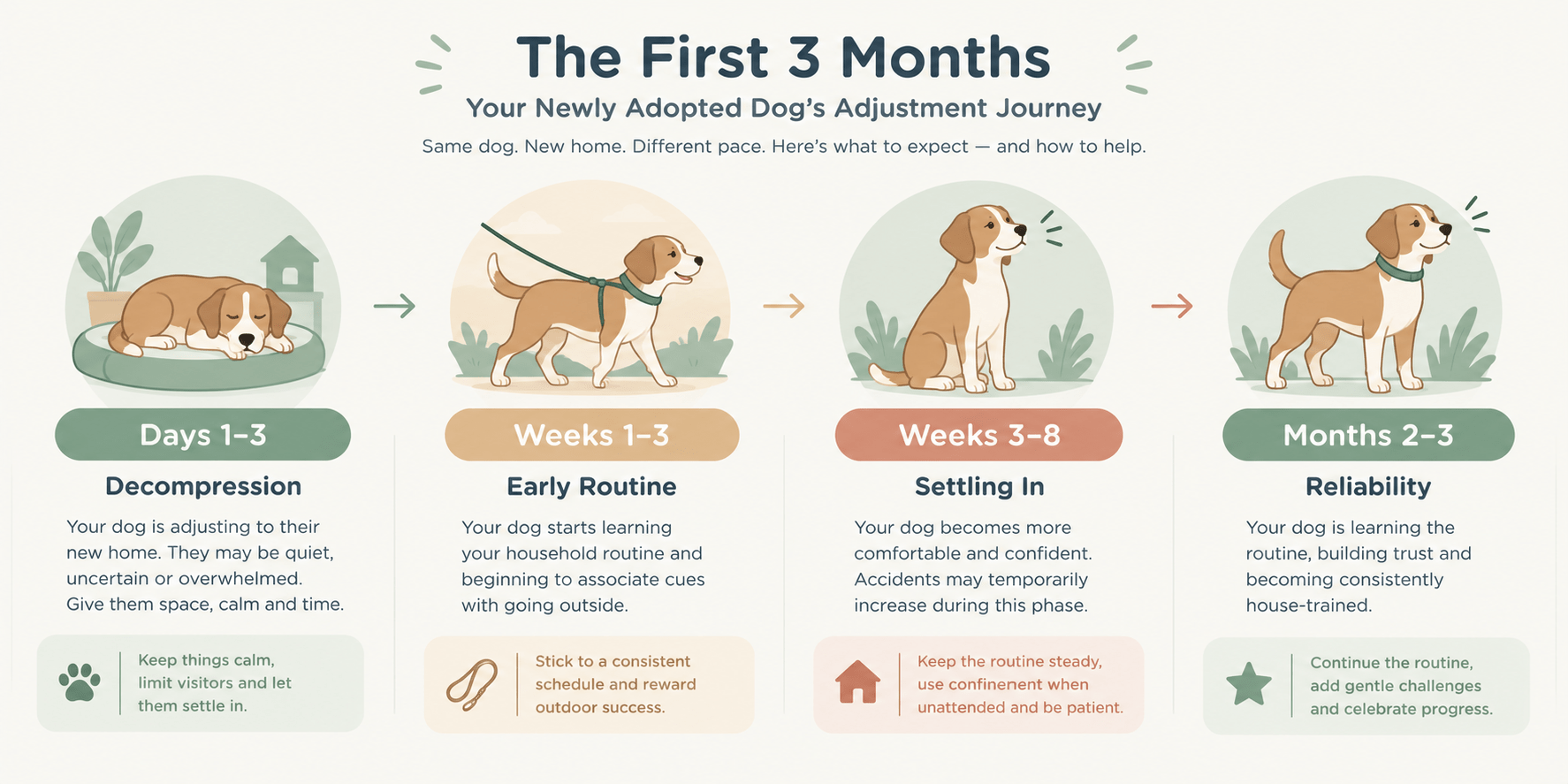
Shelters and rescues often describe a dog’s adjustment using what’s known as the 3-3-3 timeline: roughly three days to decompress from the move, three weeks to start learning your household’s routine, and three months to feel genuinely settled. House-training tends to follow that same arc. A dog who seems to “forget” everything in week one hasn’t forgotten anything — they’re still decompressing.
Pet Care Tip: Resist the urge to test your dog’s limits early on (free roam of the house, skipping a scheduled trip outside). The first few weeks go more smoothly with more structure, not less.
Diagnose What You’re Actually Dealing With
Before you can fix the accidents, it helps to know which of these you’re dealing with, since each one calls for a slightly different response.
Never house-trained. The dog shows no sign of recognizing “outside” as the goal — no hesitation before going indoors, no relief-seeking behavior at doors.
Stressed or regressed. The dog was likely trained before but is having accidents tied to the move itself — often clustered in the first days or during the week-3-to-8 adjustment dip.
Surface preference. Some dogs, especially those who lived outdoors on concrete or spent time on shelter flooring, associate elimination with a specific surface rather than “outdoors” generally.
Submissive or excitement urination. This is involuntary and tied to greetings or excitement, not a house-training failure. According to the American Kennel Club, dogs displaying it often show accompanying signs like a tucked tail, flattened ears, or crouching, and it’s a social signal rather than a bladder-control issue.
Marking. Marking uses small amounts of urine in multiple spots rather than a full, single-spot emptying, and it often follows a period of sniffing beforehand.
Pet Care Tip: Keep a simple log for the first two weeks — time, location, and what happened right before. Patterns usually surface within a few days and point straight to the cause.
Week-by-Week Expectations for the First 3 Months
Days 1–3 (decompression): Expect some accidents even from previously house-trained dogs. Keep the schedule tight and the household calm; this isn’t the week to judge progress.
Week 1–3 (early routine): Your dog starts associating specific cues — a leash, a door, a phrase — with going outside. Accidents should start spacing out, even if they haven’t stopped.
Weeks 3–8 (settling in, and the dip): This is when many owners see a frustrating step backward. As your dog relaxes and starts showing their real personality, testing boundaries or reacting to lingering anxiety, accidents can tick back up. This dip is a sign of adjustment, not failure — hold the routine steady rather than loosening it.
Months 2–3 (reliability): Most rescue dogs are dependable with an established routine by this point, though dogs with a harder background or ongoing anxiety may need longer.
[IMG: calendar or timeline graphic showing the 3-3-3 adjustment phases]
Pet Care Tip: Don’t judge progress week to week in isolation — compare each week to the one before it. A slow downward trend in accidents matters more than any single bad day.
Building the Core Routine
The daily mechanics are the same fundamentals every trainer recommends, and they matter regardless of your dog’s background:
- Take your dog out on a consistent schedule — roughly every 1–2 hours at first, plus immediately after waking, eating, and play.
- Keep them on a leash for outdoor breaks, even in a fenced yard, so you can see exactly what happens.
- Reward the moment they finish outside, not after you’re back inside. Timing is what makes the connection stick.
- Feed on a consistent schedule so bathroom needs become predictable too.
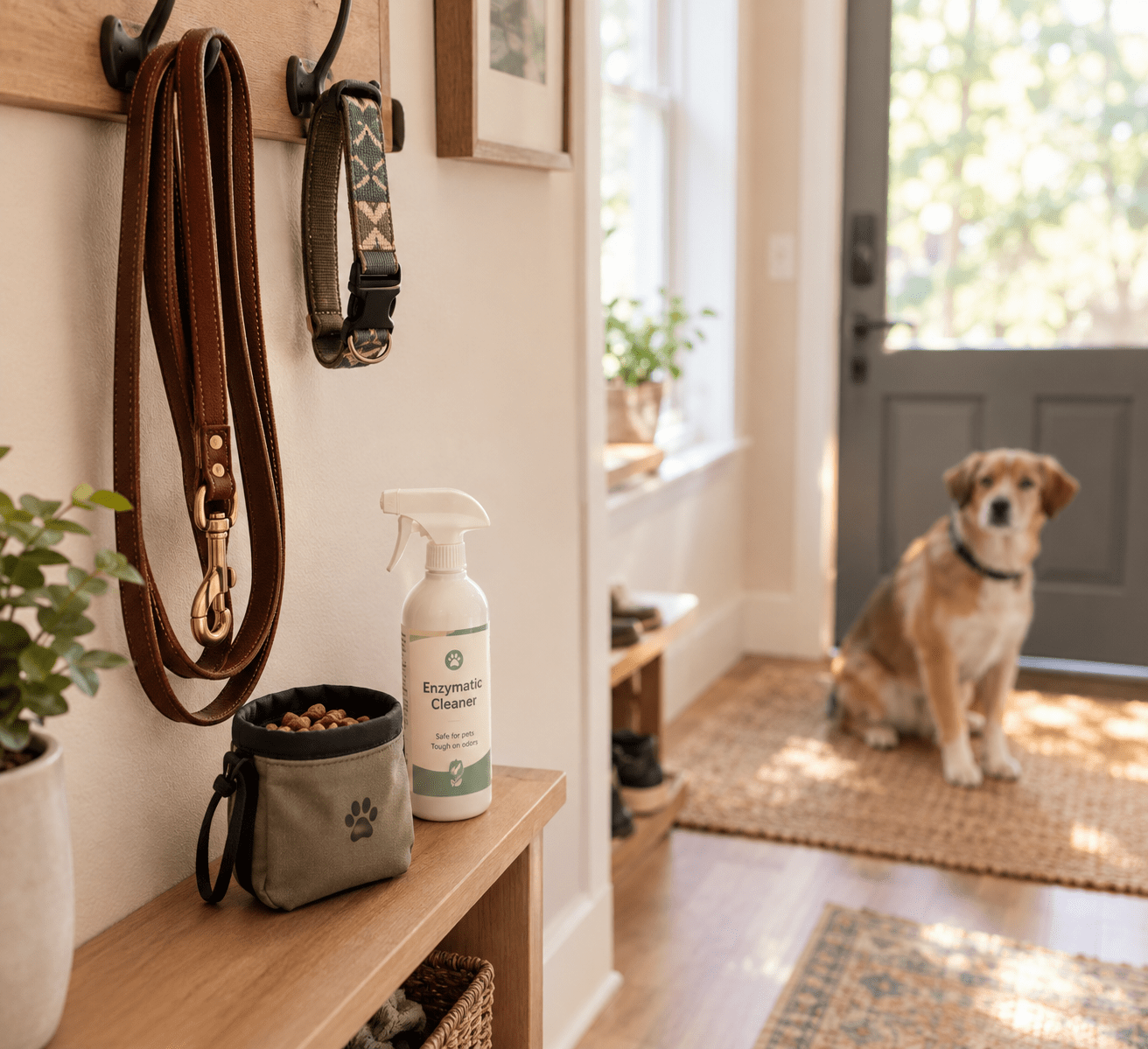
- Clean any indoor accidents with an enzymatic cleaner rather than an ammonia-based one, since standard cleaners can leave a scent trace that draws the dog back to the same spot.
Pet Care Tip: Reserve one particularly high-value treat exclusively for successful outdoor trips. A reward your dog only gets for this one behavior builds the connection faster than everyday treats.
Choosing a Confinement Setup for an Unknown History
When you can’t supervise directly, some form of confinement prevents accidents from happening unseen — but the right choice depends on your dog’s comfort, not just your floor plan.
A dog who shows no fear of small spaces generally does well with a properly sized crate. A dog who paces, pants, or resists entering one may have had a bad experience with crates before and may do better in an exercise pen or a gated room with more open space. For dogs who are calm but benefit from staying close to you, a short indoor tether during active hours can work well as a bridge step.
Confinement Options at a Glance
|
Method |
Best For |
Watch Out For |
|
Crate |
Dogs with no crate anxiety who need tight, reliable containment |
Can worsen stress if the dog has a negative crate history |
|
Exercise pen |
Dogs uneasy in enclosed spaces who need more room to settle |
Takes up more floor space; less secure than a crate |
|
Gated room |
Larger dogs or multi-dog households |
A bigger area gives more room for an accident to go unnoticed |
|
Indoor tether |
Supervised time and building trust |
Not appropriate for unsupervised periods |
Pet Care Tip: Introduce any new confinement space gradually, with the door open and treats scattered inside, before ever closing your dog in. This matters even more when you don’t know their history with crates or small spaces.
Handling the Honeymoon-Period Dip (Weeks 3–8)
This is the part most guides skip, and it’s often the most discouraging stretch for new adopters. Your dog does well for a few weeks, then accidents pick back up.
This isn’t your dog backsliding on purpose. As the initial stress response fades, dogs often become more comfortable expressing their actual personality and, sometimes, their actual anxiety. They may also start testing which behaviors get a reaction from you.
The right response is to tighten the routine back to what worked in week one rather than loosen it, keep rewarding outdoor success consistently, and resist reading this as a sign the dog can’t be trained. For most dogs, this phase passes within a few weeks if the routine stays steady.
Pet Care Tip: If the dip coincides with a specific change — new visitors, a schedule shift, a different food — note it. Sometimes the setback has an identifiable trigger you can simply remove.
Senior-Specific Adjustments
Older dogs sometimes need physical accommodations that a younger adult doesn’t. Arthritis or joint pain can make it harder for a dog to hold a position long enough to signal you, or to get up quickly enough to reach the door.
Age can also bring true urinary incontinence, which is different from a house-training issue. According to VCA Animal Hospitals, this involuntary leakage — often noticed as wet spots where a dog has been sleeping or resting — happens because the dog isn’t aware it’s occurring, unlike a normal accident. It’s most common in middle-aged to senior dogs, and it’s worth ruling out rather than assuming it’s behavioral.
For senior dogs, plan on more frequent outdoor access, a shorter distance to the door, and non-slip footing on the way out if mobility is a concern.
Pet Care Tip: If your senior dog suddenly needs to go out far more often than before, or you notice wet bedding after naps, that’s a vet conversation — not a training problem to solve alone.
When to Call the Vet vs. When to Call a Trainer
See a veterinarian first if accidents start suddenly, involve straining, blood, or a strong odor, or if a previously reliable dog starts having frequent accidents without a clear behavioral trigger. A healthy adult dog can typically hold their bladder for about 8 to 10 hours, so unusually frequent urination is worth flagging.
Consider a certified trainer or behaviorist if you’ve ruled out a medical cause and accidents continue past the 2–3 month mark, or if you’re seeing signs of fear, anxiety, or resource guarding alongside the house-training issue.
Pet Care Tip: Bring your accident log to the vet appointment. A clear record of timing and frequency helps them narrow down a cause much faster than a general description.
Practical Examples
A 6-year-old shelter dog with no known history. Treated as fully untrained from day one, on a strict two-hour schedule with a crate she showed no aversion to. Accidents dropped off steadily by week four, with a brief uptick around week five that resolved by tightening the schedule back up for a few days.
A senior dog with mild arthritis. His owner moved his overnight setup closer to the bedroom door and added a ramp to the yard exit. Once getting outside took less effort, nighttime accidents nearly stopped.
A dog with visible crate anxiety. She paced and drooled in a crate but settled easily in a gated laundry room with a bed and a chew toy. Switching setups, not more crate time, solved the problem.
Common Mistakes to Avoid
- Punishing accidents. Scolding a dog for an accident — especially one you didn’t catch in the act — tends to increase anxiety and can teach a dog to hide when eliminating, making the problem harder to solve.
- Assuming “no known issues” means “already trained.” Shelters and rescues don’t always have complete information. Start as if your dog needs full training unless you have clear evidence otherwise.
- Giving up during the weeks 3–8 dip. This stretch feels like failure but is usually a normal part of adjustment.
- Inconsistent rules across the household. If one person allows unsupervised roaming while another confines the dog, the routine your dog needs to learn gets muddled.
- Skipping the vet check. Sudden changes, blood, straining, or unusual frequency deserve a medical look before you assume it’s purely behavioral.
Editor’s Insights
- Use the same exit door and the same general outdoor spot at first. A consistent location builds the habit faster than a rotating routine.
- If you catch your dog starting to go indoors, an upbeat interruption and an immediate trip outside works better than a sharp correction.
- Ask your shelter or rescue directly what surface the dog eliminated on before adoption (grass, gravel, concrete, pads) — it can explain a stubborn preference.
- A consistent verbal cue, said calmly right as your dog goes, helps them connect the word to the action over time.
Which Confinement Setup Fits Your Dog?
- Does your dog show fear or avoidance around small enclosed spaces? → Start with a gated room or exercise pen.
- Is your home hard to gate off, or multi-level? → Try a crate, introduced slowly and positively.
- Is your dog calm but benefits from staying near you during the day? → Use a short indoor tether during supervised hours only.
Checklists
First 48 Hours Checklist
- Leash on for every outdoor trip, even in a fenced yard
- Confinement area set up and ready before your dog arrives
- One agreed-upon verbal cue the whole household will use
- A notebook or note app started for tracking accidents and successes
What to Ask Your Shelter or Rescue
- Is there any known house-training history?
- Has the dog shown any reaction to crates?
- What was their living situation before (indoor, outdoor, kennel)?
- Are there any known anxiety triggers?
- Is there any medical history relevant to bathroom habits?
Frequently Asked Questions
How long does it take to potty train a rescue dog?
Most rescue dogs become reliable within 2–3 months on a consistent routine, though dogs with a harder background or ongoing anxiety may take longer.
Why does my rescue dog pee when excited or being greeted?
This is usually submissive or excitement urination, an involuntary social response rather than a house-training failure. Keeping greetings calm and low-key typically helps.
Will an older dog ever be fully house-trained if they never were before?
Yes. Adult dogs already have full bladder control, so with a consistent routine, most can become reliably house-trained regardless of age.
Do older rescue dogs potty train faster than puppies?
Often, yes, because they don’t need to develop physical bladder control — only a routine. Progress depends more on stress level and consistency than age.
Why did my rescue dog start having accidents again after doing fine for weeks?
This is commonly the weeks 3–8 adjustment dip. Tighten the routine back to basics rather than assuming the training has failed.
Should I use pee pads for an adult rescue dog?
Pee pads can help in specific situations, such as limited mobility, but they can also confuse a dog who’s meant to learn to go outside only. Use them deliberately, not as a default.
Is it normal for a senior rescue dog to have accidents overnight?
Occasional accidents can be behavioral, but frequent overnight wetting — especially while asleep — can point to age-related incontinence and is worth a vet visit.
What if my rescue dog won’t eliminate outside at all?
Try a longer, quieter outdoor session with less pressure, and consider whether a specific surface (like grass versus concrete) is the sticking point.
Related Reading
- Crate Training a Rescue Dog: A Step-by-Step Guide
- Separation Anxiety in Rescue Dogs: Signs and Solutions
- Senior Dog Care Basics: What Changes as Your Dog Ages
- Adopting a Dog: A Complete Adjustment Checklist
- Best Enzymatic Cleaners for Pet Stains and Odors
- Understanding Your Dog’s Body Language and Anxiety Signals
Sources & References
- American Kennel Club, “Dog Urine Marking vs. Peeing: How to Tell the Difference”
- American Kennel Club, “Tips for Dealing with Submissive Urination”
- VCA Animal Hospitals, “Urethral Incontinence in Dogs”
- Mills Animal Hospital, “How Long Can a Dog Go Without Peeing?”
- SPCA of Hancock County, “The 3-3-3 Rule for Adopting”
Written and reviewed by the Pets Store Home editorial team. This article is intended for general guidance and is not a substitute for professional veterinary advice — always consult your veterinarian about sudden or persistent house-training changes.
Last reviewed: September 2026
Ready for the Next Step?
A settled bathroom routine is often the first real sign that your rescue dog is starting to trust their new home. If accidents keep showing up in the same context — like being left alone — it may be less about the bathroom and more about anxiety around your absence. Our guide to separation anxiety in rescue dogs walks through how to recognize that pattern and what to do about it, so you can keep building on the progress you’ve already made together.
[…] Which foreign pets are legal in Washington State? […]