clumber spaniel size

clumber spaniel size

Clumber Spaniel Size: Height, Weight and Growth Guide (2026)

How big is a Clumber Spaniel? The AKC lists males at 18 to 20 inches and 70 to 85 pounds, and females at 17 to 19 inches and 55 to 70 pounds. That makes the Clumber the largest of the AKC’s flushing spaniels. It is long, low and heavy-boned, so it looks even bigger than its height suggests.

In our experience, Clumber Spaniel size surprises many people who picture a spaniel as a small, light dog. This guide explains exactly how big Clumbers get, how males and females differ, how they compare with other spaniels, how size links to health, and what living with a dog this heavy really involves. Every figure links to its source.

Key takeaways

  • Males: 18 to 20 inches, 70 to 85 pounds (AKC).
  • Females: 17 to 19 inches, 55 to 70 pounds (AKC).
  • The Clumber is the largest AKC flushing spaniel.
  • Its long, heavy body raises the risk of joint and back strain.
  • Keeping a Clumber lean protects its joints, the AKC says.

Clumber Spaniel Size at a Glance

The American Kennel Club (AKC) breed page gives separate height and weight ranges for males and females, along with a 10 to 12 year life expectancy. Chewy lists the same figures. The table sums them up.

Measure Male Female Source
Height at the shoulder 18 to 20 inches 17 to 19 inches AKC, Chewy
Weight 70 to 85 pounds 55 to 70 pounds AKC, Chewy
Life expectancy 10 to 12 years 10 to 12 years AKC, Chewy
Build Long, low, heavy-boned, massive head Same AKC

How Big Do Clumber Spaniels Get?

The AKC puts it simply: Clumbers stand 17 to 20 inches, a small female might weigh 55 pounds, and a large male could reach 85 pounds. Chewy calls them big dogs and gives the same 55 to 85 pound range. As general advice, look at both parents to estimate where a puppy will land in that range.

Is the Clumber the Largest Spaniel?

The AKC calls the Clumber the largest of its flushing spaniels and describes powerful bird dogs of heavy bone, built long and low. In our experience, people meeting one for the first time are most surprised by the weight, not the height. For other uncommon breeds, see our rare dog breeds guide.

Large white dog with a soft coat lying on the grass and resting its head
The Clumber is a heavy, mostly white spaniel that loves to relax. Photo: Gundula Vogel / Pexels

Clumber Spaniel Size vs Other Spaniels

The table compares Clumber Spaniel size with four other AKC spaniel breeds, using each breed’s AKC page. Among these spaniel breeds, the Clumber is not the tallest, but its Clumber Spaniel weight range is by far the heaviest.

Breed Height Weight Life expectancy
Clumber Spaniel 17 to 20 inches 55 to 85 pounds 10 to 12 years
English Springer Spaniel 19 to 20 inches 40 to 50 pounds 12 to 14 years
Field Spaniel 17 to 18 inches 35 to 50 pounds 12 to 13 years
Sussex Spaniel 13 to 15 inches 35 to 45 pounds 13 to 15 years
Cocker Spaniel 13.5 to 15.5 inches 20 to 30 pounds 10 to 14 years

Source: AKC breed pages for each breed. Ranges combine male and female figures.

Why a Clumber Looks Bigger Than Its Height

The AKC describes a massive head and a body built long and low, made to push through thick cover in the field. Chewy calls Clumbers “low-riders” with big bodies on short legs, deep chests and large feet. So a Clumber about the height of a Springer weighs far more: by AKC figures, a male Clumber at 70 to 85 pounds is 20 to 35 pounds heavier than a 50-pound male Springer.

English Springer Spaniel with a liver and white coat sitting on a wooden floor indoors
An English Springer is about as tall as a Clumber but much lighter, per the AKC. Photo: chris price / Pexels

Male vs Female Clumber Spaniel Size

Males are both taller and heavier. The AKC lists males at 18 to 20 inches and 70 to 85 pounds, and females at 17 to 19 inches and 55 to 70 pounds. That means a large male can outweigh a small female by around 30 pounds. As general advice, choose a female if you want the smaller end of Clumber Spaniel size.

Where the Breed Comes From

The AKC says a reliable trail starts in the late 1700s in Nottinghamshire, England, with the Duke of Newcastle, though the breed is believed to have originated in France. Chewy notes the name comes from Clumber Park, the Duke’s estate. The first Clumber was registered with the AKC in 1878.

Clumber Spaniel Size and Growth

Clumber puppies grow from a small bundle into a 55 to 85 pound adult, and that fast growth matters. The AKC notes that, like many large breeds, Clumber puppies that grow too quickly can develop eosinophilic panosteitis, a painful bone condition they usually outgrow. Chewy adds it can cause lameness in one or more legs.

When Is a Clumber Spaniel Full Grown?

Neither the AKC nor Chewy gives an exact age. As general advice, heavy-boned breeds often reach their full height in the first year and keep filling out after that. Ask your vet to track your puppy’s growth toward adult Clumber Spaniel size at each checkup rather than relying on a chart.

Keeping a Healthy Weight

The AKC stresses that a Clumber must not become overweight, because extra weight strains the joints and bones of this sturdy breed. It notes Clumbers are very food oriented, so count training treats; a lean body keeps Clumber Spaniel size from turning into a health problem. If your dog is heavy, our guide on how to help your dog lose weight can help.

White puppy with orange ear markings lying on the ground among green leaves
Large-breed puppies grow fast, so steady growth and a lean body matter. Photo: Андрей / Pexels

How Build and Weight Affect Health

The AKC calls Clumbers generally healthy but lists several conditions, some linked to their heavy, long build.

Condition Link to size or build Source
Intervertebral disc disease A long body raises the risk of disc problems AKC
Hip dysplasia Occurs in the breed; extra weight adds joint strain AKC
Panosteitis Linked to rapid growth in puppies AKC, Chewy
Entropion or ectropion Eyelids that roll in or out AKC
Hypothyroidism Can cause skin and ear issues AKC
Immune-mediated hemolytic anemia Seen in some Clumbers; avoid sulfa drugs AKC

Back Problems in a Long Body

The AKC says the Clumber’s long body makes it somewhat predisposed to intervertebral disc disease (IVDD). Veterinary Medicine at Illinois explains that IVDD happens when a disc presses on the spinal cord, and signs range from neck or back pain to being unable to walk. A paralyzed dog that has lost pain sensation is an emergency. It advises discouraging at-risk dogs from jumping on and off furniture.

Recommended Health Tests

The AKC lists the parent club’s recommended tests: hip and elbow evaluations, an eye exam by a veterinary ophthalmologist and a DNA test for PDP1 (pyruvate dehydrogenase phosphatase 1) deficiency. You can check results on the Orthopedic Foundation for Animals (OFA) website. As general advice, ask to see results for both parents.

Living With a Dog of Clumber Spaniel Size

As general advice, a dog this heavy needs room to stretch out, a sturdy bed and a car that fits it. The AKC says that despite their lumbering look, Clumbers can be very active and benefit from long walks with sniff breaks, plus fetch in the yard. Chewy says they shed a lot and drool a little.

Grooming a Big White Coat

The AKC calls the dense, mostly white coat very easy care, needing a brush and comb once or twice a week, monthly baths for a non-working dog and monthly nail trims. Clean the heavy, low-set ears routinely, and wipe and dry the head folds to prevent yeast infections.

Temperament and Training

The AKC calls Clumbers mellow, sweet and easygoing at home, a bit wary of strangers, and dogs that bark only when they have something to say. They are smart and eager to please but tend to think before obeying, so keep sessions interesting and never heavy-handed. The American Veterinary Society of Animal Behavior (AVSAB) says puppy classes can start at 7 to 8 weeks, after first vaccines.

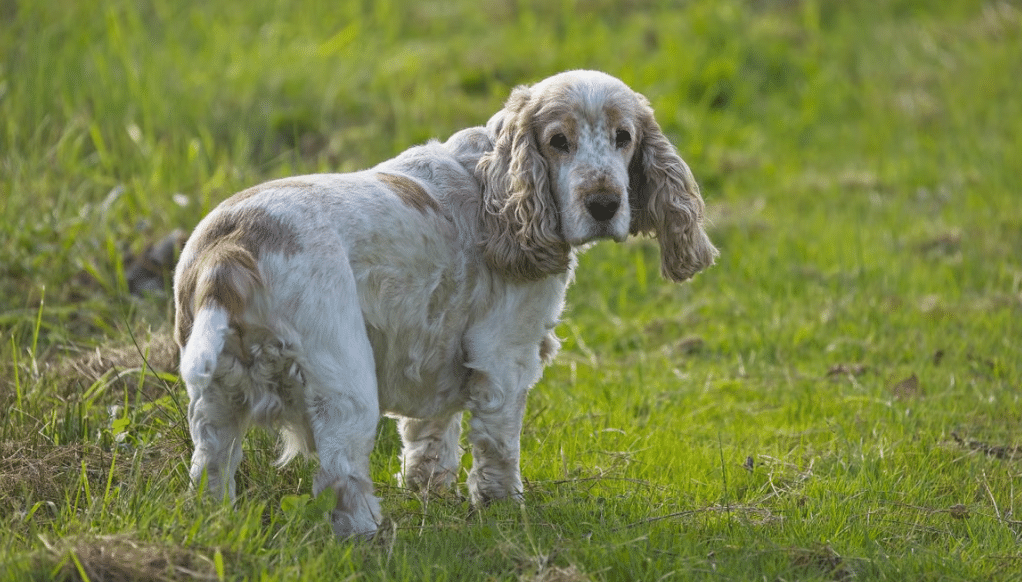
Cocker Spaniel with a light roan coat standing on green grass
A Cocker Spaniel weighs 20 to 30 pounds; a male Clumber can weigh up to 85, per the AKC. Photo: Olavi Anttila / Pexels

Price

Chewy puts Clumber Spaniel puppies at around $800 to $1,200. As general advice, prices vary by region and breeder, and Clumber Spaniel size also means larger food, bed and vet bills. An AKC article by Randa Kriss suggests asking about parent health tests and whether the breeder will take the dog back.

Pet Care Tip: Our suggestion is to weigh your Clumber monthly on a vet or pet-store scale and note it down. In our experience, a few extra pounds are easy to miss under a thick coat but show up quickly on paper.

When to call a vet right away: As general advice, call your vet or a 24/7 emergency animal hospital if your dog suddenly cannot walk, cries when touched along the back, drags its back legs, or collapses. Book a prompt visit for limping, squinting or a bad smell from the ears or skin folds.

7 questions to ask a breeder

  1. How tall and heavy are both parents?
  2. Can I see hip and elbow results for both parents?
  3. Have the parents had eye exams and the PDP1 DNA test?
  4. Has any related dog had back or disc problems?
  5. What and how much is the puppy eating now?
  6. How are puppies socialized before going home?
  7. Will you take the dog back at any age?

Example Scenario (illustrative)

Karen in Columbus expected a “medium spaniel” and was surprised when her male Clumber hit 78 pounds. She bought a larger crate and a ramp for the car, swapped some treats for green beans with her vet’s OK, and kept him lean with two sniff walks a day.

Myth Fact
“All spaniels are small or medium.” The AKC calls the Clumber its largest flushing spaniel.
“Clumbers are lazy couch dogs.” The AKC says they can be very active and enjoy long walks.
“A heavy Clumber is just big-boned.” The AKC says extra weight strains joints and bones.
“Easy-care coat means no grooming.” The AKC still advises brushing once or twice a week and cleaning ears and head folds.

What most owners get wrong

In our experience, many owners judge a Clumber’s weight by eye and miss gradual gain under the coat. Regular weigh-ins and measured meals matter more for this breed than for lighter spaniels.

Clumber Spaniel Size FAQs

How big is a full-grown Clumber Spaniel?

The AKC lists 17 to 20 inches and 55 to 85 pounds.

How much does a male Clumber Spaniel weigh?

70 to 85 pounds, according to the AKC.

How much does a female Clumber Spaniel weigh?

55 to 70 pounds, according to the AKC.

Is the Clumber Spaniel the biggest spaniel?

The AKC calls it the largest of its flushing spaniels.

How long do Clumber Spaniels live?

The AKC gives 10 to 12 years.

Is a Clumber Spaniel bigger than a Springer Spaniel?

It is about as tall but much heavier: up to 85 pounds vs 40 to 50 pounds for a Springer (AKC).

Do Clumber Spaniels shed a lot?

Chewy says they shed a lot and drool a little.

Final Verdict: Is Clumber Spaniel Size Right for Your Home?

Clumber Spaniel size is the breed’s defining trait: a heavy, long, low spaniel of 55 to 85 pounds with a calm, friendly nature. If you have room for a big dog, can keep it lean and active, and can handle shedding, a Clumber can be a gentle, loyal companion for 10 to 12 years.

Your next steps

  1. Meet adult Clumbers to see their real size and weight.
  2. Ask for hip, elbow, eye and PDP1 results on both parents.
  3. Plan a large crate, a sturdy bed and monthly weigh-ins.

Share your Clumber on the Pets Store Home Facebook page, explore other gentle breeds in our excellent family dogs guide, and find more breed guides in our Dogs section.

About the author: Written and reviewed by the Pets Store Home Editorial Team, pet owners who check every guide against trusted sources.

How we checked this guide: Size, build, health, tests, grooming, exercise, training and history come from the AKC Clumber Spaniel page. Comparison sizes come from the AKC pages for the English Springer, Field, Sussex and Cocker Spaniels. Back-disease details come from the University of Illinois College of Veterinary Medicine. Price, shedding and history details come from Chewy, breeder questions from the AKC, and socialization timing from AVSAB.

No source gives an exact age for full size, so we say so. This guide was written in November 2026 and is reviewed every 12 months.

Last reviewed: November 2026.

black russian terrier

black russian terrier

Black Russian Terrier: Size, Temperament, Health, Grooming and Cost (2026)

What is a Black Russian Terrier? It is a large, powerful, all-black guard dog created by the Soviet military’s Red Star Kennel. The AKC lists males at 27 to 30 inches and adults at 80 to 130 pounds, with a 10 to 12 year lifespan. Expect a confident, loyal protector that needs daily exercise, early training and regular grooming.

The Black Russian Terrier, or BRT, looks like a giant teddy bear but was built to guard. This guide covers its Soviet history, size, temperament, training, exercise, coat care, health tests and US price range, and explains who this big Russian dog suits best. Every fact links to its source.

Key takeaways

  • The BRT is a Working Group breed, not a true terrier, recognized by the AKC in 2004.
  • The AKC lists 80 to 130 pounds and a 10 to 12 year lifespan.
  • Black is the only accepted coat color.
  • It is naturally aloof with strangers and needs lifelong socialization.
  • Chewy puts puppy prices at about $3,000 to $4,000.

What Is a Black Russian Terrier?

The American Kennel Club (AKC) describes this breed as a large, immensely powerful worker with heavy bone and a coarse all-black coat, known for courage, confidence and intelligence. Bred to guard and protect, it is naturally aloof with strangers. The AKC calls it a brawny guard dog of the Siberian steppes.

Is the Black Russian Terrier Really a Terrier?

Not in the usual sense. Despite the name, the AKC places the breed in the Working Group, not the Terrier Group. It was recognized by the AKC in 2004 as its 151st breed. You may also see it called the Russian black terrier or simply the Black Russian, especially outside the US.

A Rare Russian Dog in the US

The AKC popularity ranking places the breed at 154 of 210, and Chewy describes it as relatively rare in the US. As general advice, expect to join a waiting list and to travel to meet a good breeder. For other uncommon breeds, see our guide to rare dog breeds.

Large shaggy black dog standing alert on a green lawn in a park
A shaggy all-black coat is the hallmark of the BRT. Photo: Paul Groom Photography Bristol / Pexels

Soviet Origins: The Red Star Kennel

The AKC says the Soviet government set up the Red Star Kennel in the 1930s, where scientists and breeders worked to create a “superdog” for the Russian army. The breed came from selective breeding of many breeds, including Rottweilers, Giant Schnauzers and Airedales.

Chewy adds that the breed was developed in Moscow to be trainable, reliable and able to cope with cold climates, and that about 17 breeds were used, including the Newfoundland. The AKC notes the dense coat is warm enough for some of the coldest inhabited places on earth. Chewy also notes that BRTs served as military guardians in the 20th century.

The Breed Club in America

According to the AKC, the Black Russian Terrier Club of America was founded in 1997 and is the breed’s official AKC parent club. As general advice, start your breeder search with the parent club’s referral list rather than online ads.

Airedale Terrier in a harness splashing through a clear stream
The Airedale Terrier is one of the breeds used to create the BRT, according to the AKC. Photo: Chris F / Pexels

Black Russian Terrier Size and Appearance

The AKC lists males at 27 to 30 inches and females at 26 to 29 inches, with adults weighing 80 to 130 pounds. It adds that some can tip the scales at 140 pounds. In our experience, that makes it one of the largest Russian dog breeds you are likely to meet in the US.

Trait Black Russian Terrier Source
Height (male) 27 to 30 inches AKC
Height (female) 26 to 29 inches AKC
Weight 80 to 130 pounds (some up to 140) AKC
Life expectancy 10 to 12 years AKC
Coat Tousled double coat: soft undercoat, coarse outer coat AKC
Color Black only AKC
AKC group Working (recognized 2004) AKC

The AKC describes a huge, brick-shaped head and calls the breed nimble-footed for its size. Its grooming notes also mention the breed’s beard and mustache, which give the BRT its bearded look.

Black Russian Terrier Temperament

Chewy describes BRTs as calm, confident and vigilant, with strong loyalty to their family; owners often call them “Velcro dogs.” Bred as guardians, they assess a situation before acting and can be wary of strangers. The AKC warns that a BRT that does not spend enough time with its family can develop aggressive tendencies.

Is a BRT Good With Kids and Other Pets?

In our experience, a well-socialized BRT can be gentle with its own family, but its size alone means toddlers can be knocked over. As general advice, supervise all time with young children, introduce other pets slowly, and never leave a powerful guardian breed alone with visiting kids. For gentler options, see our list of excellent family dogs.

Woman crouching beside a large black shaggy dog on a city sidewalk
Chewy describes BRTs as strongly loyal to their families. Photo: Gustavo Fring / Pexels

Training and Socialization

The AKC is blunt: an owner who is not willing or able to train a powerful, willful dog should not get a BRT. It says socialization must start in puppyhood and continue for life, and obedience training should begin as early as possible and continue into adulthood.

The AKC adds that BRTs can become pushy with anyone they can intimidate, so training must be firm and consistent but always reward-based, never punishment-based. The breed is intelligent and learns quickly when treated with kindness and respect. The American Veterinary Society of Animal Behavior (AVSAB) says puppy classes can start at 7 to 8 weeks, after first vaccines.

Dog Sports for the BRT

The AKC says many BRTs excel at obedience, agility, rally and Schutzhund (protection) competitions. As general advice, a weekly class gives this smart working dog a job and strengthens your bond.

Exercise and Grooming Needs

The AKC says a BRT needs at least 30 to 40 minutes of exercise every day and enjoys brisk walks, long runs, bike rides, swims and hikes. Chewy suggests a longer 60 to 90 minutes of purposeful activity plus mental work. The AKC warns that an under-exercised BRT can become unhappy and destructive.

Grooming the BRT Coat

The AKC says the double coat needs a thorough brushing once or twice a week to prevent mats, while Chewy suggests two to three times a week. Owners should learn to scissor the face, beard and mustache or use a groomer, and a clipper trim every few months keeps the coat tidy. Check ears regularly and brush teeth often.

Care task How often Source
Exercise 30 to 40 minutes daily (Chewy: 60 to 90) AKC, Chewy
Brushing Once or twice a week (Chewy: 2 to 3 times) AKC, Chewy
Clipper trim Every few months AKC
Professional grooming About every six weeks Chewy
Nail trims Regularly AKC
Ears and teeth Check ears and brush teeth regularly AKC
Close-up of a black dog with a thick, shaggy coat sitting on a tiled floor
A thick, tousled coat like this needs regular brushing to prevent mats. Photo: Matheus Barbosa / Pexels

Big dogs need the right diet. See how to build muscle on a dog with food, and if your BRT gains weight, our guide on how to help your dog lose weight.

Black Russian Terrier Health and Lifespan

The AKC calls the BRT a typically healthy breed and lists a 10 to 12 year life expectancy. Responsible breeders screen for allergies, urinary tract stones, hip and elbow dysplasia and progressive retinal atrophy.

Condition What to know Source
Hip and elbow dysplasia Joint problems; breeders should test AKC, Chewy
JLPP Juvenile laryngeal paralysis and polyneuropathy; inherited, no treatment; DNA test available AKC, Chewy
Hyperuricosuria (HUU) Inherited; raises the risk of bladder or kidney stones Chewy, UC Davis VGL
Progressive retinal atrophy Can cause vision loss AKC
Allergies Breeders screen for them AKC
Bloat (GDV) Risk in large, deep-chested dogs; an emergency Chewy, VCA

Recommended Health Tests

The AKC lists the parent club’s recommended tests: hip and elbow evaluations, a cardiac exam, an eye exam by a veterinary ophthalmologist and a JLPP DNA test. You can look up results on the Orthopedic Foundation for Animals (OFA) website. As general advice, ask to see results for both parents.

Hyperuricosuria and Bladder Stones

The UC Davis Veterinary Genetics Laboratory says hyperuricosuria (HUU), high uric acid in the urine, is most common in the Dalmatian, Bulldog and Black Russian Terrier. Affected dogs can form bladder or kidney stones that often need surgery. It is inherited as a simple recessive trait, and a DNA test shows whether a dog is clear, a carrier or affected.

Bloat Warning Signs

VCA Animal Hospitals says bloat is most common in large, deep-chested dogs and lists restlessness, heavy drooling and retching without bringing anything up as signs. It calls bloat a life-threatening emergency. Chewy suggests smaller meals and asking your vet about a preventive gastropexy.

Price and Ethical Breeders

Chewy puts a Black Russian Terrier puppy at about $3,000 to $4,000. As general advice, budget for a large crate, big food bills and regular grooming too. An AKC article by Randa Kriss says parents should be tested for breed-specific genetic diseases, that puppies usually go home at 8 to 12 weeks, and that you should ask whether the breeder will take the dog back.

Pet Care Tip: Our suggestion is to enroll your BRT puppy in a class the week it comes home. In our experience, early, reward-based training is far easier than correcting a 100-pound adolescent later.

When to call a vet right away: As general advice, go to your vet or a 24/7 emergency animal hospital immediately if your dog retches without bringing anything up, has a swollen belly, drools heavily, collapses, struggles to breathe, or strains to urinate.

7 questions to ask a breeder

  1. Can I see hip, elbow, cardiac and eye results for both parents?
  2. Are the parents clear of JLPP by DNA test?
  3. Have the parents been tested for hyperuricosuria?
  4. How do the parents behave with strangers?
  5. How are the puppies socialized before going home?
  6. Are you a member of the Black Russian Terrier Club of America?
  7. Will you take the dog back at any age?

Example Scenario (illustrative)

Mark in Denver brought home a BRT puppy and started a weekly obedience class at nine weeks. By one year, his 110-pound dog greeted guests calmly on cue, enjoyed daily hikes and loved his weekly brushing session.

Myth Fact
“The BRT is a terrier.” The AKC places it in the Working Group.
“A guard dog does not need socializing.” The AKC says socialization must continue for life.
“Big dogs are lazy.” The AKC says at least 30 to 40 minutes of exercise a day.
“Harsh training works best.” The AKC says reward-based, never punishment-based.

What most owners get wrong

In our experience, many owners fall for the teddy-bear look and underestimate the guardian instinct. A BRT needs leadership, daily exercise and lifelong socialization, not just love.

Black Russian Terrier FAQs

How big does a BRT get?

The AKC lists 26 to 30 inches and 80 to 130 pounds.

How long do BRTs live?

The AKC gives a life expectancy of 10 to 12 years.

Is a Black Russian Terrier a good family dog?

Chewy calls BRTs loyal to their families, but the AKC stresses lifelong socialization; always supervise them with kids.

Do BRTs shed?

They have a double coat that needs brushing once or twice a week to prevent mats, per the AKC.

How much is a BRT puppy?

Chewy puts puppies at about $3,000 to $4,000.

What breeds make up the Black Russian Terrier?

The AKC names Rottweilers, Giant Schnauzers and Airedales among many breeds used.

Is a BRT good for first-time owners?

The AKC says owners unwilling or unable to train a powerful, willful dog should not get one.

Final Verdict: Is a Black Russian Terrier Right for You?

This breed is a loyal, intelligent and imposing guardian with a softer side for its family. It suits experienced owners who can give daily exercise, regular grooming and lifelong, reward-based training. Choose a health-testing breeder, and this rare Russian working dog can be a devoted companion for many years.

Your next steps

  1. Meet adult BRTs and their owners before you commit.
  2. Ask for hip, elbow, cardiac, eye and JLPP results.
  3. Book a puppy class before your puppy comes home.

Share your BRT on the Pets Store Home Facebook page, and find more breed guides in our Dogs section.

About the author: Written and reviewed by the Pets Store Home Editorial Team, pet owners who check every guide against trusted sources.

How we checked this guide: Size, history, temperament, training, exercise, grooming, health and recommended tests come from the AKC breed page. Price, extra health detail and grooming frequency come from Chewy’s breed guide, bloat signs from VCA Animal Hospitals, hyperuricosuria from the UC Davis Veterinary Genetics Laboratory, breeder questions from the AKC, and socialization timing from AVSAB.

Where sources differ, such as exercise time and brushing frequency, we show both. This guide was written in November 2026 and is reviewed every 12 months.

Last reviewed: November 2026.

miniature bernard poodle

miniature bernard poodle

Miniature Bernard Poodle (Mini Bernedoodle): Size, Temperament, Health and Cost (2026)

What is a miniature Bernard poodle? It is a common name for the mini Bernedoodle, a cross between a Bernese Mountain Dog and a Miniature Poodle. PetMD lists the mini size at 20 to 45 pounds and up to 22 inches tall, with a 14 to 16 year lifespan. Expect a gentle, playful family dog with a low-shedding coat.

The miniature Bernard poodle packs the Bernese Mountain Dog’s sweet nature into a smaller, longer-lived body with a curlier Poodle-type coat. This guide covers size, generations, temperament, grooming, health and price, all sourced.

Key takeaways

  • A miniature Bernard poodle (mini Bernedoodle) crosses a Bernese Mountain Dog with a Miniature Poodle.
  • PetMD lists 20 to 45 pounds, up to 22 inches and a 14 to 16 year lifespan.
  • Plan for at least two walks a day plus brain games.
  • The coat sheds little, but no dog is fully hypoallergenic.
  • Ask for hip, elbow and eye screening on both parents.

What Is a Miniature Bernard Poodle?

PetMD, in an article by Kaitlyn Arford reviewed by Barri J. Morrison, DVM, describes the Bernedoodle as a Bernese Mountain Dog and Poodle cross that comes in standard, mini and toy sizes. The miniature Bernard poodle uses a Miniature Poodle, which brings the size down. Because it is a mixed breed, there is no official breed standard, so looks and size vary.

Miniature Bernard Poodle or Mini Bernedoodle?

“Miniature Bernard poodle,” “mini Bernard doodle,” “mini Bernadoodle” and “miniature Bernedoodle” are all common ways people search for this cross. As general advice, check that a seller means a Bernese Mountain Dog parent, not a Saint Bernard. In our experience, a Saint Bernard and Poodle cross is a much larger dog, usually sold as a St. Berdoodle.

Where Did the Bernedoodle Come From?

Embrace Pet Insurance credits Canadian breeder Sherry Rupke with creating the Bernedoodle in 2003; PetMD gives no origin date, so treat this as a commonly repeated account. For other popular crosses, see our designer dog breeds guide.

Bernedoodle puppy relaxing on green grass, illustrating a guide to the miniature Bernard poodle
A Bernedoodle puppy relaxes on the grass on a sunny day. Photo: Rob Waller / Pexels

Miniature Bernard Poodle Size, Coat and Generations

PetMD lists the mini at 20 to 45 pounds and up to 22 inches tall. Embrace Pet Insurance gives a narrower 16 to 18 inches and 25 to 50 pounds. Both are far smaller than the Bernese parent, which PetMD lists at 23 to 27.5 inches and 70 to 115 pounds.

How Big Do Mini Bernedoodles Get?

The chart below shows how a miniature Bernard poodle compares with the other Bernedoodle sizes and with its Bernese parent. As general advice, the parents’ sizes are the best guide to your puppy’s adult size.

Size Weight Height Lifespan
Toy Bernedoodle Under 20 pounds 12 to 17 inches Up to 18 years
Mini Bernedoodle 20 to 45 pounds Up to 22 inches 14 to 16 years
Standard Bernedoodle 61 to 100 pounds Up to 29 inches 12 to 15 years
Bernese Mountain Dog (parent) 70 to 115 pounds 23 to 27.5 inches 7 to 10 years

Source: PetMD Bernedoodle and Bernese Mountain Dog profiles. Individual dogs vary.

F1, F1B and Other Generations

PetMD explains that an F1 Bernedoodle has one Bernese and one Poodle parent, while an F1B has one Poodle parent and one F1 Bernedoodle parent. As general advice, F1B and later Poodle-heavy crosses usually have curlier, lower-shedding coats, while F1 puppies vary more. Ask the breeder which generation your puppy is.

The Miniature Poodle Parent

An AKC article by Micaela Erickson says Miniature Poodles stand 10 to 15 inches tall and weigh 10 to 15 pounds. It describes Poodles as highly intelligent, easy to train and minimal shedders, though their curly coat needs serious grooming.

Small Bernedoodle vs Standard Bernedoodle

Size is the main difference. PetMD lists standard Bernedoodles at 61 to 100 pounds and up to 29 inches, compared with 20 to 45 pounds for a small Bernedoodle like the mini. PetMD also notes that bloat is a particular risk for deep-chested standard Bernedoodles.

A Bernese Mountain Dog on the grass, the larger parent breed of the mini Bernedoodle
The Bernese Mountain Dog parent can pass on its tricolor markings and gentle nature. Photo: Gregory Wolf / Pexels

Coat Colors and Shedding

Embrace Pet Insurance says the coat is usually wavy and often tricolor, with black, rust and white. PetMD calls the coat low-shedding and low-allergen but stresses that no dog is truly hypoallergenic, and notes that dogs taking after the Bernese parent may shed more.

Miniature Bernard Poodle Temperament and Personality

PetMD describes Bernedoodles as loving, kind, goofy, playful and gentle. They tend to get along with children and other dogs, are usually gentle with cats, and are fairly quiet, barking mainly when surprised or playing.

PetMD notes that many Bernese Mountain Dogs dislike being left alone and may be shy with strangers. As general advice, practice short absences early and introduce your puppy to calm visitors so it grows into a confident adult.

Two Bernedoodle puppies sitting on a white blanket indoors, showing the mini Bernedoodle's playful puppy stage
PetMD describes Bernedoodles as loving, goofy and playful. Photo: Balanced Obedience / Pexels

Is a Miniature Bernard Poodle Good With Kids?

PetMD says Bernedoodles enjoy spending time with children. As general advice, a mini is sturdy enough for most families, but teach kids to play gently, supervise young children, and give the dog a quiet spot to rest.

Is a Mini Bernedoodle Good for Apartments?

Yes, if its needs are met. PetMD says well-exercised Bernedoodles of any size can suit most families, and in our experience a mini fits a smaller home far more easily than a 100-pound standard. PetMD recommends at least two walks a day plus puzzle toys and games.

Training and Socialization

PetMD calls Bernedoodles, including the mini Bernedoodle, intelligent and eager to please, quick to learn cues, tricks, crate training and potty training with positive reinforcement. The American Veterinary Society of Animal Behavior (AVSAB) says puppy classes can begin at 7 to 8 weeks, after a first round of vaccines. As general advice, keep sessions short and fun.

Pet Care Tip: Handle your puppy’s paws, ears and face gently every day from the start. In our experience, a Bernedoodle that is relaxed about being touched is much easier to brush, trim and examine later.

Exercise and Grooming Needs

PetMD recommends at least two walks a day plus mental work such as games, snuffle mats and puzzle toys. Hiking, swimming, agility and trick training are all good outlets. PetMD warns that Bernese Mountain Dogs overheat easily, so as general advice, exercise your dog in the cooler parts of hot days.

Grooming Needs

PetMD advises weekly brushing, regular professional grooming, daily tooth brushing, baths no more than about once a month to avoid dry skin, and ear cleaning after swimming. Embrace Pet Insurance adds that Poodle-type coats may need daily brushing to prevent mats.

A groomer trimming a dog's fur at a salon, the regular grooming a mini Bernedoodle needs
Regular professional grooming helps prevent mats in a doodle coat. Photo: Goochie Poochie Grooming / Pexels
Care task How often Source
Brushing At least weekly; daily for curly coats PetMD, Embrace
Professional grooming Regularly PetMD
Bathing No more than about once a month PetMD
Tooth brushing Daily PetMD
Ear cleaning After swimming PetMD
Exercise Two walks a day plus brain games PetMD

Miniature Bernard Poodle Health and Lifespan

PetMD gives the mini size a 14 to 16 year lifespan and notes that smaller Bernedoodles generally live longer. That is a big contrast with the Bernese parent, which PetMD lists at 7 to 10 years. PetMD and Embrace list these conditions.

Health issue What it is Source
Hip and elbow dysplasia Inherited joint problems that can lead to arthritis PetMD
Progressive retinal atrophy Gradual vision loss; night blindness often comes first PetMD
Allergies Food or environmental; itching, rashes, ear infections PetMD
Bloat (GDV) Stomach twists; mainly a risk in larger, deep-chested dogs PetMD
Aseptic meningitis A spinal cord condition, more common on the Bernese side Embrace
Osteochondrosis dissecans Joint cartilage problem in shoulders and elbows Embrace
Addison’s disease Adrenal gland disorder from the Poodle side Embrace
Histiocytic sarcoma Cancer the Bernese parent is prone to PetMD (Bernese)

A mix may inherit some, all or none of these risks.

Bloat in Larger Bernedoodles

VCA Animal Hospitals says bloat (GDV) is most common in large, deep-chested dogs and names the Standard Poodle among predisposed breeds. Signs include restlessness, drooling and retching without bringing anything up. VCA calls it a life-threatening emergency that needs a vet immediately. A mini is smaller, but as general advice, know the signs anyway.

Why Parent Health Checks Matter

The Bernese Mountain Dog Club of America (BMDCA) calls the Bernese lifespan of 7 to 8 years too short for a large breed and asks breeders to be willing to review a puppy’s pedigree with buyers. It also supports Berner-Garde, an open health database. As general advice, ask whether your puppy’s Bernese parent and grandparents are listed there, and ask about cancer in the family line.

Extra weight strains growing joints. If your dog needs to slim down, read our guide on how to help your dog lose weight, and for active dogs see how to build muscle on a dog with food.

When to call a vet right away: As general advice, go to your vet or a 24/7 emergency animal hospital immediately if your dog retches without bringing anything up, has a swollen belly, drools heavily, collapses or seems in severe pain. Book a prompt visit for limping, a new lump, night blindness or constant itching.

Miniature Bernard Poodle Price and Ethical Breeders

PetMD puts the average Bernedoodle price at $2,000 to $5,000, and Embrace Pet Insurance says minis can cost from a couple of thousand dollars to $5,000 or more, often with a waiting list. As general advice, a higher price does not guarantee health; ask for screening results instead. Not sure about a rescue’s mix? A dog DNA test can help.

How to Find an Ethical Breeder

An AKC article by Randa Kriss says parents should be tested for the genetic diseases common to their breed and that puppies usually go home at 8 to 12 weeks. It also suggests asking about the health guarantee and whether the breeder will take the dog back. As general advice, an ethical miniature Bernard poodle breeder will ask you questions too.

7 questions to ask a breeder

  1. Is the Bernese parent a Bernese Mountain Dog, not a Saint Bernard?
  2. Can I see hip and elbow results for both parents?
  3. Have the parents had eye exams for PRA?
  4. Which generation is the puppy (F1, F1B or later)?
  5. How big are the parents, and what adult size do you expect?
  6. How are puppies socialized before going home?
  7. Will you take the dog back at any age?

Example Scenario (illustrative)

The Garcia family in Minneapolis brought home a 30-pound F1B mini. By four months his curly coat was matting behind the ears. They added a five-minute brush every evening, booked a groomer every six weeks, and moved summer walks to early morning. His coat stayed tangle-free and he stayed cool.

Pros and Cons of a Miniature Bernard Poodle

Pros Cons
Longer lifespan than the Bernese parent: 14 to 16 years (PetMD) Needs weekly brushing and regular professional grooming (PetMD)
Low-shedding, low-allergen coat (PetMD) No dog is truly hypoallergenic (PetMD)
Gentle and enjoys children and other dogs (PetMD) Bernese side may dislike being left alone (PetMD)
Intelligent and eager to please (PetMD) Costs about $2,000 to $5,000 or more (PetMD, Embrace)
Easier to travel with than a standard (general advice) Adult size varies: 20 to 45 pounds (PetMD)
Myth Fact
“Doodles are 100% hypoallergenic.” No dog is truly hypoallergenic (PetMD).
“Doodles don’t need grooming.” PetMD advises weekly brushing and regular grooming.
“A mini lives as long as a Bernese.” PetMD lists 14 to 16 years vs. 7 to 10 for the Bernese.

What most owners get wrong

In our experience, many owners expect a “mini” to stay tiny and are surprised by a 40-pound adult. Meet both parents if you can, and budget for grooming from the first month.

Miniature Bernard Poodle FAQs

How big do mini Bernedoodles get?

PetMD lists 20 to 45 pounds and up to 22 inches tall.

Is a miniature Bernard poodle the same as a mini Bernedoodle?

Usually, yes. Most people searching that term, or ‘mini Bernard doodle,’ mean a Bernese Mountain Dog and Miniature Poodle mix, not a Saint Bernard cross.

How long do Bernedoodles live?

PetMD gives 12 to 18 years overall and 14 to 16 years for the mini size.

Do Bernedoodles shed?

Very little, though dogs that take after the Bernese parent may shed more, PetMD says.

Are Bernedoodles hypoallergenic?

No dog is truly hypoallergenic, but their coat is low-shedding and low-allergen, per PetMD.

How much does a mini Bernedoodle cost?

PetMD gives $2,000 to $5,000 for Bernedoodles; Embrace says minis can cost $5,000 or more.

Are Bernedoodles good family dogs?

PetMD says Bernedoodles are gentle and enjoy children and other dogs.

Final Verdict: Is a Miniature Bernard Poodle Right for You?

A miniature Bernard poodle is a gentle, goofy and loyal family dog with a longer lifespan than its Bernese parent and a coat that sheds little. In return, it needs two walks a day, regular grooming and plenty of company. Choose a breeder who screens both parents, keep your dog cool in summer, and you can enjoy many happy years together.

Your next steps

  1. Meet both parents and ask for health results.
  2. Budget for grooming every few weeks.
  3. Sign up for a puppy class.

Share your Bernedoodle on the Pets Store Home Facebook page, and find more breed guides in our Dogs section.

About the author: Written and reviewed by the Pets Store Home Editorial Team, pet owners who check every guide against trusted sources.

How we checked this guide: Sizes, temperament, care, health and price come from PetMD’s Bernedoodle profile (reviewed by Barri J. Morrison, DVM). Bernese parent facts come from PetMD (Virginia LaMon, DVM). Poodle parent facts and breeder questions come from the AKC, breeder guidance from the BMDCA, and bloat facts from VCA Animal Hospitals. Origin, mini size and extra health risks come from Embrace Pet Insurance, and socialization timing from AVSAB.

Where sources differ, such as size and price, we show each figure. This guide was written in November 2026 and is reviewed every 12 months.

Last reviewed: November 2026.

shih tzu cross breed poodle

shih tzu cross breed poodle

Shih Tzu Cross Breed Poodle (Shih-Poo): Size, Temperament, Grooming and Health (2026)

What is a Shih Tzu cross breed Poodle? It’s the Shih-poo, a mix of a Shih Tzu and a Toy Poodle. PetMD describes it as a smart, friendly, confident small dog that usually stays around 10 inches tall and lives about 10 to 18 years. It sheds little but needs daily brushing, and it is not an AKC-recognized breed.

In our experience, the Shih Tzu cross breed Poodle wins people over fast, and it is easy to see why: a teddy-bear face, a soft coat and a big personality in a lap-sized body. This guide covers its size, coat, temperament, exercise, grooming, health risks from both parent breeds, and who the mix suits best, with every fact linked to its source.

Key takeaways

  • A Shih-poo is a Shih Tzu crossed with a Toy Poodle; it is not an AKC breed.
  • Both parents top out around 10 inches, so the mix stays small.
  • PetMD gives an average lifespan of 10 to 18 years.
  • Low-shedding does not mean hypoallergenic or low-maintenance.
  • Expect daily brushing and a groomer visit every 1 to 2 months.

What Is a Shih Tzu Cross Breed Poodle?

PetMD, in an article by Sarah Mouton Dowdy, MA, reviewed by Veronica Higgs, DVM, defines the Shih-poo as a cross between a Shih Tzu and a Toy Poodle. It calls the Shih-poo a relatively new mix and notes it is not recognized as an official breed by the American Kennel Club. PetMD also mentions another name for it, the “Shoodle.”

You will see the same dog sold or searched under many labels: Shih-poo, Shih Tzu Poodle mix, poodle cross Shih Tzu, “shih poodle” and even “shepoo dog.” Others search for a “dog breed Shih Tzu Poodle,” though it is a mix, not a breed. Each label describes the same thing: a cross breed Poodle and Shih Tzu. As general advice, check which Poodle size a breeder uses, because the name alone will not tell you.

Is the Shih Tzu Cross Breed Poodle a Purebred?

No. Because it is a mix, there is no breed standard for its size, coat or color, and puppies in the same litter can look quite different, in our experience. That also means no kennel club health-testing rules apply to the mix itself, so it is worth asking about the tests done on each parent, as covered later in this guide.

Shih Poo dog with a wavy tan coat wearing a bright orange jacket outdoors
The Shih-poo mixes the Shih Tzu and the Toy Poodle in one small, fluffy package. Photo: Manish Sharma / Pexels

Shih Tzu Cross Breed Poodle Parent Breeds and Size

Knowing both parents is the best way to predict a mix. The table compares the Shih Tzu and the Toy Poodle using the AKC breed pages, with PetMD’s figures where they differ.

Trait Shih Tzu Toy Poodle
Height 9 to 10.5 inches (AKC) No more than 10 inches (AKC)
Weight 9 to 16 pounds (AKC); PetMD: 8 to 18 4 to 6 pounds (AKC)
Life expectancy 10 to 18 years (AKC) 10 to 18 years (AKC)
Bred for House companion (AKC) Companion; agile, athletic (AKC)
Exercise Minimal (AKC) Daily, high energy (AKC)
Coat care Daily brushing for a long coat (AKC) Daily brushing or a short trim (AKC)

How Big Does a Shih-Poo Get?

PetMD notes that both parent breeds reach about 10 inches at most, so a full-grown Shih-poo usually stays around that size. There is no set Shih-poo weight range; in our experience, adults usually land somewhere between their two parents. As general advice, ask for both parents’ adult weights for the best estimate.

Shih Tzu Toy Poodle Mix vs Miniature Poodle Shih Tzu Mix

Most Shih-poos use a Toy Poodle, but some breeders use a Miniature. The Poodle Club of America standard puts Miniatures at over 10 and up to 15 inches, so a miniature Poodle Shih Tzu mix may grow larger than a Toy cross. As general advice, confirm the Poodle parent’s size before you put down a deposit.

Shih Tzu puppy with a brown and white coat sitting on green grass
The Shih Tzu parent brings a sweet face and a long, flowing coat. Photo: Edyttka Stawiarska / Pexels

Comparing small mixes? Read our guides to the Maltese and Shih Tzu mix, the Lhasa Apso Poodle mix and the Cavapoo.

Shih Tzu Cross Breed Poodle Coat and Colors

PetMD says a Shih-poo coat can be medium or long, and straight or curly. Common colors include white, cream, red, brown and black, alone or in combination. PetMD calls the mix low-shedding but stresses that it is not low-maintenance, and that a shorter haircut can make brushing easier.

Is a Shih-Poo Hypoallergenic?

Not fully. PetMD states that no dog is truly hypoallergenic and suggests that people with allergies spend time with the breed before bringing one home. As general advice, meet the parents and, if possible, an adult Shih-poo from the same breeder.

Close-up of a white Shih Poo dog with a soft wavy coat wearing a blue scarf
PetMD says Shih-poo coats can be medium or long, straight or curly. Photo: Jay Brand / Pexels

Shih Tzu Cross Breed Poodle Temperament and Training

PetMD describes Shih-poos as smart, friendly and confident. When properly socialized and trained, they can bond closely with people and other animals, do well with family members of all ages and are generally friendly with other dogs and cats. Their confidence, PetMD adds, can lead to a bit of willfulness at times.

Training Tips

PetMD recommends positive reinforcement. The AKC calls the Toy Poodle extremely intelligent and easily trained, so many Shih-poos learn quickly, in our experience. The American Veterinary Society of Animal Behavior (AVSAB) says puppy classes can start at 7 to 8 weeks, after first vaccines. As general advice, keep sessions short, fun and reward-based.

Exercise Needs

PetMD puts the Shih-poo’s energy level at moderate, with about 30 minutes of mental and physical activity a day. The AKC says the Shih Tzu needs only minimal exercise while Poodles of all sizes are very active, so your dog may lean either way. As general advice, mix short walks with indoor games and puzzle toys.

Is a Shih Tzu Cross Breed Poodle Good for Apartments?

Usually, yes, in our experience. Its small size and moderate energy level suit apartment life, as long as it gets daily walks and play. As general advice, start alone-time training early, because a Shih Tzu and Poodle mix that bonds closely with its people may struggle when left for long hours.

Shih Tzu Cross Breed Poodle Health

A mix can inherit problems from either parent. PetMD lists the following conditions for the Shih-poo, and the AKC notes several of the same issues in each parent breed.

Condition What to know Source
Patellar luxation A kneecap that slips out of place PetMD, AKC
Hip dysplasia Abnormal hip joint development PetMD, AKC
Eye problems Cataracts, dry eye and progressive retinal atrophy PetMD, AKC
Periodontal disease Gum disease; brush teeth often PetMD
Legg-Calvé-Perthes disease A hip problem; the AKC says it is more likely in Toy and Miniature Poodles PetMD, AKC
von Willebrand disease An inherited bleeding disorder PetMD, AKC
Puppy hypoglycemia Low blood sugar; feed 3 to 4 meals a day PetMD
Tear stains and ear infections Care-related; keep face and ears clean PetMD

Heat and Breathing

The AKC Shih Tzu breed page says Shih Tzus do not tolerate heat well because of their heavy coats and short faces, and are not good swimmers. VCA Animal Hospitals lists both Shih Tzus and Toy Poodles among breeds often affected by tracheal collapse, and advises a harness instead of a collar. As general advice, avoid hot midday walks.

Health Tests to Ask For

The AKC Toy Poodle breed page lists the Poodle club’s recommended tests: a patella evaluation, an eye exam by a veterinary ophthalmologist and a PRA-prcd DNA test. The AKC Shih Tzu page lists no club-recommended tests but says responsible breeders screen for hip dysplasia, patellar luxation and eye problems. As general advice, ask to see results for both parents.

Small apricot Toy Poodle puppy sitting on a gray floor beside red tulips
The AKC describes the Toy Poodle parent as highly intelligent, with a curly, low-allergen coat. Photo: Anna Bondarenko / Pexels

Shih Tzu Cross Breed Poodle Puppies

PetMD notes that Shih-poo puppies can be at risk of low blood sugar and should eat three or four meals a day. As general advice, keep a Shih Tzu cross breed Poodle puppy on the breeder’s food at first, switch slowly, and ask your vet how much to feed. Shihpoo puppies also need gentle handling, since a fall from a sofa can injure a small dog.

Grooming and Daily Care for a Shih-Poo

Care task How often Source
Brushing Daily PetMD, AKC
Professional grooming Every 1 to 2 months PetMD
Bathing About every 3 to 4 weeks (Shih Tzu guidance) AKC
Face and eye care Comb face hair daily and gently clean the eye corners AKC (Shih Tzu)
Puppy meals 3 to 4 a day PetMD
Exercise About 30 minutes a day PetMD

White and cream Shih-poos often show tear stains; our guide on how to clean tear stains on white dogs walks you through it. Small dogs gain weight fast, so see how to help your dog lose weight if needed.

Pet Care Tip: Our suggestion is to ask your groomer for a short “puppy cut.” In our experience, it cuts daily brushing time in half and makes it much easier to spot mats, skin issues and ticks.

When to call a vet right away: As general advice, call your vet or a 24/7 emergency animal hospital if your dog is weak, trembling or has a seizure (especially a puppy), struggles to breathe or overheats, has a honking cough that will not stop, or suddenly holds up a back leg.

Adopting or Buying a Shih-Poo

As general advice, check local shelters and small-breed rescues first, since mixes like the Shih-poo are often listed as “Shih Tzu mix” or “Poodle mix.” If you buy a puppy, choose a breeder who lets you meet a parent and shares health results. We do not list prices, because they vary widely by region and breeder.

7 questions to ask a breeder

  1. Is the Poodle parent a Toy or a Miniature?
  2. How much do both parents weigh?
  3. Do the parents have patella and eye exam results?
  4. Has the Poodle parent had the PRA-prcd DNA test?
  5. What coat type do the parents and past puppies have?
  6. How many meals a day is the puppy eating now?
  7. Will you take the dog back if it does not work out?

Example Scenario (illustrative)

Linda in Columbus brought home a cream Shih-poo whose coat matted within weeks. She switched to a short puppy cut every six weeks, five minutes of brushing each evening and a daily face wipe. The mats stopped, and the tear stains faded.

Myth Fact
“Shih-poos are hypoallergenic.” PetMD says no dog is truly hypoallergenic.
“Low-shedding means low-maintenance.” PetMD says daily brushing and regular grooming are needed.
“A Shih-poo is an AKC breed.” PetMD says the AKC does not recognize the mix.
“Small dogs need no exercise.” PetMD suggests about 30 minutes of activity a day.

What most owners get wrong

In our experience, many owners let the coat grow long and fluffy, then discover mats down to the skin. Book the first groomer visit early, keep the coat a manageable length and brush a little every day.

Shih Tzu Cross Breed Poodle FAQs

What is a Shih Tzu Poodle mix called?

Most often a Shih-poo; PetMD also mentions the name Shoodle.

How big does a Shih Tzu cross breed Poodle get?

PetMD says it usually stays around 10 inches, like both parents.

How long do Shih-poos live?

PetMD gives an average of 10 to 18 years.

Do Shih-poos shed?

PetMD calls them low-shedding, but they need daily brushing.

Are Shih-poos good with kids?

PetMD says they can do well with family members of all ages when socialized.

How much exercise does a Shih-poo need?

About 30 minutes of mental and physical activity a day, per PetMD.

Is the Shih-poo recognized by the AKC?

No. PetMD notes it is a relatively new mix, not an official breed.

Final Verdict: Is a Shih Tzu Cross Breed Poodle Right for You?

A Shih Tzu cross breed Poodle is a small, friendly and clever companion that, in our experience, suits many homes, including apartments. The trade-off is grooming: the coat needs daily attention and regular professional trims. If you can commit to that, pick a breeder who health-tests both parents, and you may enjoy many years with this affectionate little dog.

Your next steps

  1. Confirm whether the Poodle parent is a Toy or a Miniature.
  2. Ask for patella, eye and PRA-prcd results on the parents.
  3. Book a groomer and a vet visit before your puppy comes home.

Share your Shih-poo on the Pets Store Home Facebook page, and find more breed guides in our Dogs section.

About the author: Written and reviewed by the Pets Store Home Editorial Team, pet owners who check every guide against trusted sources.

How we checked this guide: Shih-poo size, lifespan, coat, temperament, exercise, grooming and health come from PetMD (Sarah Mouton Dowdy, MA; reviewed by Veronica Higgs, DVM). Parent breed data and health tests come from the AKC Shih Tzu and Toy Poodle pages and the Poodle Club of America standard, tracheal collapse from VCA, and socialization timing from AVSAB.

Where sources differ, such as Shih Tzu weight, we show both figures. This guide was written in November 2026 and is reviewed every 12 months.

Last reviewed: November 2026.

teacup poodle

teacup poodle

Teacup Poodle: Size, Health Risks, Care and What to Know Before You Buy (2026)

What is a teacup Poodle? It’s a marketing name for a Poodle bred smaller than the Toy variety. The AKC recognizes only three Poodle sizes: Standard, Miniature and Toy, which stands 10 inches or under. A vet writing for PetMD warns that teacup dogs face higher risks of low blood sugar, fragile bones, heart and liver problems.

A teacup Poodle looks like a living stuffed toy, which is a big part of its appeal. But before you search for one, it helps to know what the label really means, how these dogs compare with a healthy Toy Poodle, which health problems are linked to very small size, and how to find a small Poodle responsibly. Every fact below links to its source.

Key takeaways

  • “Teacup” is not an official Poodle size; Toy is the smallest recognized variety.
  • The AKC lists Toy Poodles at no more than 10 inches, 4 to 6 pounds and 10 to 18 years.
  • PetMD says adult teacup dogs often weigh well under 4 pounds.
  • Tiny size is linked to hypoglycemia, fractures, dental, heart and liver problems.
  • A well-bred Toy Poodle is usually the safer choice.

What Is a Teacup Poodle?

The Poodle Club of America breed standard, used by the AKC, sets three Poodle varieties by height at the shoulder: Standard (over 15 inches), Miniature (15 inches or under, but over 10) and Toy (10 inches or under). A teacup Poodle is not a fourth variety. It is a seller’s term for a dog at the very bottom of the Toy range, or below it.

PetMD, in an article by Jennifer Coates, DVM, explains that teacup dogs are much smaller than the typical size for their breed and are also sold as “micro” or “pocket” dogs. She notes there is no official weight for a teacup dog, but adults often weigh well under 4 pounds. You may also see the spelling “tea cup dog.”

Is a Teacup Poodle an Official Size?

No. The standard does not mention a teacup size at all, and the American Kennel Club (AKC) breed page lists only Standard, Miniature and Toy. That means “teacup” on a sales listing is a description chosen by the seller, not a registration category. As general advice, treat the word as a reason to ask more questions, not as a mark of quality.

Small apricot Poodle puppy sitting on a wooden bench outdoors
A tiny Poodle puppy can look like a “teacup,” but the label is not an official size. Photo: Anna Bondarenko / Pexels

Teacup Poodle Size vs Toy, Miniature and Standard

The table compares the official Poodle varieties with the unofficial teacup label. Heights come from the Poodle Club of America standard, Toy weight and lifespan from the AKC, and the teacup weight note from PetMD.

Size Height at shoulder Typical weight Official?
Standard Over 15 inches Not set by the standard Yes (AKC)
Miniature Over 10, up to 15 inches Not set by the standard Yes (AKC)
Toy 10 inches or under 4 to 6 pounds (AKC) Yes (AKC)
“Teacup” Below typical Toy size Often well under 4 pounds (PetMD) No

How Big Does a Teacup Poodle Get?

There is no set answer, because no standard defines the size. In our experience, sellers use the label for puppies they expect to stay below a typical 4 to 6 pound Toy. Note that the Poodle standard treats small size as a tiebreaker only “when all other points are equal,” so tiny is never the main goal. As general advice, ask for both parents’ adult weights.

Coat and Colors

The standard calls for an even, solid color at the skin, and its notes on nose and eye color cover black, blue, gray, silver, brown, café-au-lait, apricot, cream and white coats. Parti-colored Poodles are disqualified in the show ring. The AKC describes the coat as curly and low-allergen, but notes it must be brushed daily unless kept in a short trim.

Small brown Poodle puppy sitting on a patterned dog bed against a white wall
Even a healthy Toy Poodle is tiny; the AKC lists 4 to 6 pounds as typical. Photo: Anna Bondarenko / Pexels

If you want a fluffy miniature dog that is not bred below its standard, you might also compare the Maltese or Poodle crosses like the Cavapoo and the Lhasa Apso Poodle mix.

Teacup Poodle Health Risks

Dr. Coates writes that teacup breeders often simply pair the smallest females with the smallest males to sell tiny puppies at high prices, which makes it easy for health problems to pass from parent to puppy. She lists the conditions below as more likely in teacup dogs.

Condition What it means Source
Hypoglycemia Dangerously low blood sugar; can cause weakness, tremors and seizures PetMD
Hydrocephalus Pressure inside the skull that can damage the brain and cause blindness PetMD
Liver shunt Many tiny abnormal vessels that often cannot be closed with surgery PetMD
Dental disease Teeth often do not grow in normally in a tiny mouth PetMD
Collapsing trachea A weak windpipe; higher-than-average risk PetMD
Heart disease Degenerative mitral valve disease is very common PetMD
Joint problems Luxating patella and Legg-Calvé-Perthes disease PetMD, AKC

Low Blood Sugar in a Teacup Poodle Puppy

PetMD says teacup puppies are prone to dangerously low blood sugar, with signs such as mental dullness, weakness, muscle tremors and seizures, and that it can be fatal. Dr. Coates adds that owners may need to feed them every two hours, even overnight, until they are a year old. As general advice, ask your vet for an emergency plan before you bring a puppy home.

Fragile Bones and Joints

PetMD warns that a teacup dog’s bones are relatively fragile, so even jumping off a bed can cause a fracture. The AKC notes that Legg-Calvé-Perthes disease and luxating patellas are more likely in Toy and Miniature Poodles than in Standards. As general advice, use pet steps, block stairs and supervise young children.

Breathing and a Weak Windpipe

VCA Animal Hospitals lists Toy Poodles among the breeds most often affected by tracheal collapse. The usual sign is a dry, harsh cough, sometimes called a “goose honk,” which may worsen at night, with excitement or in hot, humid weather. VCA advises using a harness instead of a collar and keeping weight under control.

Recommended Health Tests

The AKC lists the national breed club’s recommended tests for Toy Poodles: a patella evaluation, an eye exam by a veterinary ophthalmologist and a DNA test for progressive retinal atrophy (PRA-prcd). You can check results on the Orthopedic Foundation for Animals (OFA) database. The AKC adds that hip dysplasia and some eye disorders can occur, and that epilepsy, sebaceous adenitis and von Willebrand’s disease are seen on occasion.

Small curly Poodle playing in a green park with a red toy ball
Health-tested parents give you a clearer picture of joint and eye risks. Photo: Davide Negro / Pexels

Daily Care for a Very Small Poodle

Caring for a very small Poodle is mostly about preventing problems. The table pulls together the main daily tasks from PetMD and the AKC, plus clearly marked general advice.

Care area What to do Source
Feeding Frequent meals; teacup puppies may need food every 2 hours, even overnight PetMD
Warmth Keep warm; the smaller the dog, the harder it is to stay warm PetMD
Grooming Brush daily or keep in a short trim AKC
Exercise Daily activity; Poodles of all sizes are very active AKC
Dental care Brush teeth daily if your vet agrees General advice
Safety Pet steps, no jumping from furniture, careful handling PetMD, general advice
Walking gear A harness instead of a collar VCA

Training and Temperament

The AKC calls Toy Poodles extremely intelligent and easily trained, and says they excel in sports such as agility, obedience and tracking. It recommends fun, positive and consistent sessions. The American Veterinary Society of Animal Behavior (AVSAB) says puppy classes can start at 7 to 8 weeks, after first vaccines. As general advice, choose small-dog classes so your puppy is not hurt in play.

Feeding a Tiny Poodle

The AKC suggests asking your vet or breeder to help choose a food for your dog’s age, activity level and size. As general advice, use a small-breed formula with tiny kibble, weigh portions on a kitchen scale and never skip meals. If your adult dog needs to slim down, see our guide on how to help your dog lose weight.

Pet Care Tip: Our suggestion is to keep a written feeding log for the first weeks: time, amount and whether your puppy ate it all. A missed meal is often the first clue of a problem in a tiny puppy, in our experience.

Buying a Teacup Poodle Responsibly

Dr. Coates’ advice is simple: if you want a small puppy, consider a small dog that meets the breed standard instead. If you still want a tiny one, she suggests a breeder of regular-size dogs who does the breed-specific tests recommended by the Canine Health Information Center. Smaller-than-normal puppies are born now and then, and reputable breeders place them on the condition that they are not bred.

As general advice, be wary of sellers who advertise “teacup,” “micro” or “pocket” puppies as a premium product, will not let you meet a parent, or ship puppies sight unseen. In our experience, these listings often cost more than a well-bred Toy Poodle, so we do not list prices here.

Teacup Poodle or Toy Poodle: Which Should You Choose?

As general advice, choose a Toy Poodle that meets the standard if you want the smallest Poodle with the best health odds. A smaller-than-normal puppy from a health-testing breeder can still be a good fit, but only if you are ready for frequent meals, extra vet visits and careful handling from day one.

Close-up of a white Toy Poodle with a fluffy coat looking at the camera
A well-bred Toy Poodle that meets the standard is usually the healthier choice. Photo: Blue Orchid Creations Photography / Pexels

When to call a vet right away: As general advice, call your vet or a 24/7 emergency animal hospital if your puppy is weak, trembling, unusually sleepy, has a seizure, refuses food, struggles to breathe or has a honking cough, or yelps and holds up a leg after a fall.

7 questions to ask a breeder

  1. How much do both parents weigh, and can I meet them?
  2. Do the parents have patella, eye and PRA-prcd results?
  3. Can I see the results on the OFA database?
  4. Has the puppy had any low blood sugar episodes?
  5. What and how often is the puppy eating now?
  6. Has a vet examined the puppy, and can I see the records?
  7. Will you take the dog back at any age?

Example Scenario (illustrative)

Maria in Phoenix nearly paid a deposit for a “micro teacup” puppy shipped from out of state. Instead, she found a local Toy Poodle breeder who showed her both parents and their health results. Her 5-pound puppy came home with a feeding plan and vet records.

Myth Fact
“Teacup Poodles are a recognized breed size.” The standard lists only Standard, Miniature and Toy.
“Smaller means healthier and lower-maintenance.” PetMD links tiny size to more health problems.
“Curly coats need little care.” The AKC says daily brushing or a short trim.
“Tiny dogs need no exercise.” The AKC says Poodles of every size need daily exercise.

What most owners get wrong

In our experience, many buyers chase the smallest puppy in a litter and overlook the parents’ health results. Size is the one trait you should not pay extra for; health testing, temperament and a breeder who supports you are worth far more.

Teacup Poodle FAQs

Is a teacup Poodle a real breed?

No. It is a marketing term; the AKC recognizes only Standard, Miniature and Toy Poodles.

How big is a teacup Poodle?

There is no standard. PetMD says adult teacup dogs often weigh well under 4 pounds.

How big is a Toy Poodle?

The AKC lists no more than 10 inches and 4 to 6 pounds.

How long do Toy Poodles live?

The AKC gives a life expectancy of 10 to 18 years.

Do teacup Poodles have health problems?

PetMD links teacup dogs to hypoglycemia, hydrocephalus, liver shunts, dental, tracheal, heart and joint problems.

Are teacup Poodles hypoallergenic?

The AKC describes the Poodle coat as low-allergen. If you have allergies, spend time with a Poodle before you commit.

What is a better alternative to a teacup Poodle?

A health-tested Toy Poodle that meets the breed standard, as PetMD suggests.

Final Verdict: Should You Get a Teacup Poodle?

A teacup Poodle is not a separate size but a label for a Poodle bred below the Toy range, and vet guidance links that tiny size to real health risks. If you want a small, smart and loyal companion, a health-tested Toy Poodle from a responsible breeder gives you the same charm with far better odds of a long, healthy life.

Your next steps

  1. Look for a Toy Poodle breeder who shares patella, eye and PRA results.
  2. Meet at least one parent and ask about their weights.
  3. Book a vet visit within days of bringing your puppy home.

Share your small Poodle on the Pets Store Home Facebook page, and find more breed guides in our Dogs section.

About the author: Written and reviewed by the Pets Store Home Editorial Team, pet owners who check every guide against trusted sources.

How we checked this guide: Size varieties and colors come from the Poodle Club of America standard. Toy Poodle size, lifespan, health tests, grooming, exercise and training come from the AKC. Teacup health risks and buying advice come from PetMD (Jennifer Coates, DVM), tracheal collapse from VCA Animal Hospitals, and socialization timing from AVSAB.

We do not list prices because “teacup” pricing varies widely and is set by sellers. This guide was written in November 2026 and is reviewed every 12 months.

Last reviewed: November 2026.